Phase out fractional frame rates!

jonpais

Well-known member
A group of industry professionals led by JayDee Vandenberg, Director of Post Production at Walt Disney Animation Studios, is calling for the electronic display industry to begin to phase out support for fractional frame rates over time so that content can be displayed at its intended frame rate. According to the people behind the request, “this should include displays, recorders, play back devices, and cameras among others.”

https://nomore2398.com
 
I’ve said repeatedly that they should have done it when they set the specs/standards for UHD/4K/8K. They finally killed off interlace, but missed the perfect opportunity for the ‘ole “two birds, one stone”….
 
While slightly annoying this is one of those things that is very unlikely to impact viewers or real people in any way. I'm 100% on board if it happens but its a ton of effort to eliminate a very minor annoyance.
 
I think someone on this forum once answered a similar question and said lots of legacy equipment in hundreds of thousands of television locations across the world aren't compatible with the integer framerates. I don't know, but I could see the transition happening in the future if people already started upgrading (I'm assuming many have and continue to adapt to more modern practices).

Stuff like that takes time though and starts with the devices that are used to create the images.
 
While slightly annoying this is one of those things that is very unlikely to impact viewers or real people in any way. I'm 100% on board if it happens but its a ton of effort to eliminate a very minor annoyance.
Not according to the industry leaders who spearheaded the movement in the document I linked to, which illustrates how the issue affects everything from production, post-production to distribution, introducing unnecessary costs in storage, mastering and distribution, frame rate mismatches, and out-of-sync audio in editorial. It results in a doubling of the needed storage. I know if I had to double my own storage, that would be a massive expense! It is impeding the adoption of HFR, which happens to be the future of video, like it or not.

I cannot fathom what is meant by real people: it's unclear what everyone involved in the film/video industry is if not real people: the implication being, that if a problem doesn't affect someone personally, whether it unduly impacts the lives of others is of little consequence. That can't be the kind of thinking that moves the filmmaking community forward.

This is a call for a gradual phase out - not the immediate and unconditional replacement of every recorder, playback device, camera and display in the inventory of every manufacturer, broadcaster, production house and rental house in every corner of the world overnight.

"a ton of effort": The document calls on all industry leaders agree on a timeline upon which fractional frame rates will no longer be supported by newly released equipment. Sure it will involve some effort, but this appears to target only products that will be available in the future; it's unclear what is meant by "a ton" but it doesn't seem to me that eliminating fractional frame rates in cameras, audio recorders etc. is going to require "a ton" of effort. In fact, it seems almost trivial compared to some of the other upheavals affecting the industry nowadays.

The document is also asking that manufacturers indicate the correct frame rate and that content be distributed at the intended frame rate. That seems like a reasonable enough request - not too onerous or burdensome as far as I can tell!

If anything, it appears as though, once the goals are reached, that it will actually reduce redundancy and the amount of time, work and effort that is currently expended in juggling fractional frame rate material.

"that is very unlikely to impact viewers": If ordinary viewers at home don't notice a difference, it's only because of the costly and time-consuming workarounds the industry has put in place to ensure that the audience is unaware of all the technical hurdles that have to be overcome! But in fact, it does affect consumers. To take just one example, FlatPanelsHD pointed out that the new Xbox Series X console accepts 24.00fps Blu-ray discs, but outputs the content at 23.976Hz, resulting in a dropped frame every 41 seconds. Apparently some editing programs run at 23.98fps while others at 23.976fps.

It is highly unlikely that industry leaders would intentionally or perversely recommend a course of action that would adversely affect their bottom lines. This is a cost-saving measure that will initially require the cooperation of everyone, but which ultimately should benefit all, from directors, whose content will be seen as intended, to production houses and consumers (it's hard to think of any filmmaker who seriously doesn't want cameras that support true 24p). In fact, I'd be seriously shocked if those calling for action had not already done a cost/benefit analysis.

Here are some of the issues created by fractional frame rates:
  • Increase in cost of production and mastering to account for both frame rates.
  • Increase in cost of distribution (storage, QC check, transfer, …) as all the assets have to be stored in both formats doubling the needed storage.
  • The fractional frame rates in use have an infinite set of repeating decimals digits resulting in different values being used in practice (e.g. 23.98 or 23.976 is in reality 23.976023976023976023976023976023976023…)
  • Inaccurate frame rate is indicated on some recording and playback devices (reported as 24fps while, in reality, running at 23.976fps), which introduces a mismatch in editorial and out of sync issues down the line.
  • Creation of two extra timecode systems: drop-frame and non-drop-frame.
  • The 0.1% slow down propagation down the pipeline, which creates even more fractional frame rates (e.g. 59.94fps).
  • Slowing down adoption of HFR (High Frame Rate) technology because of the cost and complexity of supporting fractional frame rate as well.
What We Propose
  • We believe fractional frame rate is a technology of the past and should be phased out over time.
  • We invite the manufacturers to use non-fractional frame rates (e.g. 24fps) and accurately indicate the correct frame rate for each device.
  • We invite the industry to transport and display content at their intended frame rate.
  • We invite all stakeholders, content creators, industry leaders, Television and Movie executives, editors and mastering? Artists? to agree on a timeline upon which fractional frame rates will no longer be supported by newly released equipment.
Our goal is for the content creation and distribution chains to remain at its intended frame rate and to convert content only for legacy formats and devices.
Why now?


With the emergence of streaming services, the distribution chain has simplified. Unlike with broadcasting, a program can be encoded in 24fps only and played back directly by the consumer’s device at that cadence. This makes supporting fractional frame rates superfluous. Some may argue that the fractional frame rates are needed for legacy formats and displays. However, in the rare event that a legacy display does not support 24fps or 30fps, the content can be converted to the adjusted frame rate by a playback device instead of at the source.
 
Last edited:
So.... Film is Integer, PAL is Integer... it is just NTSC that has the issue. While we are at it, lets also go Decimal, with 25fps for traditional film, 50 for Broadcast and 100 for hfr. Nice and easy to get quality conversions between all frame rates and most of the world's population is already 50fps! Anyway, I'm not going to hold my breath, it's like waiting for the last three holdouts to convert to Metric (USA, Liberia, Myanmar..... oh wait, Myanmar has said they plan to convert! so it is down to 2 countries).
 
...yet I bet you think decimal currency work well, or do you yearn for the return of the Pound, Shilling, and Pence?
 
Not according to the industry leaders who spearheaded the movement in the document I linked to, which illustrates how the issue affects everything from production, post-production to distribution, introducing unnecessary costs in storage, mastering and distribution, frame rate mismatches, and out-of-sync audio in editorial.

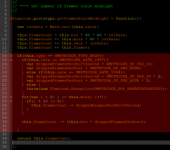
You're not kidding. In the code below, the area shaded in red disappears if we delete drop-frame timecode.

dfsucks.png
 
A group of industry professionals led by JayDee Vandenberg, Director of Post Production at Walt Disney Animation Studios, is calling for the electronic display industry to begin to phase out support for fractional frame rates over time so that content can be displayed at its intended frame rate. According to the people behind the request, “this should include displays, recorders, play back devices, and cameras among others.”

https://nomore2398.com

Well, now that the horrible old world of NTSC (Never Twice the Same Color) TV transmissions has finally bit the dust in the US of A it is indeed the time to ditch fractional frame rates. Also, time to ditch that drop frame time code. What a nasty development that was! Sadly though a lot of the rest of the world still live in the 29.97 and 25 frames "interlaced" world. The sooner the world is all progressive the better but a while to go I think. In the meantime, a nice little eulogy to good old 29.97 NTSC, "End Of An Era: NTSC Finally Goes Dark In America"

https://hackaday.com/2021/07/14/end-of-an-era-ntsc-finally-goes-dark-in-america/

Chris Young
 
Not according to the industry leaders who spearheaded the movement in the document I linked to, which illustrates how the issue affects everything from production, post-production to distribution, introducing unnecessary costs in storage, mastering and distribution, frame rate mismatches, and out-of-sync audio in editorial. It results in a doubling of the needed storage. I know if I had to double my own storage, that would be a massive expense! It is impeding the adoption of HFR, which happens to be the future of video, like it or not.

I cannot fathom what is meant by real people: it's unclear what everyone involved in the film/video industry is if not real people: the implication being, that if a problem doesn't affect someone personally, whether it unduly impacts the lives of others is of little consequence. That can't be the kind of thinking that moves the filmmaking community forward.

This is a call for a gradual phase out - not the immediate and unconditional replacement of every recorder, playback device, camera and display in the inventory of every manufacturer, broadcaster, production house and rental house in every corner of the world overnight.

"a ton of effort": The document calls on all industry leaders agree on a timeline upon which fractional frame rates will no longer be supported by newly released equipment. Sure it will involve some effort, but this appears to target only products that will be available in the future; it's unclear what is meant by "a ton" but it doesn't seem to me that eliminating fractional frame rates in cameras, audio recorders etc. is going to require "a ton" of effort. In fact, it seems almost trivial compared to some of the other upheavals affecting the industry nowadays.

The document is also asking that manufacturers indicate the correct frame rate and that content be distributed at the intended frame rate. That seems like a reasonable enough request - not too onerous or burdensome as far as I can tell!

If anything, it appears as though, once the goals are reached, that it will actually reduce redundancy and the amount of time, work and effort that is currently expended in juggling fractional frame rate material.

"that is very unlikely to impact viewers": If ordinary viewers at home don't notice a difference, it's only because of the costly and time-consuming workarounds the industry has put in place to ensure that the audience is unaware of all the technical hurdles that have to be overcome! But in fact, it does affect consumers. To take just one example, FlatPanelsHD pointed out that the new Xbox Series X console accepts 24.00fps Blu-ray discs, but outputs the content at 23.976Hz, resulting in a dropped frame every 41 seconds. Apparently some editing programs run at 23.98fps while others at 23.976fps.

It is highly unlikely that industry leaders would intentionally or perversely recommend a course of action that would adversely affect their bottom lines. This is a cost-saving measure that will initially require the cooperation of everyone, but which ultimately should benefit all, from directors, whose content will be seen as intended, to production houses and consumers (it's hard to think of any filmmaker who seriously doesn't want cameras that support true 24p). In fact, I'd be seriously shocked if those calling for action had not already done a cost/benefit analysis.

My point was the people at home watching the content are not impacted by this issue at all. sure it may reduce cost but I highly doubt that cost will get passed on to consumers. I handle conversions all the time and it doesn't impact me very much at all. Why are they bouncing back and forth so much? If they shot at 24 they should stay 24 until its time to distribute. Online distribution doesn't really care and it can stay 24p. Theaters can use 24p. Broadcast has a standard and that means one conversion for distribution to streaming platforms, and TV stations.

I think those trying to make this argument are taking an infomercial approach to explaining this. Making it sound 10x worse than it actually is to try to make a point.

Like I said its annoying and yes it may cost more to convert and store multiple copies but should the entire country have to change just to reduce storage costs for studios? How will this impact less profitable TV stations who barely could afford the upgrade to HD? How will this impact DVD which is still a valid and popular form of buying TV shows and movies for consumers?

I still stand by what I said. Its more of a nice to have than a must have kind of thing. I will gladly take it if it happens but I just do not consider this a must have. I have been able to shoot whole 24p on the GH4 for years and the conversion is not a massive deal. I tend to prefer to only shoot 23.976 because I do not distribute to anything that actually requires whole 24p like a theater which I believe can also handle 23.976.

In fact why shouldn't the FCC enforce the opposite here? Force Hollywood to use 23.976. After all its used everywhere. DVD, Blu-ray, TV broadcast, online streaming, streaming to TVs, our camera monitors, our editing monitors and so forth. Seems like a vastly easier move to just ditch 24p in favor of 23.976 and eliminate that one source which is cinema cameras. Those cameras can shoot 23.976. Why does Hollywood have to use whole 24p instead of just using 23.976 like everyone else? There is zero quality reason to do so and it would eliminate every single issue brought up.
 
Non integer frame rates are an archaic NTSC kludge.

In fact why shouldn't the FCC enforce the opposite here? Force Hollywood to use 23.976. After all its used everywhere. DVD, Blu-ray, TV broadcast, online streaming, streaming to TVs, our camera monitors, our editing monitors and so forth. Seems like a vastly easier move to just ditch 24p in favor of 23.976 and eliminate that one source which is cinema cameras. Those cameras can shoot 23.976. Why does Hollywood have to use whole 24p instead of just using 23.976 like everyone else? There is zero quality reason to do so and it would eliminate every single issue brought up.

I'd argue the exact opposite - Only 15% of the worlds population live in NTSC countries. So why don't you join "everyone else" (well the vast majority) and have the FCC enforce 25/50/100 instead?
 
I remember the first time I ever shot a true 24fps was in 2012 with the BMCC and 60fps and 80fps later in 2014 with the URSA. I didn't even know those framerates existed.

Didn't matter much as far as the end-result, but I liked the idea of them and it felt better shooting 24.00 than 23.98 which began to test my OCD after my discovery.
 
Non integer frame rates are an archaic NTSC kludge.


I'd argue the exact opposite - Only 15% of the worlds population live in NTSC countries. So why don't you join "everyone else" (well the vast majority) and have the FCC enforce 25/50/100 instead?

You act like I'm against this and I'm not. I just pointed out that its kind of splitting hairs and really over exaggerated which is a fact. If studios run into sync issues its because they did something wrong. Its not rocket science to convert. Storage costs are high but why should the rest of the US change just to reduce a studios storage costs? I'm not sure why that is the problem of 99% of consumers.

Yes fractional framerates are outdated. Like I said earlier they should have been eliminated when we moved to HD but alas it was not and now a lot of us have gear that only works with fractional. It is what it is.

If it happens thats awesome but I still feel its kind of whiney and massively reeks of first world problems. I can't believe we are debating something so pointlessly mundane and trivial.

If the FCC forces this change to please 1% of 1% of 1% of the population that actually converts 24p to 23.976 then I hope they factor in every single thing this may impact and what cost that may impose on others. Do it but they better damn well do it in a 100% unobtrusive way. Like it or not but many of us shoot with cameras that only have 23.976, 29.97 or 59.94 as an option. I don't want to see all of us suddenly forced in the situation where we now have to handle conversion just because some wealthy studios got greedy and wanted to save money on storage. You are robbing Peter to pay Paul if this isn't handled correctly.

Besides 24 is already a HD standard on Blu-ray and. It can be used more. If the TV stations insist on only having 23.976 then let them handle the temporary conversion and storage.
 
I don’t think it’s pointless. Do a google search and see how many posts regarding 23.98, 23.97, 24 exist and the confusion on deciding what to use when are. it’s been going on for years. And then think of al the unnecessary work required when multiple source video and audio using different rates because of that confusion are thrown to post people.
 
You act like I'm against this and I'm not. I just pointed out that its kind of splitting hairs and really over exaggerated which is a fact.

Sorry! I was trying to point out that in any argument about (potentially) changing standards for acquisition, distribution, consumption needs to have a global context. For us PAL users we have always been stuck with trying to mix and match frame rates and unless there is an exact multiple / division you see the pull down judder - this is all a PITA.

We have three main groupings currently around the globe, 23.976/24/25fps, 59.94/50fps and then for "fun" you also have your 29.94. Seems to me 23.976/24/25fps could all be folded into one integer frame rate, then higher frame rates should be a clean multiple of that. We are no longer bound to timing being driven by the frequency of the power delivery in houses.
 
Back
Top