Zoom F8 - 8 track recorder

Glad to see that this recorder supports BEXT/iXML metadata and 48.048kHz. They're really trying to compete with the big guns! I wonder how the pres sound...
 
I was confused on the line-out. Looks like it remains at -10 db and there's no provision for a switchable return so that you can listen to the camera. To bad they did not get that right. It places it squarely in the high end amateur section of the market.
 
Here it is on BH: http://www.bhphotovideo.com/c/product/1140426-REG/zoom_zf8_f8_field_recorder.html
At $1000 it may make sense to spend a few extra $ for a used SD 702...

Well if your looking at an eight track recorder your not really going to be interested in a two track one.

I would love some actual field reports from folks who know what they are talking about.

On paper it looks like a strong entry in the market in that prize range. Many of the features are only on recorders going for many times the price.

The big question would be how is it in the field? What does it sound like? Are the limiters any good and how durable is it?

It looks like plastic sandwiched between a pair of metal plates but???

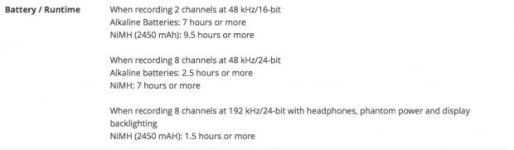
Battery life looks decent. You can always go with an external pack.

I'm probably in the same boat as a lot of folks who do recordings for film and FX in that I have a two track recorder. Actually a number of them. Until they die I'm probably not going to get another two track recorder, but what I do need occasionally is more tracks. Right now that means hauling around a laptop and an interface. Not that cumbersome but not very field worthy.

This, if it is actually a decent recorder, would fill that gap. The four track Tascam DR70 was fairly high on the list and this is four times the price, but it also has the features that would let you bring it to a full fledged shoot. So IF it gets good reviews and some respect from pros I can see a lot of folks I know getting one.
 
I was confused on the line-out. Looks like it remains at -10 db and there's no provision for a switchable return so that you can listen to the camera. To bad they did not get that right. It places it squarely in the high end amateur section of the market.

Kind of depends on the shoot. If you are doing isos and just sending a guide track to the camera it's not that big a deal I wouldn't think. IF it was a mixer then yes that would be a major problem. If it is a big deal adding something like a mix pre as your headphone amp would "fix" it.

But I'm more in the post/SFX side so I hardly ever am feeding a camera at all so maybe doing production on a big shoot that would be a killer?

At the moment we are doing eight mic setups for recording cars for some national spots and that is certainly a pro gig that doesn't require a camera return.
 
The BIG problem with this and to a certain extent the DSLR type camera and the low cost kit that is now available is that people are trying to think that they can make a zillion dollar feature film for nothing and cut basic production corners all the time.

Most of the movies in the past 70 years were made with mono recorders using one mic on a pole and had probably less than 8 tracks of dialogue, sound effects and music in the dub.

I now work at a major UK broadcaster beginning with the second letter of the alphabet but I hear dreadful audio more than I ever have in 35 years in broadcast but I doubt it is down to pre amps and the huge dynamic range and 24 bit recording that we now have to our hands.

It is down to people not knowing how to do things properly and taking the care to actually listen and learn their craft, this is then compounded by the mentality of if we record everything that moves it may cover our backsides when we get to post and are able to sort it out later.

But how can you know that you have 8 useable tracks and do you actually have the skills to record valid audio and then treat it in post?

I have seen people who call themselves audio department who can't even point the mic in the right place and others that seem to think that it is all some dark art that needs concept and re-inventing of the wheels rather than understanding the fundamentals of the job in hand.

Just look at these forums and at the end of the day these are all just tools of the trade and it is more about understanding your workflow from shoot to delivery rather than recording everything that moves and trying to cobble it together afterwards.

Looks a nice bit of kit but so is all of it but it all is invalid if you don't know how to use it or lack the care and attention in capturing your basic location audio.

So what if the timecode drifts but it records at 48k 24 bit so the timecode is just there to know where you are timewise and digital post has been that way since I worked at AMS Neve in 1993, I have been cheating sync on drama for decades to make the final product work.

I do hope that all this new kit makes people more creative but I suspect that it will just end up with more bad audio and forums like this full of specmanship and discussions about noise floor, pre amps, dynamic range etc rather than valid production techniques!
 
Last edited:
As Ray Charles once said, "I don't care if you've got ninety tracks... what does it sound like baby".
 
Gary,

Agree with most all of your post. Thee will be a bunch of bozo's who will buy it because it's got TC so it's "more professional" and record eight tracks of Cr@p. I got a show like that once and ironically in that case it wasn't the sound guy but an incompetent director. He had insisted on a three walled set and a two camera shoot. A lot of the characters were either shirtless or had costumes that didn't allow wireless and the boom op had to work from a ladder over one of the walls to stay out of the crossed fields of view. Some scenes on other sets were OK but this was the main set and basically all the sound sucked. The mixer probably could have done better but after getting beaten up by the idiot director he probably gave up on working too hard at it. The director had written the show and gotten the investors, had never even directed a short (but had read what he referred to as "the book" on making a film) and had NO IDEA of what he was doing. And to add spice he must have read "in the book" that a good director is a total @ss.

I've only quit two shows in my life, and counting theatre that is 300-400 shows, and that was one.

In the general discussion on this recorder though I don't see the DSLR no-budget film folks as really part of this market. It's too expensive. Your here and they think the DR70 is "expensive". If this recorder is decent I think the big market will be professional FX recordists and probably music folks. If it had a way to sync via word clock probably more music folks. IF it is actually durable then maybe some Event things, and performance/ concert recordings. A lot of panel discussions for instance come in under eight tracks. The price point is just about right for the pro FX recordist market. It's about what I paid for my first DAT, my first portable pre, the flash recorder, just a bunch of things at around $1K US get bought by folks like me because it's at a point where you can recoup fairly fast. Plus you are almost never under the same "it must work the first time everytime" pressure of a production mixer. THe director is not breathing down your neck etc. so you can take the chance on something that may be a bit finicky. And for FX having more tracks is really nice. It means you can cover a vehicle better and do more in less times. Editors love the options for post.

If I were a production mixer I would be keeping my distance till it proved it was much better quality than I have seen out of Zoom in the past. Even then things others have brought up like camera returns might still make it nothing more than a backup recorder.

To the # of tracks in films.
It kind of depends on how you count things. As in if you count everything the same you probably over estimated it. With magnetic recording not arriving till the basically 50's the track counts were very small. Pre 70's pretty much everything was mono as a release format and on an optical track with not very good noise reduction. You don't get digital really till the late 80's to mid 90's and that is when you see both a lot of surround releases and track count bloom. By the late 90's a feature was almost always over 100 tracks and some were closer to 300. By 2010 even 30 second spots were getting 80 - 100 tracks in some shops. Also since multi track recorders got affordable directors other than Altman have been micing lots of actors and weaving the dialog in post. So while the guy with a stick going mono is generally true, most of that was for a completely different release format. Surround takes more tracks to produce than mono does.

I agree that it's gotten a bit over the top and some of that I think is bragging rights. I know the editors were very happy to tell you that action film X "had over 100 tracks, just for weapons!". But it was a very complicated dance in the mid 90's to make it work with the limited track counts. You really couldn't get a LOT of tracks AT the mix till you had DAW's IN the mix stage so they could chase the mix. And you really didn't see the exploding track counts at the mix till folks started mixing in the box. You just can't hang 300 tracks of mag.
 
I'm probably in the same boat as a lot of folks who do recordings for film and FX in that I have a two track recorder. Actually a number of them. Until they die I'm probably not going to get another two track recorder, but what I do need occasionally is more tracks. Right now that means hauling around a laptop and an interface. Not that cumbersome but not very field worthy. This, if it is actually a decent recorder, would fill that gap.

I see the same thing. It will be interesting to put it through it's paces. When I'm doing automotive work for example, many times I have at least 6 mics going, and not dragging out a laptop and interface would be nice.
 
Last edited:
Dont get me wrong guys I think it is great that these products are coming along as in time some real creativity will be available to a next generation but I also think that it de values a skill set and makes people think more of the gear than the person. Sadly that in time affects our industry and the rates of pay as the perception is that the technology will make it cheaper.

I used to own my own dubbing facility with over £500k of AMS Neve kit and another £500k of high end video kit! Like others the bubble burst and now people pay half the rates they did 15 years ago and a £20k digidesign system is the de facto with young kids on less than £100 a day. People still think audio post is too expensive for their production and as said I hear dreadful audio more than ever from location and after the surgery is attempted in post.

Multi track audio is now becoming standard in doco and other broadcast productions but they have had to pay extra for it in the past but I can see it now becoming the standard and once kit like this floods the market it will be expected to be included as part of std kit along with radio mics etc.

We shall see but with the low cost cameras now flooding the broadcast market it will be a tough time for the next generation to keep up with trends and attain the skills required to keep quality reasonably high!
I call it the "McDonaldization" of the creative fields. I am mainly a DP and even 7 or 8 years ago I was getting $500 for a half-day and $800 for a full. Today I'm lucky to get $500 for a full... Of course, it's a double edged sword because filmmaking has become a more democratic medium. If you look back even 25 years ago it was prohibitively expensive to make a film and there were undoubtedly talented people out there unable to realize their talents. Then again today there are a slew of untalented people who can afford the technology but shouldn't be making films...
 
I'm with all of this. When I started a low budget indi was just getting the first wave of "affordable" which was a Teac 8 track cassette with synchroniser so you could lock to VHS. My cutting edge DAW was a four track and all the theatre work was delivered on 1/4" RtR. The High End field recorder was a Nagra. Even the low end was a BIG step. THe cheapest video editing was with twi decks, the cheapest NLE was about $15,000.

I don't have actual numbers but my guess is that about 1 in 1000 people who think they can make a film can make one that is watchable. Maybe 1 in 1000 of those people can actually make a Good film and maybe 1 in 1000 of those will be lucky enough and talented enough to make a living at it. So that is 1 in 100 million. Maybe that is over stating it a bit but not by a lot. The percentage of junk to possibilities is very connected to where you are. In SF the bar was fairly high so a lot of the really bad stuff never made it out of peoples bedrooms because of peer pressure. Now in Detroit there is kind of a "Gee Whiz I made a film" level bar. I don't think the top changes that much but a lot of the bottom that on the coast folks would be ashamed to show to anyone but stoned friends gets "presented" as a "real" film. So I probably see almost as many good films as there but I'm also swamped with junk.

I'm optimistic that kind of like garage bands, once the shine wears off and people come to grips with the amount of work to make a product that anyone but your stoned friends will tell you is good the wave will recede.

But?
 
Yeah, Scott, I agree. From what I hear Detroit is becoming inhabited with similar types that we have hear in NYC -- in Williamsburg, Brooklyn and other areas of the city. It basically consists of a self-contained creative community that reinforces the delusion that they and their friends are amazing artists creating profound masterworks. Maybe a bit of a generalization, but not far off...
 
When the film "Blow-Up" came out in 1966, everyone thought it was cool to be a photographer. Lots of wannabes proclaimed they were 'Photographers' but few had the skills to do a good job. Now as it was then - you can be successful if you have the ability, desire, and luck. A wannabee with a $1000 recorder only means short term pain that will go away. It is the producers and directors that listen to cheap BS that is the real problem.

Kevin
 
Look on the bright side. When all the wannabees give up we will be able to pick up those $1k recorders for pennies on the dollar!
 
I'm with all of this. When I started a low budget indi was just getting the first wave of "affordable" which was a Teac 8 track cassette with synchroniser so you could lock to VHS. My cutting edge DAW was a four track and all the theatre work was delivered on 1/4" RtR. The High End field recorder was a Nagra. Even the low end was a BIG step. THe cheapest video editing was with twi decks, the cheapest NLE was about $15,000.

I don't have actual numbers but my guess is that about 1 in 1000 people who think they can make a film can make one that is watchable. Maybe 1 in 1000 of those people can actually make a Good film and maybe 1 in 1000 of those will be lucky enough and talented enough to make a living at it. So that is 1 in 100 million. Maybe that is over stating it a bit but not by a lot. The percentage of junk to possibilities is very connected to where you are. In SF the bar was fairly high so a lot of the really bad stuff never made it out of peoples bedrooms because of peer pressure. Now in Detroit there is kind of a "Gee Whiz I made a film" level bar. I don't think the top changes that much but a lot of the bottom that on the coast folks would be ashamed to show to anyone but stoned friends gets "presented" as a "real" film. So I probably see almost as many good films as there but I'm also swamped with junk.

I'm optimistic that kind of like garage bands, once the shine wears off and people come to grips with the amount of work to make a product that anyone but your stoned friends will tell you is good the wave will recede.

But?

Unfortunately, this is very, very true. People don't realize that it's actually not even about the talent of the director, unless you understand "talent" very broadly. Simply put, even if you are a first class directing genius, you are dependent on other people doing a good enough job too, otherwise there is simply no way to do everything yourself. You can be the world's best director, but if everybody around you is amateur hour, including the actors, you are basically counting on pure luck - and we all know how often somebody wins the big lottery... not often. Of course, some will argue that a great director can somehow get everyone to do great work, which is true only to the degree that you have at least some additional advantage like a budget to hire real pros, or a great producer etc., or you're friends with a very talented actor(s) etc. Bottom line, you need a metric ton of LUCK - a good film is the result of a million things going just right time after time - it's like having hands dealt to you and coming up the royal flush ten times in a row. Your talent as a director is only one factor - necessary, but not sufficient by itself.
 
Now in Detroit there is kind of a "Gee Whiz I made a film" level bar. I don't think the top changes that much but a lot of the bottom that on the coast folks would be ashamed to show to anyone but stoned friends gets "presented" as a "real" film. So I probably see almost as many good films as there but I'm also swamped with junk.

I'm optimistic that kind of like garage bands, once the shine wears off and people come to grips with the amount of work to make a product that anyone but your stoned friends will tell you is good the wave will recede.

But?

Yeah, Scott, I agree. From what I hear Detroit is becoming inhabited with similar types that we have hear in NYC -- in Williamsburg, Brooklyn and other areas of the city. It basically consists of a self-contained creative community that reinforces the delusion that they and their friends are amazing artists creating profound masterworks. Maybe a bit of a generalization, but not far off...

I'm in Detroit myself and would like to know where all these filmmakers are. I can throw a dime in this town and hit a musician but have yet to meet more than a few other local filmmakers. Even if they are the type you describe. I'm being serious. I would love to meet other local filmmakers just to have a coffee with if nothing else.

I'm one of those filmmakers you describe. Although I'd like to believe I'm not delusional and actually know where I stand in the scheme of things. I gave up those Hollywood goals in my early twenties. But I do corporate video production as a day job and haven't made an actual indie film in ten years. Although I'm excited to get back into that game as my skills have improved a lot in ten years just doing corporate productions.

The films I made back then weren't exactly amazing. I'm ok with that. Looking back I was really hard on myself and wondered why I just couldn't get something made that looked and felt more like a Holywood film. It wasn't until I got older I realized that wasn't realistic. I was working with two or three man crews (myself included). The others not knowing nearly as much as I did on the subject because they weren't even interested enough to take the time to read forums like these. Compare that to crews of hundreds or thousands of professionals on big budget films over the course of an entire production.

My little three man crew/$3000 budget feature film I directed back in 2003 looked and sounded like you would expect something like that to be. Even if we were the most talented guys in the world (which we weren't) we still would have missed stuff that bigger crews would have gotten, simply because they would have had a dedicated person(or team) there to take care of it. There is only so much you can do with limited manpower. But we completed it. Even had a little premiere at a local theater and sold some DVDs.

A pro sound guy would have had a heartattack on that feature because we were doing audio from an AT835b shotgun mic through an XLR to a $60 mixer and then from there out through 20 feet of RCA cable into the back of an XL1 camera's RCA audio in jacks. On some scenes we had a portable minidisc recorder recording backup via that 1/8" input jack. Compared to that, my shotgun directly into my H4N is a step up. Compared to that, this new Zoom would be a further step up. So I do think it has its place.

As I get older I'm starting to form a different take on all of this. The numbers you state for success rates are probably right if your goal is to play in the big leagues. But then, what's wrong with making small films only a handful of people may see and enjoy? Films that are less than perfect in a lot of ways. Why should everything be a moonshot? I think that if a lot more of us took the mentality that we're making shoestring budget films because we enjoy doing it, we can redefine what we consider success.

Most craft beers will be enjoyed only by the local popluation around where it's brewed. Most garage bands aren't going to ever play stadiums but they may play gigs at local bars for decades and sell a few albums to a niche group of people. Most artists aren't going to have their work hung in major galleries or sold at auctions for high dollar. They'll tour a few art fairs and sell pieces to regular fair goers for tens to hundreds of bucks a pop.

Filmmaking can be the same way. In fact it always kind of has been. Yet there is this ego in this industry that if you arent working on big shows you're a failure, a talentless hack or some other negative thing. But what if you just do it because you love it and it just so happens that a small group of a hundred or less people also love it? With so much media to be consumed in this world these days, that's kind of where it's going. If you can't be the next Tarantino, you may still be able to carve out a niche fan club. You're more likely to have that success than the other.
 
Well, ....

Beer hmmm, Here is the thing. Those Craft brewers are making top notch beer (and a profit), most of them, and even homebrewers are doing outstanding work a lot of times, so I think that analogy dies right there. And I'm speaking as a home brewer.

I personally have no problem at all with people making films for a hobby. I do stuff for a hobby that I would fail at if I tried to be a pro. But filmmaking can be a pretty expensive hobby. What I have an issue with is the folks who are working at hobby or sub hobby levels and then pretending they are on the road to greatness. Don't advertise your film as being good for someones career if it's a hobby film. Don't pretend your film is just as good as X, if it's a hobby film, etc. There is also the case where someone is starting out and they do want to get really good but they are just starting out and so they just aren't yet. They NEED constructive criticism and a bar that is higher than they are at so they will get better. When you have a lot of the hobby players pretending to be professionals then it really hurts those that want to do it for a living because they don't realize they have a long way to go. It's tricky because you also don't want to trash then because they need more experience and the only way to get that is to keep making films and that gets hard if people trash you all the time. So there is a tricky balance that needs to be in place.

What I'm finding locally is a lot of people who think that their seriously flawed (technically) films have a good chance because nobody has ever told them that you DO need to mix the sound. You DO need to do some color correction and you DO need to do decent edits and you DO need to have a cast that can act. And local folks are busy giving them awards and telling them they are great filmmakers. The sad truth is that if they take that and head to NYC, LA, or even say Chicago they are going to be in a world of hurt because they are not even close.

On the good side locally (Detroit), there is a bit of advertising work around, some is pretty good. Most of the bigger national spots for cars and such are NOT done in state since they were never able to get incentives. THe bigger films that were coming around won't much anymore since the legislature not only killed the incentives they actually said in so many words that the DO NOT WANT film and media in Michigan. Talk about brain dead.

There is however a number of folks making films here, and they were never eligible for incentives so no big whoop that they are gone. Three Lions did a short this year called "thick Air" that was really good. It needed a bit of sound work, or rather could use some - it was OK as is. There was a group that kind of stopped meeting called the Detroit Film Collective that had a number of folks doing interesting stuff. DAFT is a group that connects some local film and media folks. Ric Vers is local (Sound FX Bible etc.). It's thin and not super connected at the moment but it is growing.
A friend who is local used to work for Robert Corman and was at AFI when James Stewart used to hang out there. Another is an animator with a good international rep.

There also have been a number of films that could be a LOT better if they did some post polish. The big problem is that they are "really good" VS the local bar for indi's and they don't realize what the bar outside of the city is. I know at least two films that submitted to Sundance that have sound tracks that are essentially unplayable.

Anyway drop me a line. I'm trying to connect with more folks on the local scene. A couple are dying do do some practice films. One likes doing short docs. Personally I do think it's going to bloom here. And it's probably (from a local filmmaker perspective) a good thing that the incentives are gone. It sucks from a professional point but that may change also.

To your other point, how many films can you make at $3,000 if you don't make a dime off them? While working on a $100,000,000 film is a lot of fun it's also VERY stressful. Edward Burns has decided to not make expensive films and he is doing OK. You have to plan on a couple of hundred thousand for a feature but IF you work it out everyone can get paid and you make enough to be able to do another. Distribution is now possible in that price range and folks can make a good living making films in that range. That is really the zone I would like to be working consistently in. It's freer and generally more fun. You can take risks because in that price range it's expected and the risk is lower. That is where Michigan and Detroit could really make a mark. Quirky well made low budget Indi films.
 
Well, ....

Beer hmmm, Here is the thing. Those Craft brewers are making top notch beer (and a profit), most of them, and even homebrewers are doing outstanding work a lot of times, so I think that analogy dies right there. And I'm speaking as a home brewer.

I personally have no problem at all with people making films for a hobby. I do stuff for a hobby that I would fail at if I tried to be a pro. But filmmaking can be a pretty expensive hobby. What I have an issue with is the folks who are working at hobby or sub hobby levels and then pretending they are on the road to greatness. Don't advertise your film as being good for someones career if it's a hobby film. Don't pretend your film is just as good as X, if it's a hobby film, etc. There is also the case where someone is starting out and they do want to get really good but they are just starting out and so they just aren't yet. They NEED constructive criticism and a bar that is higher than they are at so they will get better. When you have a lot of the hobby players pretending to be professionals then it really hurts those that want to do it for a living because they don't realize they have a long way to go. It's tricky because you also don't want to trash then because they need more experience and the only way to get that is to keep making films and that gets hard if people trash you all the time. So there is a tricky balance that needs to be in place.

What I'm finding locally is a lot of people who think that their seriously flawed (technically) films have a good chance because nobody has ever told them that you DO need to mix the sound. You DO need to do some color correction and you DO need to do decent edits and you DO need to have a cast that can act. And local folks are busy giving them awards and telling them they are great filmmakers. The sad truth is that if they take that and head to NYC, LA, or even say Chicago they are going to be in a world of hurt because they are not even close.

I get what you're saying now.

On the good side locally (Detroit), there is a bit of advertising work around, some is pretty good. Most of the bigger national spots for cars and such are NOT done in state since they were never able to get incentives. THe bigger films that were coming around won't much anymore since the legislature not only killed the incentives they actually said in so many words that the DO NOT WANT film and media in Michigan. Talk about brain dead.

Yeah that is pretty sad.


There is however a number of folks making films here, and they were never eligible for incentives so no big whoop that they are gone. Three Lions did a short this year called "thick Air" that was really good. It needed a bit of sound work, or rather could use some - it was OK as is. There was a group that kind of stopped meeting called the Detroit Film Collective that had a number of folks doing interesting stuff. DAFT is a group that connects some local film and media folks. Ric Vers is local (Sound FX Bible etc.). It's thin and not super connected at the moment but it is growing.
A friend who is local used to work for Robert Corman and was at AFI when James Stewart used to hang out there. Another is an animator with a good international rep.

I actually took a 16mm class at the DFC back in 1998 when they were in Redford. It was a good time. But I didn't keep connected with them. I don't even know why. I should have.

There also have been a number of films that could be a LOT better if they did some post polish. The big problem is that they are "really good" VS the local bar for indi's and they don't realize what the bar outside of the city is. I know at least two films that submitted to Sundance that have sound tracks that are essentially unplayable.

Anyway drop me a line. I'm trying to connect with more folks on the local scene. A couple are dying do do some practice films. One likes doing short docs. Personally I do think it's going to bloom here. And it's probably (from a local filmmaker perspective) a good thing that the incentives are gone. It sucks from a professional point but that may change also.

I will. I think I just took a backseat for a number of years while my life was a bit crazy. Had a kid, dad passed away, lot of life changes. So while I've been working in the corporate video world, I just wasn't inspired enough to get back into indie film. But now I'm interested in meeting others around, if for nothing more than to grab a beer and see who if anybody I connect with on a creative level.

To your other point, how many films can you make at $3,000 if you don't make a dime off them? While working on a $100,000,000 film is a lot of fun it's also VERY stressful. Edward Burns has decided to not make expensive films and he is doing OK. You have to plan on a couple of hundred thousand for a feature but IF you work it out everyone can get paid and you make enough to be able to do another. Distribution is now possible in that price range and folks can make a good living making films in that range. That is really the zone I would like to be working consistently in. It's freer and generally more fun. You can take risks because in that price range it's expected and the risk is lower. That is where Michigan and Detroit could really make a mark. Quirky well made low budget Indi films.

I agree. I remember back when I was a teenager watching films from smaller companies like Full Moon Entertainment and thinking to myself "Even if I could just make a living making films like these one day, that would be a fun life." The $3000 feature we made was our first and completely out of pocket. It was a good learning experience.
 
Back
Top