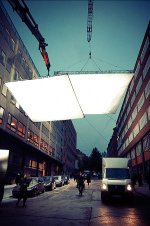
Why so much light ?

Norman99

Well-known member
With cameras that practically see in the dark and the lure of super fast high aperture lenses and variety of out there, what need be of the 2K, 4K high output Moles and Arris and the like ?? I saw an interview session with a total of well over 4000 watts 3-point system..at a camera to subject less than 15 ft. What's the point ?. Why so much lumens needed.?
 
With cameras that practically see in the dark and the lure of super fast high aperture lenses and variety of out there, what need be of the 2K, 4K high output Moles and Arris and the like ?? I saw an interview session with a total of well over 4000 watts 3-point system..at a camera to subject less than 15 ft. What's the point ?. Why so much lumens needed.?

Realistically, even with the 'best', say the Arri Alexa and similar Reds, 800 seems to be the preferred ISO value for most shooting. To be sure one can read going up to 1280(*) on the Alexa (don't know about Red...), but more often than not it's 800.
(* I was just looking at the American Cinematographer article on "Anonymous"(2011), shot on an Alexa, at ISO 1280 for some of the interior candle light scenes.)


With that in mind, that's only 3 stops worth of light 'better' than ISO 100.

So, even with the increased ISO value, one may still need 'quite a bit of light' for a given shot.

While many of the DSLRs tout high ISO values, when it comes down to it, many have much noise beyond 800, and only 'fan' appreciation makes this an 'aesthetic'...
 
A direct answer could be to stop down the lens for more depth. Also, slow motion needs massively more light. And of course to darken the background compared to the subject.
 
Realistically to shoot at ISO 320 - 640 you will be keying your interview with 1k or 650 or 575 (for ISO 160 if you have window in the frame). Add another light as back light and one accent light and you already are around 3000w of lighting for a typical run of the mill interview.

On top of that often there are certain effects you want to accomplish. I'm preplaning the shoot where we'll be using a few 2k lights close to the talent for certain very specific effect. Again, not exactly small power consumption scenario. There is plenty of times when w high power HMI is playing along with low power LED or medium power Kino.
 
And remember that the quality of light you need can massively affect how much power you need.

Your not going to light up a 8'x8' bounce with a 300w Fresnel. That's when you bring out the 4k HMI.
 
What used to blow my mind when reading american cinematographer is when theyd talk about some relatively simple-sounding source/technique, and then mention how they used 18k hmis or something. WHAT????


But when you actually see the real world results of the relatively meh difference between, say, a 500 and a 1000 watt light, and then, as others have said, factor in fstop, iso, distance of light from whatever its hitting, whether its being diffused, reflected or gelled (all of which reduce light output significantly), and how hot its supposed to look on camera (if applicable)...yeah, the necessary watts can start to add up pretty quickly. It still hurts to think about though
 
Opinions will fly.

some situations call for the whole schebang, some call for smaller lights and higher iso. different budgets, different clients, different expectations, that's simple industry
 
Yeah, and some dps just like to do things differently. Where most might use a diva 400 or a 2x3 chimera with an arrilite to key, someone might pound a 2k through a 4x diffusion frame in the same situation
 
Well, also your rate as DP does influence the choices. I don't do simple set-up when my rate is $3k/d. For one, because then i also have crew to support complicated "simple" set-ups. On the other hand when you have some of those $1500 gigs (all gear inluded), you might want to make it easy on yourself (and yous small crew).
 
It really doesn't matter how sensitive cameras get, that won't change the large contrast ranges that exist in the scenes we try and shoot.

I've got a job I've been doing pretty regularly lighting some talking heads in a studio space that's 140'x95', with windows absolutely everywhere. We usually go in there with 2 4k HMI's, 2 M18's, and an 800 Jo-Leko, but I'll tell you its nowhere near enough. But of course we had to come to some sort of compromise with the client as we could even use a couple 12k's in the space if we could afford it, but thats where we ended up.

So between balancing contrast, the desire to shoot things through heavier and heavier diffusion, and as others have already said, the laws of physics. Bigger lights are here to stay, sensitive cameras or not.
 
Thanks everyone, I get it now.
I thought that with the new breed of high sensitivity sensors the need for a lot of light would diminish.
 
It all depends on what you're trying to do with that light/how it's being used. There are surely some instances where cranking it to 20,000 ISO and using a 300w fresnel will do the trick, others where you need the big stuff.
 
Despite all of the advances in improved S/N chip fab processes, the native sensitivity of silicon sensors has not really changed. That is a physical property limitation of the material. The high ISO performance we enjoy with newer cameras comes from better processing, more gain, and better S/N ratios, not greater sensitivity.

Bottom line, even high ISO potential cameras still produce their best quality highest DR richest images at ISO speeds between 200 and 800 with controlled lighting ratios. You want to fill those pixel wells up with light.
 
I think there is are two tracks going on in the world of light. The kind of oppose each other and also meet.

To some extent I feel that some people have failed to grasp the potential of wider DR and higher sensitivity shooting machines.

I feel confused when people move to (more expensive) cameras/data loads with more DR/latitiude and dont cash in by reducing their lighting package.

What is the point of extra spending in camera and data costs and not getting a trade off with a larger saving in another department?

With enough control over light one can really make any camera/data rate shine.

The flip side is 'control' and 'fill' - at 800, 6400, whatever you only get X stops of DR so whatever you have to control the scene to that band - and if the scene includes midday sun - you are going to need a bunch of fill whatever the ISO

The other flip side is 'continuity' - where one must control the light (ie crush the changing ambient) to create a constant level for the duration of a scene - maybe many hours.

In summary I can see a failure of fleet footed productions to just grab light minimally and quickly pushing the new cameras to the limits and can also see the value of the traditional methods where a couple of stops of extra sensitivity really just does not make much of a difference

On that basis one really wonders the value of using cameras with fat data rates and high rental costs when proper lighting basically equalises cameras anyway!

S
 
Movie shooters have, in the main, not made the cultural shift that would fully exploit modern wide DR/sensitive cameras.

My main experience of 'big lighting' is shooting stills of hotels - the scenario being usually a large foyer and a sea view behind. In the early 2000s I used to do such shoots with my 25ISO hasselblad - and a van of lights - I got the shots right 'in camera' and the post budget per shot was basically nothing - but lighting the shot could take a long time - with the implied cost. Clean 800 raw stills cameras (5d2, D800 etc) have opened options for using less lighting and going a mile further in post (basically recovering the ext portion of the image in post). Now working these 'shot for post' files is expensive. But the impact on set is way cheaper especially if you factor in situations like closing a resturaunt and losing taking for a lunch time etc.

The skill is to understand the choices, the costs and the implications. On occasion a small package and more attention in post will be cheaper, on other occasions the full package and a minimised post flow will win over.

There is no 'right' there is only understanding the tools and choices..
 
On a shoot two weeks ago, we were to shoot in a restaurant under available light. I scouted with the meter and at 800 ISO we'd be wide open, f2 tops. It is all hand held, one big long shot on a 25 so I needed a little depth in focus. I also did not like the light, no eye light, and very little modeling, and no separation or depth in the frame. Everything looked as if on the same plane. So I took that light level and did some testing.

All I did was bounce an inbetweenie off the white table cloth and knock the ISO up to 1250, which was comfortable. I'm surprised how well that worked. I got up to better than f5.6. There is noise in the shadows but I could get good exposure on the skin, perfectly reasonable eyelight and an interesting glow underneath. The producer was not at all worried about the noise. They had shot a lot this way and would clean it up with neat video.

Frankly I would much rather have gone in there and lit but you can compromise thanks to the ability to bump up the ISO. Same thing for night exteriors. It's worth experimenting with.
 
Typical scenario: shoot, day 1: bright sunlight everywhere, sunlight as key and bounced for fill. day 2: overcast, no bright sunlight - but you need the same lighting conditions for continuity - so you bring up your 6K or whatever Wattage HMI and there you have the sun again... (of course you'll need more than 1 big HMI then in most cases, but you get it i guess :) )
 
Back
Top