Why is HMC 150 never mentioned in 'best camcorder' lists

Mark Turner

Active member
I am on the brink of biting the bullet - but one thing concerns me.

Despite the good things people have to say here about the camera, it doesn't seem to have made any '10 best' lists, or comparisons like that.

Also, the main proponents of this camera tend to be event videographers (weddings and so forth).

I see nothing from documentary film makers about this camera - the use I am hoping to put this too.

Any thoughts why?
 
The 150 is a much better 720p camera than 1080 camera due to a low rez sensor that is interpolated to a higher resolution. I'll probably get flamed for such sacrilege.

If you are going to play it on the TV you'll never notice. (Lots of HD programming on TV is 720.) If you're going to project it big, or print it on a poster you'll notice.

The following captures were zoomed in 5x for comparison. Sure that's pixel peeping, but that's what happens on the big screen.

The HPX170 has the same sensors as the HMC150, and an even better codec so the HPX170 should look even better than the 150.

The titles of the pictures will tell which camera, and they are mixed together, but examine edge of the lips for alias artifacts, how visible are the eyelashes, how good is the color separation in the shadow of the eyes, etc.

It really depends on what you want. They are all good cameras. These close up looks were all from full resolution images at: http://camcorder-test.slashcam.com

HFS100
attachment.php


HPX170
attachment.php


HV20
attachment.php


PMW-EX1
attachment.php


XH-A1
attachment.php
 

Attachments

  • HFS100-Face.jpg
    HFS100-Face.jpg
    8 KB · Views: 0
  • HPX170-Face.jpg
    HPX170-Face.jpg
    9.4 KB · Views: 0
  • HV20-Face.jpg
    HV20-Face.jpg
    7.8 KB · Views: 0
  • PMW-EX1-Face.jpg
    PMW-EX1-Face.jpg
    8.1 KB · Views: 0
  • XH-A1-Face.jpg
    XH-A1-Face.jpg
    8 KB · Views: 0
Last edited:
NEver base jusdgement off of lists. Most publications are probably paid or sponsered to promote cameras etc. the 150 is an excellent documentary camera. Buy what you like/want/ and what suits your needs. Not what some list tells you.
 
lol. Yeah, the "best" cam lists are not the best way to go to look for a camera. Get some native MTS files from someone with an hmc150. You'll see it's a wonderful camera.

Everything in the sub 100,000dollar price range is going to have trade-offs.

Duke: This is not a flame, but you're not correct about interpolation on the panny series of cameras. This is totally understandable, though, as it is one of the most potent "myths" that have gone around.

They use Pixel-shifting (or spacial offset) to achieve HD resolution. This is done 1/2 pixel vertically and horizontally. The native imagers are three 960 x 540 CCD chips. This process brings the effective resolution to about 1440 x 810. Interpolation is the process of trying to reconstruct information that doesn't exist and in this case, implies that it is simply resizing low rez imagers to HD sizes for recording. This is not the case. Though, the 1440 x 810 rez is resized to 1920 x 1080p (in either 14 bit or 19 bit [I forget] color space) for image processing before scaling down to the DVCPRO HD codec which records 1280 x 1080p, or 960 x 720p. In AVCHD, on the HMC150 it records the full raster, but in a lower color space of 4:2:0, like the rest of the sub-10k cams.

(Keep in mind too that HV20, which most agree is a 1080p camera, is a single sensor. 1920 x 1080. If you offset a block of three 960 x 540 chips a Full pixel vertical and horizontally, you will achieve 1920 x 1080 photosites. The big difference is with cams like EX1 which have true 3x 1080p full raster chips. Every company chooses a different way to expose what they feel is the best image. Panny's recipe is with CCDs, and large fill photosites... less pixels, same area, more sensitivity, less resolution, and pixel shift to achieve HD.)

I've used the HVX200 and the HMC150, and I have to say that I'm not impressed with DVCPRO HD at all, as a codec. The 4:2:2 is an advantage but there are massive problems with macroblocking (I've found) in low light, or even slightly underexposed shots. I like the look of h.264, and the way it renders motion. The implementation in the hmc150 (remember these codecs can be configured in many iterations) is nice; the codec doesn't "break" into a mosiac, rather it blurs detail, therefore lends itself to the motion blur of 24p (at 1/48 shutter). And I have not found the 4:2:0 color space to make much of a difference during color correction, I can push it just as much as DVCPRO HD, though I have not tried any crucial keying.

Alright, enough from my mouth. :)
 
Yeah, the "best" cam lists are not the best way to go to look for a camera. Get some native MTS files from someone with an hmc150. You'll see it's a wonderful camera.

I even wonder what kind of signal you get out of the HDMI connection. Might be the same (uncompressed or 4:2:2?) as with the hpx 170.

If so, the 150 would even be a nice and cheap studiocam for any bluescreen operations.:D
 
Duke: This is not a flame, but you're not correct about interpolation on the panny series of cameras. This is totally understandable, though, as it is one of the most potent "myths" that have gone around.

They use Pixel-shifting (or spacial offset) to achieve HD resolution. This is done 1/2 pixel vertically and horizontally. The native imagers are three 960 x 540 CCD chips. This process brings the effective resolution to about 1440 x 810. Interpolation is the process of trying to reconstruct information that doesn't exist and in this case, implies that it is simply resizing low rez imagers to HD sizes for recording. This is not the case. Though, the 1440 x 810 rez is resized to 1920 x 1080p (in either 14 bit or 19 bit [I forget] color space) for image processing before scaling down to the DVCPRO HD codec which records 1280 x 1080p, or 960 x 720p. In AVCHD, on the HMC150 it records the full raster, but in a lower color space of 4:2:0, like the rest of the sub-10k cams.

(Keep in mind too that HV20, which most agree is a 1080p camera, is a single sensor. 1920 x 1080. If you offset a block of three 960 x 540 chips a Full pixel vertical and horizontally, you will achieve 1920 x 1080 photosites. The big difference is with cams like EX1 which have true 3x 1080p full raster chips. Every company chooses a different way to expose what they feel is the best image. Panny's recipe is with CCDs, and large fill photosites... less pixels, same area, more sensitivity, less resolution, and pixel shift to achieve HD.)

@ Arrestthisman,
Thank you for not flaming. I enjoy nice intellectual, fact based discussions. I did call the 150's process as interpolation, rather than pixel shifting, but I'm not sure it's a miss label or not.

We both agree that they are using 960x540 sensors. You assert that a shift of a row of pixels doubles the resolution vertically and horizontally and isn't creating new data from a lack of data.

Lets think about that a moment. Lets say I have a telephone pole that only hits the first column of photosites on the left side of the image of an EX1. No problem, it's a straight line.

On the XH-A1 this will be the same straight line that is stretched to a 1.33 pixel aspect ratio (i.e. is a one third wider pixel.) Just as an aside though the A1 also uses a pixel shifting technology on the green CCD to get more detail and is starts with 1440 pixels. I'm amazed the A1 and HV20 do so well out of 1440 HDV video tape.

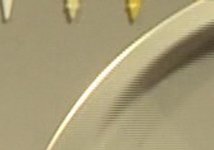
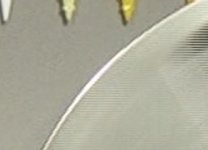
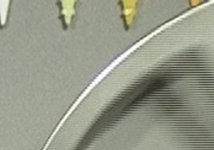
That same situation on a HPX170 or HMC150 will only hit every other row of pixels OR it will become two columns. Either it must create the data, or skip the data. The empirical evidence is in the face photos above. The eye lashes are almost gone, it has skipped the data. Looke at the lips, which have aliased curves (i.e. created data.) The other empirical data is in the curve of the film reel below. The HPX170 has the most jaggy edge of them all so it's not like I'm making this up.

Don't get me wrong, I think the 170 and 150 are very good cameras, even great for event purposes. The question of the OP was for film work.


@ Shaun1970 "To me it looks as if the HFS100 is the better image, as far as detail and clarity goes. "

The HVS100 has a full 1920x1080 sensor and a full raster 1920x1080 file format. It's biggest failing is in the aliasing caused by skipped pixels, the same problem as the 5D mk2.

Below are some images showing the alias of the various cameras. This is the edge of a locked down spinning film reel while interlaced. The spinning causes one issue with interlaced, but the edge of the reel and how much of the jaggy aliasing is what to look for here.

HFS100
attachment.php


HPX170
attachment.php


HV20
attachment.php


PMW-EX1
attachment.php


XH-A1
attachment.php
 

Attachments

  • PMW-EX1-Reel.jpg
    PMW-EX1-Reel.jpg
    8 KB · Views: 0
  • HV20-Reel.jpg
    HV20-Reel.jpg
    8.6 KB · Views: 0
  • HPX170-Reel.jpg
    HPX170-Reel.jpg
    11.3 KB · Views: 0
  • HFS100-Reel.jpg
    HFS100-Reel.jpg
    12.5 KB · Views: 0
  • XH-A1-Reel.jpg
    XH-A1-Reel.jpg
    9.9 KB · Views: 0
Last edited:
I even wonder what kind of signal you get out of the HDMI connection. Might be the same (uncompressed or 4:2:2?) as with the hpx 170.

If so, the 150 would even be a nice and cheap studiocam for any bluescreen operations.:D

The signal output through the HDMI port in camera mode bypasses the AVCHD compression, so it is 4:2:2 instead of AVCHD's 4:2:0.
 
Duke - from these pics it does look like the HFS100 gives the nicest result.

That would seem to be a very counterinuitive result - that the cheapest camera here is the best for a big screen.

Is that what you are suggesting?
 
Hey Mark,

I've seen the original webpage that previously posted images were taken from, and I personally don't think the author knew how to optimize the image quality of each camera in the test.

If you are after maxium image resolution then you will probably want to look for a full raster camera like the Sony EX-1/3 or the Panasonic HPX300. ( provided your budget is big enough )

...Myself, I bought a Panasonic HMC150 ( the SDHC card featured edged out the HPX170 ) because I wanted a tapeless workflow and I love the "film like" look that Panasonic cameras produce.

For me, maximum resolution is the least important quality I look for in a camera.

Higher Resolution ≠ Better Picture Quality
 
Duke - from these pics it does look like the HFS100 gives the nicest result.

That would seem to be a very counterinuitive result - that the cheapest camera here is the best for a big screen.

Is that what you are suggesting?

No that's not what I'm suggesting. It's a matter of what you want from the images.

However, it's not as counter intuitive as you think. The HFS100 is probably the newest of those cameras, has the new version III firmware with a full raster 1920 sensor and full raster file format. It should look sharper. As was pointed out resolution isn't the only issue. The HFS100's major failing is the stair stepping from the aliasing issue from the 8.59 megapixel sensor. It should take decent still images though.

Also, it's not the cheapest camera there. The HV20 is about half that price now and really the HV20 did very well on the aliasing issue, plus details like the eyelashes. Of these I think that's the most bang for the buck.

Once you take into account the manual controls I think the A1 is the most bang for the buck. Both the A1 and the HV20 seem to have an organic feel. In some images they actually look superior to the newer cameras. Certainly not all. Sometimes they look softer because they are a 1440 format.

Everyone's conclusions will be different, but the conclusions that I drew are as follows:

a) The venerable (discontinued) HV20 is still excellent and the most bang for the buck. The HV40 can do the same and has native 24F even if they are HDV. Whether you want to spend the money on a tape camera is another thing. If you are fed up with pulldown removal, it's native 24fps. No pulldown to remove.

b) The HFS100 can kick butt for a small consumer cam, plus it has manual gain control!

c) The PMW-EX1 beats them all, but you may have to tweak the colors.

d) The HPX170 (and HMC150) have good dynamic range (look at the eyes), but I personally wouldn't pick it to blow up. (You may have other opinions, that's mine.)

e) The XH-A1 (also discontinued) still stands up remarkabley well to every other camera. Used ones can be found for $2,000-$2,300. Plus it's 3 CCD so no skew artifacts like many CMOS cameras have.

They are all good cameras. Pick what suits you. I'm cheap so I have an A1 and an HV20. They also play nice together since the HV20 can act as a deck and play any mode the A1 can produce.

The reason for the pictures is so others can draw their own conclusions dependant on their own needs and desires. Remember, these images are stress test nighmare for cameras. They are meant to show any faults the camera has, and they all have faults. The question is how big of a fault, relatively speaking.
 
Last edited:
Let me say, to be fair, that you must ignore all the color settings in the images because we don't know the settings or if they were optimized.

The only thing we can compare are artifacts and details. The low light images for comparison on that site are worthless because they don't give the settings. You can't tell how much gain, or if they were optimized, with inconsistent results. So I didn't compare those images.
 
"We both agree that they are using 960x540 sensors. You assert that a shift of a row of pixels doubles the resolution vertically and horizontally and isn't creating new data from a lack of data." -Duke

Sorry, but that's not what I was attempting to say at all. If I didn't make that as clear as I should have that's my fault. Now that Barry's here he can explain better than anyone, but it's out there on the internet. Very detailed explanations on pixelshift, and specifically the panny way (as it is a bit atypical). As far as I know most cams, if they offset the prism, do so either a full pixel on one axis or another, not both.

The point is, though that it is not creating new data from data that doesn't exist. It is simply using a different method to obtain a comparable level of photosites.

The other thing is that with these pics, most codecs do a lot of smoothing (very generalized statement acknowledged), in my experience DVCPRO HD doesn't seem to automatically smooth itself in certain software environments. I don't know the workflow for those images so I don't know if its final export was proper for evaluation of the panny.
 
As people have said so many times.. there's more to just a cam than the resoultion.

The HV20 does shoot a nice image, but NOT in low-light, not when there's lots of camera movment, and not from a helicopter.. as that I know. The HV20 also has horrible audio and will create massive camera hiss and just doesn't have enough manual controls to get decent audio.. so split system is necessary.

Either way... it's what people need and want for each specific purpose. Sometimes I shoot with the SD9 cause it's covert and small and cheap.. sometimes other cams are what's called for.
 
I sort of agree with what you said. The HV20 isn't that sensative in low light and you must learn the cell phone trick to avoid gain giving you unwanted grain.

Also, the HV20 is a CMOS camera and will give you skew or jello with fast panning movements. That is a fact of life for all CMOS cameras due to the fact that they scan the sensor from top to bottom. This actually makes them better in tilt situations like a crane shot.

Three CCD cameras like the A1 and and CCD sensors in general scan from side to side and exhibit skew on tilting crane shots, but little or no jello cam from panning. The best option is to have one of each. LOL

The HV20, like most consumer cams, has a noisy built in preamp plus the on-board mic will pick up tape mechanism noise. An off camera mic and a quiet preamp, like a juiced link, pretty much resolves that one. However, admittedly tapeless systems mostly avoid that situation.

But if you're comparing the HV20 to the HMC150, it's one tenth the cost. That's like comparing the HMC150 to the Red One. Ten times more expensive (with lenses) and not really comparable.

And a big yes on covert. I can't shoot in downtown LA with the A1 on a tripod and no permit. :( But I can with the HV20. :) Its all good.
 
Last edited:
I like the quote "Which is better, a hammer or a screwdriver?" It depends on what you're going to be doing.
 
HV20 is an amazing cam for its price. Actually, for any price. And I've seen some amazing low light shots too! I don't know their settings, and never used the camera. I've only seen footage, but it's all been amazing.

Duke, once again, I hope this isn't getting annoying by now, but I don't know where you're getting your info. The HMC does not scan side to side, and does not exhibit skew. I can't speak for the A1, because I have not used it.

The panny cams natively run their CCDs at 60FPS, and use a global shutter. The entire frame is captured at the exact moment in time. Every pixel = same moment. It's not that it scans in different directions, or just faster, and therefore eliminates skew. Every pixel on those chips are read at the same time every time the chips read a frame.
 
Back
Top