Why did Panasonic get out of the filmmaker game?

I know they showed a S35 prototype at NAB a couple of years ago. Looked a lot like a black Red camera.
I've owned the SDX and HDX 900's. Both nice cameras.

I'd love to see them in the S35 market, but it's probably a little too crowded now. The only real untapped niche to me is a "proper" camera in S16-sized sensor and PL mount.
 
Actually, if they can find a way to make a hybrid camera - 2/3" & s35 it would fill a lot of niches. If an owner could put a 2/3" broadcast zoom at its native focal length and also have the ability to use a s35 lens it would cover most paid work. A large sensor using a windowed mode for the 2/3" work which is lower res by nature? It would keep them in touch with the broadcast crowd as well as give them an option in the same camera for SDOF work.
 
A 10 bit, 2/3" CCD P2HD camera would do it for me. ( same form factor as the HPX170 would work ) I prefer the way CCDs render skin tones and color in general, and I don't care if it can't "see in the dark" like some of these CMOS sensors. A far more useful feature would be interchangeable lens mounts.
 
Last edited:
If you were going out today to shoot a high-end documentary for months at a time, what would be your camera choice?

P2 Varicam no question for me.

I would not choose any of the cameras you mentioned for that purpose.

I miss using the Varicam, I always loved Pana's ENG offerings. Wish I had more reasons to shoot them nowadays.
 
A 10 bit, 2/3" CCD P2HD camera would do it for me. ( same form factor as the HPX170 would work ) I prefer the way CCDs render skin tones and color in general, and I don't care if it can't "see in the dark" like some of these CMOS sensors. A far more useful feature would be interchangeable lens mounts.

The problem of squeezing 2/3" to a HPX170 form factor is majority of quality 2/3" lenses are very front heavy. Any typical broadcast wide angle (14x4.5mm), medium (23x) and super telephoto (42x) will make it too hard to handheld. You'll need an AB Hytron 140 battery with two Tandem 70s to move the battery toward the back more to counter balance the front lens. The ideal form factor for handheld shoulder mount would be the JVC HD-250. It's a bit bigger than HPX-250 but not big as the typical 2/3" broadcast cam. Unfortunately JVC HD-250 is arguably the worst camcorder I've ever used and will never use any of JVC product again. However I must give them credit for making a nice shoulder mount design but w/ a slightly larger than the HPX-170 form factor.

I do see that CCDs has a richer color rendition. Case in point: AJ-HPX3100s, AJ-HPX3700s. MOSes on the HPX-250 tends to look a bit too digitally harsh at times and lack that warmth and fidelity. I was told from Panasonic that in order to cut costs and increase frame rates, they have no choice but to switch to CMOS. Not sure how their upcoming AJ-PX5000G Varicam 3 will perform w/ CMOS. The HPX3700 couldn't do more than 30 fps w/ CCDs due to overheating problem.
 
I do see that CCDs has a richer color rendition. Case in point: AJ-HPX3100s, AJ-HPX3700s. MOSes on the HPX-250 tends to look a bit too digitally harsh at times and lack that warmth and fidelity. I was told from Panasonic that in order to cut costs and increase frame rates, they have no choice but to switch to CMOS. Not sure how their upcoming AJ-PX5000G Varicam 3 will perform w/ CMOS. The HPX3700 couldn't do more than 30 fps w/ CCDs due to overheating problem.

The PX5000 and the Varicam 3 are two different cameras. The Varicam 3 will do 120 fps in full 1080P.

But, with the announcement of the Arri Amira, will it become the shoulder-mount camera of choice for documentaries, dramas, etc. over a 2/3" Panasonic camera?
 
The PX5000 and the Varicam 3 are two different cameras. The Varicam 3 will do 120 fps in full 1080P.

But, with the announcement of the Arri Amira, will it become the shoulder-mount camera of choice for documentaries, dramas, etc. over a 2/3" Panasonic camera?

Ah yes. The PX5000G & Varicam 3 are different classes of camera. Definitely has to be corrected here and thanks for pointing that out. But with so much P2 media & extensive 2/3" lenses invested, I'm biased toward the Varicam 3 because the most important thing I see is the ability to do multicam w/ previous generations of P's 2/3" cam and existing thousands of P2 media already invested. If someone's new to the biz, then investing in 3-5 Amiras will be the perfect choice. But those who already in the biz and have Panasonic cams, getting the Amiras is an optional luxury. But I do like the Amira's 200 fps. Just sweet for wildlife or any other sports slo-mos.

The biggest issue w/ 4K production is the lack of super long lens. So far the reasonably priced 400 mm PL on a 24x36 mm sensor just don't have the reach. 400mm is roughly the same as 18x on 2/3". Based on the calculator found on http://www.digified.net/focallength, a 516 mm 2.3" lens will need an equivalent 2064 mm PL lens to get the same coverage. W/ the 2X extender engaged, it becomes a 1032 mm 2/3". At this poing, a staggering 4128 mm PL lens is needed to get that level of magnification. I have not see any 2064 mm PL lens on the market yet. If it's I think it'll be so big that you'll need a crew of 3 people just to carry that thing. I'm using more and more 25x16.5 lenes for numerous sports, wildlife and big venue concerts. 22x these days just doesn't have the reach for big venue. It's impossible to get good coverage w/ 400 mm PL unless considerable expenses in securing a stand long platform or other setups that will interfere w/ the safety and building codes of most venues. Wildlife on a 400mm PL still is not close enough. I can tell you countless situations where you simply must be very far away from the animal to get catch them or else they won't be in frame. Plus I do not see anywhere there's optical stabilizer for a 400mm PL. If you do lots of super telephoto shoots in the field, optical stabilizer is a must have when you're getting anything beyond a 22x 2/3" lens. Even the slight 3-5 mph wind will ruin the shot instantly. Or anyone on the shooting platform starts to walk, it'll be full of lens shake. Until lens mfg start to make the same features & functionality that's currently found on 2/3", I don't see any urgent need to go to 4K. So Panasonic is definitely targeting this niche segment of the production community.
 
Last edited:
The biggest issue w/ 4K production is the lack of super long lens. .........Based on the calculator found on http://www.digified.net/focallength, a 516 mm 2.3" lens will need an equivalent 2064 mm PL lens to get the same coverage. ......... I have not see any 2064 mm PL lens on the market yet. If it's I think it'll be so big that you'll need a crew of 3 people just to carry that thing.
That objection has been largely overcome by the use of B4-PL adaptors, which act optically to quadruple the focal length and increase the coverage from 2/3 to s35 sensor imaging size.

The other implication is that there is an effective aperture change of (I think) 3 f stops. At first, that sounds a major negative, but in practice it's compensated for largely by the better sensitivity of the s35 chipped camera, so operationally the lens performs the same from angle of view, depth of field and sensitivity aspects as when used on a 2/3" camera.

When I first heard about it I was sceptical, but it's actually proving itself very well, and especially for just what you talk about. Wildlife cameramen who have moved to such as the F55 report very good results. (The advantage over just using a 2/3" camera is that switch to a low range zoom or prime, with fairly large aperture, and you get the shallow depth of field that is not possible with 2/3" at wider angles. That's quite apart from all the 4K aspects.)

As s35 cameras get more common, then I'd expect more "designed-for" PL lenses. It's not true that a 2064 mm PL lens need be so big "that you'll need a crew of 3 people just to carry it". It may be if it has to be designed to have the same max f stop as the 516 mm 2/3" - but design it to be 3 stops down and expect it to be about the same size and weight. And as before, the inherent higher sensitivity of the s35 sensor will compensate - it'll be back to square one for low light performance.

Sony and FIFA have written a lot about the 4K trials done in preparation for the next World Cup, and using B4 zoom lenses with F55 cameras via such adaptors is a key part of that - see http://community.sony.com/sony/attachments/sony/large-sensor-camera-F5-F55/6006/1/4KStudio.pdf .
 
What I see here is current 2/3" lenses investment is not at all go to waste. But diving into 4K w/ out a real consistence contract job is a foolish business decision now. Those few who are fortunate enough to have proper funding for 100% 4K workflow get a head start. Within 5-10 years, it'll trickle down to the rest of us. For me, I'm sticking to what profitable and viable which is still 1080p domain. I need a camera that can do a variety of shooting scenarios & flexible. Not just shooting wildlife but also doing large venue sports & concerts and other normal shooting environments. 5-8 multi cams capability for live switching & ISO recording is also needed. And it has to be within reasonable cost. Not over $200-300K per camera. Getting 4K ISO recording per camera will cost a fortune just on the media. Many say P2 cards are expensive, 4K will make it P2 look pale. Until I really see a greater push for 4K w/ satellite & cable TV, that's when I'll start switching. Sadly, 90% of my final delivery is still 480i. That's right. Not even HD let alone 4K.

3 stops loss of light can make or break when shooting low-light sunrise, sunset scenes. I'll have to add another stop when the optical stabilizer & circular polarizer filter is used. So I'll loose 5 stops total. I got to see it w/ my own eyes whether the grain is acceptable or not during low-light. Like you say the large Super 35mm sensor will compensate but got to see the results. Plus optical stabilization performance when it gets into the Super 35mm sensor.

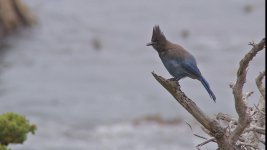
Shallow DOF on Super 35mm is not a deal breaker here. Majority of A-grade movies are still all in focus and only few times where they use just a bit of shallow DOF. I once was a shallow DOF maniac and shot everything at T2 and boy looking back it was a fad. Yes it has that nice cinematic effect but realistically majority of the times the wildlife is unpredictable and I mostly shoot at f/5.6 to f/8 (just before diffraction threshold kicks in on 2/3" sensor) to ensure that the main subject is in focus. Wildlife species rarely stay static. And when you are at extreme telephoto (1032 mm), f/5.6 is already quite shallow even w/ 2/3" sensor because of the super long distant and compression effect. The attached picts show plenty of shallow DOF for a 2/3" at f/5.6. The wider shot shows fairly good amount of shallow DOF on a 2/3" sensor. It was fairly windy but the optical stabilizer got rid of the lens vibrations. These are pure raw footage. No color grading. If it's graded, I can get pretty similar to a large sensor look by saturate the colors and add a lot of extra contrast to it. Sometimes tree branches get in the way, making a nice separation (not shown here). Anything at f/1.7 to f/4 on 2/3" will be at the risk of out of focus when the subject turns to front or side. Shooting small birds is extremely tricky and requires all the mm and optical stabilizer you can get. If they make a portable 99x lens, I'll use it w/ out hesitation.

Size-wise, the Fujinon 75-400mm PL is a monster. It's so heavy (20 lbs before matte box, filters) and it's only at 400 mm. Even a typical 12 lbs., 42x 2/3" EFP lens will need at least 2 people carrying it and mounting it on the camera. It's very already at 12 lbs and needs lens support mount. I tried to mount that 42x by myself and it's near impossible w/ out risking damage. I don't see how they can get to 3,000 mm, scale to within 6 lbs, portable & w/ out sacrificing much optical quality in the next 5 yrs. The large 4K sensor will not be forgiving to cheaper optics. And likely most serious 4K shooters will not use cheap lens. It will devalue their work & pride. It will be a very challenging thing to balance optical quality for cost. So far I'm not aware of any 3rd party lens mfg announcing a 2000+ mm super telephoto lens @ f/8-11 for native PL mount. Probably some Chinese knock offs will take the risk in the near future.

That objection has been largely overcome by the use of B4-PL adaptors, which act optically to quadruple the focal length and increase the coverage from 2/3 to s35 sensor imaging size.

The other implication is that there is an effective aperture change of (I think) 3 f stops. At first, that sounds a major negative, but in practice it's compensated for largely by the better sensitivity of the s35 chipped camera, so operationally the lens performs the same from angle of view, depth of field and sensitivity aspects as when used on a 2/3" camera.

When I first heard about it I was sceptical, but it's actually proving itself very well, and especially for just what you talk about. Wildlife cameramen who have moved to such as the F55 report very good results. (The advantage over just using a 2/3" camera is that switch to a low range zoom or prime, with fairly large aperture, and you get the shallow depth of field that is not possible with 2/3" at wider angles. That's quite apart from all the 4K aspects.)

As s35 cameras get more common, then I'd expect more "designed-for" PL lenses. It's not true that a 2064 mm PL lens need be so big "that you'll need a crew of 3 people just to carry it". It may be if it has to be designed to have the same max f stop as the 516 mm 2/3" - but design it to be 3 stops down and expect it to be about the same size and weight. And as before, the inherent higher sensitivity of the s35 sensor will compensate - it'll be back to square one for low light performance.

Sony and FIFA have written a lot about the 4K trials done in preparation for the next World Cup, and using B4 zoom lenses with F55 cameras via such adaptors is a key part of that - see http://community.sony.com/sony/attachments/sony/large-sensor-camera-F5-F55/6006/1/4KStudio.pdf .
 

Attachments

  • DVXUser_HA25x16-TS-P58A-BlueJay2.jpg
    DVXUser_HA25x16-TS-P58A-BlueJay2.jpg
    39.4 KB · Views: 0
  • DVXUser_HA25x16-TS-P58A.jpg
    DVXUser_HA25x16-TS-P58A.jpg
    53 KB · Views: 0
Last edited:
But diving into 4K w/ out a real consistence contract job is a foolish business decision now. .........For me, I'm sticking to what profitable and viable which is still 1080p domain. I need a camera that can do a variety of shooting scenarios & flexible. Not just shooting wildlife but also doing large venue sports & concerts and other normal shooting environments. 5-8 multi cams capability for live switching & ISO recording is also needed. And it has to be within reasonable cost. Not over $200-300K per camera.
But what we're mainly talking about is large sensor for high end work - not necessarily 4K. The Alexa isn't 4K, the Amira won't be. Most of the people I know who have got F5/55s recently have brought them primarily to use in 1080 HD at the moment. But knowing they are 4K capable if needed, knowing they are RAW capable, is seen as a huge positive - even if that's not how they are being used at the moment.

As far as the other points you make, then look at the link in my last post. That's all about the trials of 4K for live international football, and using F55s for such, just putting a new adaptor on the back to make it live capable and controllable via a base station. OK, maybe that's a few years off before becoming the commonplace on OBs, but I remember when the idea of an HD OB seemed exotic! As for cost - well, an F55 is well under $30,00 at B&H. Even with v/f it's still well under $35,000. Not cheap - but we're not talking anywhere near $200-300K per camera.
3 stops loss of light can make or break when shooting low-light sunrise, sunset scenes. I got to see it w/ my own eyes whether the grain is acceptable or not during low-light. Like you say the large Super 35mm sensor will compensate but got to see the results. Plus optical stabilization performance when it gets into the Super 35mm sensor.
It's *NOT* "3 stops loss of light" - it's "an effective aperture change of 3 f stops", which is a very different thing.

With the adaptor, none of the light that would go to form the image on the 2/3" sensors gets "lost" - it just gets spread out to cover an s35 frame, rather than 2/3". At any particular point, it's true the s35 image will be only about 1/8 the brightness - but each individual pixel will be 8x the area of the corresponding 2/3" pixel. Hence a single pixel will capture the same number of photons per frame in each case, so low light ability won't change because of the adaptor.
Shallow DOF is not a deal breaker here. Yes it has that nice cinematic look but realistically majority of the times the wildlife is unpredictable and I mostly shoot at f/5.6 to f/8 (just before diffraction threshold kicks in on 2/3" sensor) to ensure that the shot is in focus. Wildlife species rarely stay static. And when you are at extreme telephoto (1032 mm), f/5.6 is already quite shallow ..........
I don't disagree with any of that - but it's exactly why the B4-s35 adaptor is such a game-changer (much as I dislike that phrase) here. You would leave the lens set to f5.6 - though it will behave in s35 terms as f16 - and in terms of depth of field, diffraction etc it's just as before. Stop down another couple of stops (f11 indicated) and it's equivalent to f32, also roughly where diffraction limiting starts to become a problem with s35. Operationally, you can forget the camera being s35 - from a cameraman's perspective, the lens will behave exactly as if it was directly on a 2/3" camera.

And for the reasons given above, then equivalence also applies to low light performance. Same number of photons/pixel in s35 mode as 2/3". (Assuming all else equal.)

If you read the earlier posts in this thread, I referred to a BBC nature programme where an Alexa is being used with such an adaptor. (See, for example - http://www.bbc.co.uk/programmes/p01fyby2 . Especially worth watching at about 1 min 40 secs.) The large sensor/adaptor/B4 lens may well not offer any advantage over just using a 2/3" camera for the actual wildlife filming, but for other shots - scenery, presenter pieces etc - you can just change to a fast prime or short zoom and take advantage of the large sensor characteristics.
Size-wise, the Fujinon 75-400mm is a monster. It's so heavy (20 lbs before matte box, filters) and it's only at 400 mm. Even a typical 12 lbs., 42x 2/3" EFP lens will need at least 2 people carrying it and mounting it on the camera. It's heavy already at 12 lbs and ............ I don't see how they can get to 3,000 mm, scale to within 6 lbs, portable & w/ out sacrificing much optical quality in the next 5 yrs.
Again, yes, but the Fujinon 75-400mm is T2.8. Therefore giving equivalent performance to a hypothetical 2/3" lens of about T1.0!! I'd suggest that if it was possible to make such a thing, it too would be quite a monster!! :)

The answer to your last question is to make the max f stop of the lenses much less than the norm for 2/3". You won't get the extreme low light performance or shallow depth of field that a fast prime will give - but you will get a long zoom, and equivalent low light performance to a 2/3" lens of about the same size/weight etc.
 
I don't disagree with any of that - but it's exactly why the B4-s35 adaptor is such a game-changer (much as I dislike that phrase) here. You would leave the lens set to f5.6 - though it will behave in s35 terms as f16 - and in terms of depth of field, diffraction etc it's just as before. Stop down another couple of stops (f11 indicated) and it's equivalent to f32, also roughly where diffraction limiting starts to become a problem with s35. Operationally, you can forget the camera being s35 - from a cameraman's perspective, the lens will behave exactly as if it was directly on a 2/3" camera.

Hardrive, I would need you to clear some things up for me as I find I do not agree with the paragraph listed above.

1) You mention the 2/3" lens will behave exactly as if it were on a 2/3" camera. Well yes it will zoom but the lens will be turned into a telephoto only lens due to the adapter's increase of focal length - true? What if you need a med-wide shot?

2) f32 as a diffraction limit is way beyond what I have come accustomed to in still photography. Many landscape shooters believe f11 is the limit on full frame sensors. Granted this might not affect video like stills but 4k is getting a lot closer to still image resolution. I am sure this setup is great and the images are stunning, but I do not think it necessarily translates as well to "normal" shooting.

What I have learned in the last 5-6 years after moving to HD is that future proofing is a marketing term. Only very large companies "buy" the future because they are selling something associated with it. You would be better off buying 4k in the future when you need it. By then it will be more established with workflows and codecs and it will be more affordable. Also, let consumer demand lead the way. Looking back at my HD upgrade path, it is literally 50%-50% on if I ever really needed HD for many jobs as so many times what is delivered is on DVD or in a small internet window. I have found HD has been for that segment of the market that really wants it. Sadly, that segment of the market is a minority. Yes, I like the images I can get and many projects have benefitted, but I bring all of this up to demonstrate how 4k will be a fraction of the already small "need HD" crowd.

We all do different types of work, so we all need different solutions. Personally, I think 4k is being presented too early compared to the HD introduction. I know it has some benefits but 4k will always be a "cinema" format from my perspective, especially if the cameras are light challenged.
 
An ENG zoom will behave just like it would on an ENC camera body. But and for me and lot's of other folks this is a big But: IQ will change. Everything gets more or less doubled. CA, MTF, edge to edge sharpness, etc. To me, using an 2/3 ENG lens on a S35 chip is waste. You don't get excellent picture quality and you don't get a nice shallow DOF.
 
Hardrive, I would need you to clear some things up for me as I find I do not agree with the paragraph listed above.

1) You mention the 2/3" lens will behave exactly as if it were on a 2/3" camera. Well yes it will zoom but the lens will be turned into a telephoto only lens due to the adapter's increase of focal length - true? What if you need a med-wide shot?
I confess that when the principles were first given to me it took a while to sink in, but once you get your head round it, it's a revelation!

To answer your question above, then when I say it will behave as it would on a 2/3" camera, then imagine two cameras side by side - A is 2/3", B is s35 with a B4-s35 adaptor. You then put exactly the same lens onto each. Optically, you won't be able to tell the difference between the two outputs if you have both lenses at the same settings. They will both give the same angles of view at wide and tight end, both give the same depth of field characteristics, and both start to diffraction limit at the same setting of the iris ring. If the cameraman was operating them remotely - couldn't physically see the camera bodies - he wouldn't be aware which was which.

Imagine the lens is set at it's widest setting. It's true the effect of the adaptor will be to make this seem to be a longer focal length - but remember it's in conjunction with a larger sensor. The two facts balance each other out, and this is why the angle of view for any given lens setting will be the same in each case.

It will also be the same for low light performance (assuming equivalent sensor technologies). The f stop will be smaller by around 3 stops - but the larger sensor will be about 3 stops more inherently sensitive than the equivalent 2/3", because each photosite must be about 8x the area of it's 2/3" equivalent. So if correct exposure for a 2/3" sensor rated at (say) ISO500 is obtained at (say) f4, the equivalent s35 sensor will be rated at ISO4000 with the same s/n. Which will need f11 for correct exposure, which means setting the iris to f4 indicated...... See how the equivalence comes about?
2) f32 as a diffraction limit is way beyond what I have come accustomed to in still photography. Many landscape shooters believe f11 is the limit on full frame sensors. Granted this might not affect video like stills but 4k is getting a lot closer to still image resolution. I am sure this setup is great and the images are stunning, but I do not think it necessarily translates as well to "normal" shooting.
The diffraction limit is decided by two things: sensor size and system resolution. Increase system resolution and the effects become more pronounced (so you can't get away with as small apertures as for a lower resolution), increase sensor size and it's the opposite - you can use smaller f numbers.

Let's put some numbers to it, and for HD and 2/3", a reasonable figure for the diffraction limit may be f8. (Depends how critical you are, but let's assume f8 here.) Increase system resolution to 4K and I'd expect f4 to become "the new f8", the new diffraction limit. Now increase the sensor size to s35 (approx. 8x the area) and the limit then goes towards smaller apertures by about 3 stops - so that takes us to about f11.

Now, regarding still and landscape photography, full frame will allow you to stop down about another stop cf s35 (it's about twice the area), which would give f16 - but we're now talking of a higher resolution. If it was about 5600 pixels horizontal (which equates around 20Mpixel total) that's roughly twice the pixel count of 4K, so we need to reduce the max iris by about a stop - so back to f11.

Very rough figures, but you can see why I'm not in disagreement with what you say about landscape shooters, full frame and f11! There's approximations in that, but it's in the right ball park. It also follows that for s35 and 1080 HD, you should be OK up to about f22.
We all do different types of work, so we all need different solutions. Personally, I think 4k is being presented too early compared to the HD introduction. I know it has some benefits but 4k will always be a "cinema" format from my perspective, especially if the cameras are light challenged.
The main thing being talked about here is less 4K than s35 versus 2/3".

It started with the point that s35 offers shallow depth of field benefits that 2/3" doesn't, but it was said it had drawbacks regarding long range and narrow angle of view lenses. With the B4-s35 adaptor, that's no longer true. It is true that with such the large sensor cameras won't be able to give the shallow dof that they're associated with - but for such shots the cameraman just puts on a fast prime or short range zoom. You don't lose anything going s35 with something like an Alexa or F5/55 anymore - but you do get extra versatility, and as I understand it, that's the reason why many cameramen are going that route. 4K versus HD is a separate matter.

As far as 4K is concerned, then I don't really disagree with your comment above. But this discussion has been about cameras in the Varicam/Alexa class. Consequently, you can expect them to be working primarily on the bigger budget work, and that's where I'd expect 4K to make most impact first. If a camera is being bought for news, then 4K is not going to be an issue for a long time to come. For the Alexa/Varicam market, it's very different. Similarly, I see 2/3" cameras as being optimal for news and much other general broadcast work for the foreseeable future - for higher end work, expect to see much more s35 cameras being used, 4K or no 4K.
 
Last edited:
But and for me and lot's of other folks this is a big But: IQ will change. Everything gets more or less doubled. CA, MTF, edge to edge sharpness, etc. To me, using an 2/3 ENG lens on a S35 chip is waste. You don't get excellent picture quality and you don't get a nice shallow DOF.
No, that's not true. Think of it as all that's happening is that the image on the 2/3" sensor is being magnified to be a bigger image on the s35, about 8x the size in area terms. (say 2.5-3x linear). So whilst an effect due to (say) CA will indeed be 2.5-3x the size in microns it would have been on the 2/3" sensor, the photosites on the s35 sensor will likewise be 2.5-3x further spaced apart (assuming equivalent system resolutions etc), so it's back to square one. The effects cancel out, so no quality is lost.

If you got an s35 camera and only ever intended to use it with B4 lenses and an adaptor, then I'd agree - what's the point? Why not just use a 2/3" camera?

The answer is in the post above. You'd only expect to use such part of the time - when you need a long range zoom which isn't too big and heavy. At other times you use the camera with fast primes or shorter range zooms to fully make use of the cameras capabilities.
 
Hard Drive, thank you for your excellent post. I do have a follow up question:

Alister Chapman was representing an adpater that went on a s35 camera that allowed B4 lenses to be used but it incorporated the 2x extender, which killed wide angles. Could you clarify the adpator you are referring to and why is yours not going Alister's route or vise versa?

I would love my next camera to be a s35 sized sensor knowing I can use my B4 lenses, but I have never seen an adapter that does this without the extender. Please tell me about product info & pricing and power for the B4 lens etc...

Thanks!
 
I would love my next camera to be a s35 sized sensor knowing I can use my B4 lenses, but I have never seen an adapter that does this without the extender. Please tell me about product info & pricing and power for the B4 lens etc...
Firstly, I'll have to say straight away that I don't own such, though I've had the principle demonstrated, and I'll say again that until fairly recently I likewise thought that any reasonable long range zoom for s35 would be massive/big/heavy/expensive. When I first had explained to me what I wrote above it was a "DOH!" moment - it's so obvious once you realise what the principle is. I'd recommend going to a dealer and doing your own googling, because I think there are various solutions at different price points. Maybe start a new thread along the lines of "B4 to s35 optical adaptor - any suggestions?" ?

The first such adaptor I was aware of is a very recent one made by Sony, and the imperative seems to be the desire to advance 4K live production for big events. It's referenced in the pdf about the Sony/FIFA 4K live broadcasts trials - http://www.sony.co.uk/res/attachment/file/95/1237491578795.pdf - and is the LA-FZB2. (I now know there is also an LA-FZB1) But more about those below......

As one alternative example, try http://www.ibe-optics.com/HDx35 . More googling found me one from MTF - http://www.mtfservices.com/index.php/b4-2-3-to-sony-f3-adaptor-package-detail and at the bottom that gives a link to a video by Alister Chapman explaining the principles - http://www.youtube.com/watch?v=iqJCFBZDfLQ&feature=youtu.be . From his references to the 2x extender, I think this may be what you refer to here:

Alister Chapman was representing an adpater that went on a s35 camera that allowed B4 lenses to be used but it incorporated the 2x extender, which killed wide angles. Could you clarify the adpator you are referring to and why is yours not going Alister's route or vise versa? Thanks!
I've learnt something new from Alisters video! The basic principle of the adaptor (any of them) is to make the image that would be formed on the 2/3" sensor bigger - big enough to cover an s35 sensor. The basic way in which most zoom lenses work makes that relatively straightforward, it involves modifying the rear section of the lens, but doesn't affect the optics of other sections. It's also important to realise how a 2x extender works in a broadcast lens, which is effectively the same - it increases the image diameter from about 12mm diameter to about 24mm. Hence the sensor only registers the middle quarter of the image, so magnification. When used as designed, (on a 2/3" camera) then it's true that here all the flaws also then get magnified - which I think is what KINOKS got confused by.

What Alister is saying is that the 2x extender gets used in conjunction with other optics in the adaptor to make the total magnification more like 2.6x. That's enough to cover an s35 sensor - the 2x by itself wouldn't be. (Alisters video demonstrates this.) It's not true to say "it kills wide angles" - same argument as before, the extender/adaptor combined increases focal length by 2.6x, but the larger sensor means same angles of view as when used without the doubler on a 2/3" camera.

Back to the Sony adaptor. It appears to be much more expensive - but not surprisingly is better, and the second version incorporates filters which can be remotely swung from the racks of an OB scanner - just as with a normal dedicated broadcast camera. The "1" version doesn't need that, it's intended to be used in a EFP style situation when the cameraman can use the camera filters as normal.

Try googling LA-FZB2 directly. it brings up a lot of references, including the one below, again Alister Chapman, this time speaking on behalf of Sony themselves. The big difference between it and the MTF version is that it handles the 2.6x extension itself, without needing the optics of the extender.

http://www.newsshooter.com/2013/09/...1-and-la-fzb2-b4-lens-adapter-for-f5-and-f55/

Does all that help? Sorry to be so long winded!
 
Last edited:
Thank you yes it does. I watched Alister's video for MTF and I see how the resultant images are as if they are on a 2/3" camera. Somehow before I thought the wide end was lost but now I know. Thanks for helping me see the light! I have more options going forward for sure.
 
Last edited:
I found this recent article on DVInfo regarding the MTF adapter. http://www.dvinfo.net/article/production/camgear/review-mtf-lens-mount-adapter.html

There is some video from a C300 using the adapter down the page and it looks pretty soft to me given how detailed the C300 can be.

Yes, MTF can't be the same. The same amount of light is hitting a much bigger surface. The extender is (I think) at the end of the lens, so it's only working with the small amount of light that's coming through at the front of the lens (it's magnifying or doubling, it's why it's also called a doubler). And also, you are not getting a centre crop of the image (as you would get on a 2/3 chip when using an extender) so edge to edge sharpness can't be the same. It's the same principle with MFTs speed booster only reversed. And there is one more thing, why the images look softer when using ENG style zooms: primes that are used a lot on S35 cameras are generally much sharper and better in overall IQ than ENG zooms.

@harddrive: yeah I get what your saying. Imperfections don't really get doubled. But MTF and edge to edge sharpness do change.
 
@harddrive: yeah I get what your saying. Imperfections don't really get doubled. But MTF and edge to edge sharpness do change.
When Bassman and I refer to "MTF", we're not talking about "modulation transfer function" - rather the company that makes the adaptors Alister references.

And (fundamentally) edge to edge sharpness and mtf (in this case, yes, modulation transfer etc!) WILL change if you're talking about a lines/mm figure at the sensor - they *WILL NOT* change if you're talking about lpph. And for a given system resolution, it's lpph that's relevant in practical terms. If the lens delivers (say) 1500 lpph with an mtf of 80% onto the 2/3" sensor, it should deliver the same onto the s35 sensor. (If it was to be 100 line pairs per mm on the 2/3" sensor, then that will drop owing to the spreading - expect about 40 lines per mm on s35. But the s35 sensor is 2.6x wider - 2.6x as many mm!! - so back to square one - same total resolution.)

That's the theory, but inevitably there may be a slight degradation owing to putting more glass in the way. Everything I've seen indicates it to be slight, though hardly surprisingly the more you pay, the better it is. I'd therefore expect the Sony version to be better than the mtf version - but it's more expensive. Note that they were extensively tested for the Sony/FIFA trials, with a full 4K path, and with representatives from big broadcasters and were considered pretty good. And that's with F55s in 4K mode. Used for large sensor HD, that itself will mask much of what 4K will show up. What I take away is that whilst they are unlikely to be quite as good as a "designed-for" lens, they are a perfectly usable transitional measure from 2/3" to s35.
Bassman2003 said:
There is some video from a C300 using the adapter down the page and it looks pretty soft to me given how detailed the C300 can be.
I followed your link, and yes, my first thought was "?*&!!*@, that's soft!!!" :) But isn't that down to the Vimeo downscaling? I'm not sure what resolution it was posted at, but by setting playback to first "full screen", then "scaling off" (to give pixel-pixel mapping on the screen) the image was pretty small. I'd guess about 360p, though didn't get the Vimeo resolution reported directly. I don't think you can draw any meaningful conclusions about resolution from that link.

Maybe time to pay a visit to a dealer for a proper demo on your next day off, Bassman2003......... ? :)
 
Last edited:
Back
Top