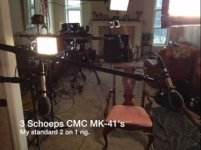
Why a lavalier instead of a boom on a stand?

It seems that a boom mic is better in every way, but a lavalier is the standard for people sitting. Why? (Or am I noticing when it's there but not noticing when it's not there?)

A boom mic:

  1. Is invisible
  2. Need not be awkwardly fed up through other people's outfits. You just place it on a pole.
  3. Sounds fuller and more natural
  4. Lets the person clutch their chest in an emotional moment
  5. Doesn't make the rustling of clothing loud

It seems like this would be easier to find articles and threads on. But googling for 15 minutes or so left me only with these:

 
Last edited:
You go with the best tool for the job, which isn't the same for every job. With a boom, it can be out of sight (out of frame) with no worry about hand hits or fabric rub or losing frequency response to layers of clothing, as you have mentioned. If the lav must be hidden, those are concerns. If burying the lav isn't a necessity, those concerns are minimized but not eliminated.

While I typically much prefer the sound of a boomed mic if I can get away with it, the major disadvantage is consistency in placement. If the talent or interviewee knows how to sit for a stand-mounted mic, it's not a big deal; but get that one person who sporadically or constantly leans forward and backward, and rocks from side to side, and the boom is useless on a stand. A lav, however, will always be placed in the same position relative to the talking head.

Also, as the old adage goes, "Whenever able, use a cable." It's always a good idea to have a couple of XLR-terminated lavs in the kit. Wireless is generally overkill for a seated interview, and a hard-wired lav eliminates the risk of RF hits.
 
Why either/or. Use both if you can. Common practice with sound recordists to lav up the talent/interviewee and use a boom/overhead. Lav is for insurance as suggested above.
 
When shooting interviews with the subject typically seated I prefer a boom on a stand for all the reasons mentioned. It's more to carry, but worth the trouble. It's less obtrusive and a little more forgiving than a lav.
 
A big factor is whether the talent is sitting on an upholstered surface or standing on carpet. The boom mic pointed toward those surfaces will sound better than a lav pointed at the ceiling due to less sound bouncing around. Not as much difference between boom and lav if all surfaces are hard. Another factor is that lavs tend to be omni and pick up more reflections than booms, which tend to be hyper.
 
Shooting interviews, I use both and much prefer the sound of the boom, a nice hyper can't be beat.
 
A big factor is whether the talent is sitting on an upholstered surface or standing on carpet. The boom mic pointed toward those surfaces will sound better than a lav pointed at the ceiling due to less sound bouncing around. Not as much difference between boom and lav if all surfaces are hard. Another factor is that lavs tend to be omni and pick up more reflections than booms, which tend to be hyper.

I don't agree with this.

An omni lav isn't pointed at the cieling. It isn't pointed at anything, as it is omnidirectional (literally, from all directions).

Lavs should be omni, not "tend to be", as a cardioid lav is only good until the talent turns his/her head even slightly. That said, the lav is generally placed closer to the source (mouth) than is practical for a boomed mic. That means a higher ratio of dialog to ambient sound. Further, the placement of the lav on the torso provides a giant absorption surface (human body + clothes) that can help to tame background issues. There are extreme locations where this doesn't help (highly reflective bathrooms, for example), but omni isn't a killer for a lav just because of a few reflections.

Boomed mics don't "tend to be" hypercardioid. They can be, or they can be shotguns, or they can be cardioid or supercardioid. It really depends on the environment and what is the best pattern for that space. I use my shotgun more often than not, but I will break out the hypercardioid for a challenging interior or where headroom is at a premium. Shotguns work just fine indoors unless the space is quite reverberant. At that point the hypercardioid may be a better bet not because it doesn't pick up reflections (because it certainly does), but because it has a more natural-sounding response to the reflections from the listener's/viewer's standpoint. And yes, this can be a better overall sound than a lav depending on the room and on mic placement.

Last, even if the room is all hard surfaces, there will be a distinct difference in sound between a boomed mic and a lav, for reasons described above.
 
Thank you, everyone. This has been very helpful so far.

Use both if you can. . . . Lav is for insurance

Thank you. Is this the consensus then? If money were no object and the room is perfect, sound guys prefer a boom, but put on a lav too, just in case.

That would explain why it looks like everyone prefers a lav, because that's the mic I see on screen. But really just above the frame is nevertheless a boom, and that's the mic that finds its way into the final mix usually.

I mean, Hollywood is famous for using a boom the most, and they have the most money of all. I used to think that TV used lavs because they sound better and there it's okay to see the mic, unlike in a movie. But after reading and hearing how a boom actually sounds a bit better most of the time, well, that's what led me to start this conversation.
 
And of course the big one, lighting. Especially in a limited lighting situation booms can be a bear to place so they don't cast a visible shadow. It also can be problematic if you have someone who moves around a bunch. You nice locked down boom can't follow and a boom operator runs the risk of dipping into the frame. If it's a news/ doc. your ability to reshoot because of a shadow or a mic dip may be small to nil so the lav is safer. OK sound in a shot you can use is better than great sound in a shot you can't.

From my somewhat limited experience (in production sound) unless there is no budget or restrictions limit the options it's pretty common to boom and run a wireless lav.
 
Shooting interviews, I use both and much prefer the sound of the boom, a nice hyper can't be beat.

What he said. Although as mentioned, if shadow from the lighting become an issue it's problematic. For a basic interview, this can usually be avoided. But having redundant audio tracks is often a benefit and doesn't take much extra effort.

Grant
 
I always do both if I can. Kind of a "why not" thing, but I prefer the sound of a boom, but for me, the one big reason to also put on a lav was already mentioned. If you have a person that moves around a lot (Quentin Tarantino) then the boom won't give you the coverage you need.
 
I normally run both, in my experience, I am usually unaware of the other content and a lav (or boom) may match the other interviews. The downside is the (video) editors will often use both (left/right) when summed to mono, phase issues abound. For films, I normally wire everyone in addition to the boom(s).
 
To me lavs are all about the talent and the lens being in different places when solo shooting.. RnGun

Say a chef doing a cookery course with 20 student he might say 'then chop the carrots' (into the lav) and you actually are filming one of the student chopping carrots and the on camera shotgun is getting the knife hitting the chopping board sound

you are then getting a sound and picture track that will cut

Ive always boomed static interviews (and usually had the lav as backup)

S
 
IMO the rise of the lav follows the rise of the solo camera op... I usually prefer the sound of a boomed mic and will set one up whenever time and cargo space allow, but so many gigs now have no budget for assistants, no accommodation for gear offload, and a wired/wireless lav and cable simply take up much less room than any stand and boom setup (even though there are some very compact alternatives). That compromise of acceptable but thinner dialogue vs. having to haul 6 more pounds over several city blocks becomes very real.

There are of course multiple other reasons to opt for the lav over a boom, but I believe that's been one of the greatest motivators in recent years.
 
I don't think so. Can you imagine trying to boom the local (or national for that matter) news or chat shows around the planet? That is just so completely impractical on so many levels.

The Tonight show was (is?) boomed. It was one of those "booms" that looks like a construction crane. Not sure if this is still the case.
 
I haven't seen mic booms on the Tonight Show since the Johnny Carson era.
And I haven't seen mic booms on any of the other late-night shows at all.
 
I might be in the minority here but many years ago I stopped delivering more than 1 source for standard interviews (99% of the time).

My reasoning is, they are paying me for my knowledge of how to get the best sound on set/location and to make those kinds of decisions.
Too many times I've heard my work later only to hear a boom on 1 speaker and the lav on another, or worse: both mixed together.
The request I find more often than not comes from someone who doesn't know anything about sound but their editor/mixer complained
once about someones mic in another city so now they want both. It's ridiculous and glad I don't have to be around that often.

If I'm on location and I truly can't tell which is the better choice and it's best left to the re-recording mixer I'll record both.

I'm a huge boom fan and in my opinion there are 3 main reasons to use a lav over a boom.
Camera framing won't allow a boom.
You get lit off set.
A noisy environment where the closer lav mic wins out, not necessarily for "quality" but because it's more intelligible.
 
The Tonight show was (is?) boomed. It was one of those "booms" that looks like a construction crane. Not sure if this is still the case.

If you want to get historically accurate, that is a proper boom. What we commonly call a boom these days is technically a fishpole.

I haven't seen mic booms on the Tonight Show since the Johnny Carson era.
And I haven't seen mic booms on any of the other late-night shows at all.

SNL is still boomed.

I might be in the minority here but many years ago I stopped delivering more than 1 source for standard interviews (99% of the time).

Absolutely. If conditions (or producers) require a lav, I will lav. Otherwise, it's a boom and only a boom.
 
Can you imagine trying to boom the local (or national for that matter) news or chat shows around the planet?

Yes, I absolutely can. Are you thinking of just one boom mic, being moved around? I was thinking one boom mic per person, just as you have one lav per person. A hypercardioid or shotgun on a mic stand that holds it above the frame, pointed down at the talent. Anchors and interviewees hardly move. They're sitting. That's why I was thinking I could get away with stands. In fact, this is what Thom Shafer does.

shafer.jpg

But as several have pointed out, sometimes the people move around too much, even in their seats. So they add a lav, for back-up.
 
Last edited:
Back
Top