GH5 Which strength and focusing with Mist filters - Pro-mist, Softon, Black mist?

analogs

Well-known member
If you could only have one mist filter, which strength would it be - 1/4, 1/8, 1/2?

Also, how does it affect focusing on a camera? What are the negative effects - does it make auto-focusing more difficult, does it make focus peaking inaccurate, etc?

What are the cheapest mist filter on the market that provide good results? Not DIY.

Are the Hoya/Kenko Softon, Nissi Black Mist, Tiffen Pro-mist the-same or similar?

Thank you.
 
If I wanted to err on the side of subtlety, i would only get 1/8.

If i wanted to hit a sweet spot of subtle but effective, i would get 1/4. That's the strength of Tiffen Black Satin i use most frequently.

If i were to say forget about subtlety, I want to make sure I have an effect and skin is soft, I would get 1/2.

Generally I think that most glass filters are decent. Resin filters are garbage. But it would pay to watch videos and reviews of the specific filters you want if you can't test them in person. Heres one on NiSi filters in general:
https://youtu.be/PIDq2WQOf6I

I really like Tiffen Black Satin because it's subtle enough that it doesn't look filtered (which is what almost all filters claim in their marketing but is never actually true). I can use it in documentary without a problem and it takes the edge off a sharp lens and smooths out skin a bit, and also has a mild halation effect that stays consistent across all strengths.

But because Black Satin is subtle, it won't give you a "look" if that's what you're searching for.

All types of black pro-mist are doing basically the same thing AFAIK - scattering the light with an array of particles, some or all of which are black which helps maintain contrast. Mist or white pro-mist filters dont have black particles and really reduce contrast in addition to blurring the image.

As for focusing - a diffusion filter will make it harder to focus the image by eye. I haven't tested it with autofocus but it will probably impact autofocus because the autofocus on my A7SIII seems to work best on subjects with contrast and detail, which will be reduced by the filter. Peaking will probably still work as long as the filter isn't too strong. Who knows, peaking may work even better if it reduces the range of pixels that are peaking and more accurately shows you the area that's in critical focus.
 
Last edited:
If I wanted to err on the side of subtlety, i would only get 1/8.

If i wanted to hit a sweet spot of subtle but effective, i would get 1/4. That's the strength of Tiffen Black Satin i use most frequently.

If i were to say forget about subtlety, I want to make sure I have an effect and skin is soft, I would get 1/2.

Generally I think that most glass filters are decent. Resin filters are garbage. But it would pay to watch videos and reviews of the specific filters you want if you can't test them in person. Heres one on NiSi filters in general:
https://youtu.be/PIDq2WQOf6I

I really like Tiffen Black Satin because it's subtle enough that it doesn't look filtered (which is what almost all filters claim in their marketing but is never actually true). I can use it in documentary without a problem and it takes the edge off a sharp lens and smooths out skin a bit, and also has a mild halation effect that stays consistent across all strengths.

But because Black Satin is subtle, it won't give you a "look" if that's what you're searching for.

All types of black pro-mist are doing basically the same thing AFAIK - scattering the light with an array of particles, some or all of which are black which helps maintain contrast. Mist or white pro-mist filters dont have black particles and really reduce contrast in addition to blurring the image.

As for focusing - a diffusion filter will make it harder to focus the image by eye. I haven't tested it with autofocus but it will probably impact autofocus because the autofocus on my A7SIII seems to work best on subjects with contrast and detail, which will be reduced by the filter. Peaking will probably still work as long as the filter isn't too strong. Who knows, peaking may work even better if it reduces the range of pixels that are peaking and more accurately shows you the area that's in critical focus.
Thanks for the quick reply!

Ahalpert, if you only have one, what strength would you choose based on your experience, 1/4, 1/8 or 1/2?
 
Thanks for the quick reply!

Ahalpert, if you only have one, what strength would you choose based on your experience, 1/4, 1/8 or 1/2?

I had a weird experience with the Tiffen Pearlesescent filter. It should have been good at 1/2nd or 1/4th, given the example videos on Tiffen's Vimeo account, but my 1/8th filter was super heavy. made my use of it super annoying, and now I rarely use that f'ing $400+ filter. I mean, A cameras cost ~$2K now.
 
I used diffusion a lot in my still portrait studio work. You're not likely to get by with just one strength, I recommend both the 1/8 and 1/4 strengths. As Ahalpert said, above, the 1/8th will be subtle but will take the "edge" off detail that is too sharp, the 1/4 will just begin to give skin tones a bit of a soft look.

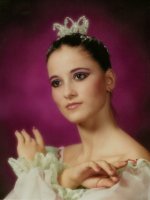
The best looking diffusion I got was with the Mamiya RB-67 and the Mamiya Sekor 150mm Soft Focus Lens. That lens had diffusion characteristics designed into it and you had 3 control disks you could install between the front element cell and the shutter. I often went for the max effect you got with the #3 disk and my clients loved the effect. The closest I've come to that look is with the Fotodiox diffusion filter which fortunately is very inexpensive.

The attached image is a sample of what I used to achieve with the RB-67 and 150mm Soft Focus lens.

050_Celia_600x800.jpg

I have the Tiffen Black Pro-Mist in 1/8, 1/4, 1/2 and 1 strengths, I would use the first two for very subtle effect but to get a soft diffuse look similar to my sample I would use the cheap Fotodiox Diffusion filter.
 
Last edited:
Yeah, what is the goal for your mist filter? Subtle effect? Take the edge off a sharp lens? Skin softener? Or a "look"?

I guess I would say (very generally and imprecisely):

1/8 = take the edge off a sharp lens
1/4 = subtle effect
1/2 = skin softener
1 = "look"

Of course, it matters what focal length you're using. People often use different strength filters on different focal lengths.

I think that generally if I could only have one strength of a filter, it would probably be 1/4. It's enough to have an effect and anything stronger than that might be too much sometimes. Unless you're going for a "look"
 
I had a tiffen pro mist filter I used on the EVA1 once and it also seemed really heavy, which bummed me out as I’d seen examples where it looks fantastic.

I’m now reminded I never followed up on my tests here, but I’m wondering if black pro mist (I think that’s what it was) was the wrong filter to get? I got a 1/8 and 1/4 version in 82mm.
 
Not the cheapest solution, but depending on the shoot and intended look, I like using Schneider Hollywood Black Magic filters.
1/8 for wide shots, 1/4 for medium and tighter shots, and 1/2 for real tights with older talent.
It is basically a combination of a 1/8 Black Frost with degrees of HD Classic Soft.


Whatever you decide on I wouldn't use the same strength on your wide shots as you do on your closeups.
But hey, that's just me.
 
Last edited:
I had a tiffen pro mist filter I used on the EVA1 once and it also seemed really heavy, which bummed me out as I’d seen examples where it looks fantastic.

I’m now reminded I never followed up on my tests here, but I’m wondering if black pro mist (I think that’s what it was) was the wrong filter to get? I got a 1/8 and 1/4 version in 82mm.

Black pro-mist is the classic choice but I think it feels a bit heavy, like you just had a big lunch. Perfect for awkward family dinner scenes maybe.

Black frost is a little classier - I'd look into that one.

I like black satin but mostly because it's so subtle that I can always get away with it. Not as classy as black frost I'd say.

Then theres glimmerglass and a host of popular modern diffusion. I haven't used glimmerglass but there are sample tests on youtube
 
I have just been experimenting with DIY mist filters using a UV filter and black gloss paint and the results are actually comparable. I am not sure whether to invest on an expensive mist filter to lower the perceived quality of an expensive lens when a DIY seems to be producing similar effects at a much lower cost. I don't understand these creative trends some times, so much money is placed on a sharp lens and so much money is placed on filters to negate these lens qualities, hmm :/
 
So would pro mist create a heavier effect than black pro mist?

I’m looking at my purchase history and looks like I mis-purchased. I got a “1/8 Pro Mist” and “1/4 Black Pro Mist”, so my weaker 1/8 wasn’t black unfortunately...
 
So would pro mist create a heavier effect than black pro mist?

I’m looking at my purchase history and looks like I mis-purchased. I got a “1/8 Pro Mist” and “1/4 Black Pro Mist”, so my weaker 1/8 wasn’t black unfortunately...

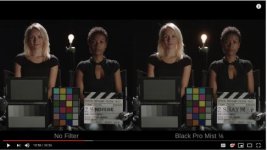
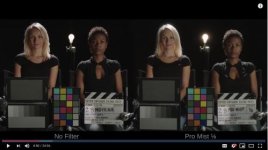
this is the video to watch: https://www.youtube.com/watch?v=rJacZa6QpJ8

lots more halation from the regular pro-mist and a general shadow lift:

Screen Shot 2020-10-21 at 5.22.40 AM.jpg

Screen Shot 2020-10-21 at 5.22.14 AM.jpg

here's a black pro-mist vs black satin:

https://www.youtube.com/watch?v=yczVPcUQJVE
 
Last edited:
It seems like for a while, like in the 80s, there were two filters: Pro-Mist and Black Pro-Mist. Sometimes Pro-Mist was called White Pro-Mist, to make it clear which one you were talking about.

And 9 times out of 10, people were using Black Pro-Mist. Some people liked the look of the Black Pro-Mist 1/8 so much that they just left it on their Betacams. They thought it made it look a bit more like film, or took the edge off, or whatever.

At some point, probably after the rise of digital cameras, the choices exploded. I count 24 different kinds of filters just by Tiffen, just in the category of Diffusion: https://tiffen.com/collections/diffusion . Besides Pro-Mist and Black Pro-Mist, you now have Glimmerglass, Pearlescent, Black Satin, and many others. Each kind has different strengths. So we're talking over a hundred choices. And that's just by one vendor, Tiffen.

I also remember reading that the strengths aren't consistent across kinds. For example, Pro-Mist is useful only at 1/8 or 1/4. At 1 or 2, it looks like a special effect, like a dream sequence from the 80s. However, a strength of 1 or 2 in one of the newer kinds, like Glimmerglass, is not so overwhelming. There is no standard. It's just a number that is relative, and only within that single kind of filter.

On top of that, I have read that many people recommend a different strength for wide angle and telephoto. The focal length affects the strength (although there is contradictory advice on the Internet about which way it affects it). Of course it also is affected by lighting: by the amount, angle, and character thereof.

---

You might start at that website by Tiffen. It describes each filter and has standardized tests of each filter, at each strength level.

Then, after you have narrowed it down, you might try to find some random videos shot with the ones you like, just to double-check your work. That Tiffen video is very tightly controlled.
 
Last edited:
Drat, lol. Well, I've REALLY been wanting to try this and of course I would order a BPM a little strong at 1/4, and a regular PM at 1/8 so it's still a bit strong. Looks like I'll have to get a BPM 1/8.

One reason I am really hoping the next round of DSLRs (GH6, S1H mark ii) get internal variable ND is filter stacking. Without a matte box, trying to shoot a video outdoors run and gunning around India with a 1/8 BPM and VND isn't ideal, especially if you're using primes that you want to swap back and forth on. I guess I could buy several BPM to affix to the lens, then mount a xume VND on the front but I'm assuming the filter stack is suboptimal, and that's an expensive proposition.

I remember Tiffen used to make a suite called DFX that emulated all filters and supposedly did a pretty good job, but ceased development. Is there a better, GPU accelerated version of this available today? Red Giant look suite does emulate some diffusion and it's been a while since I played with it, but it seemed a little artificial and intense from my last (perhaps properly misused) memory?
 
I had a weird experience with the Tiffen Pearlesescent filter. It should have been good at 1/2nd or 1/4th, given the example videos on Tiffen's Vimeo account, but my 1/8th filter was super heavy. made my use of it super annoying, and now I rarely use that f'ing $400+ filter. I mean, A cameras cost ~$2K now.

That's very interesting because my first circular diff filter was a 1/4 black promist, and it was WAY over the top, pretty much unusable and nothing like what I was seeing when folks posted examples online. I bought an 1/8 promist and it was perfectly fine and very subtle. I now want to get a new copy of the 1/4 to see what was going on with my first copy. I've since gotten rid of the first copy, but I'm pretty sure that I would be perfectly fine using 1/4 in some situations and that my copy was just messed up.

I hadn't heard of that type of QC issue with diff filters before, but seeing your post makes me wonder if it's more of a thing. Like, was it just messed up, or was it mis-labeled at the factory and was really a full strength #1 or #2?
 
this is the video to watch: https://www.youtube.com/watch?v=rJacZa6QpJ8

lots more halation from the regular pro-mist and a general shadow lift:

View attachment 140953

View attachment 140954

here's a black pro-mist vs black satin:

https://www.youtube.com/watch?v=yczVPcUQJVE

I'm guessing it can be corrected, but I never liked how almost ALL of the Tiffen examples in these series of tests show the skin skewing green compared to the no-filter tests. I like the filter effects in terms of softness and contrast, halation, etc, but the skin tones take a noticeable hit in color.
 
Without a matte box, trying to shoot a video outdoors run and gunning around India with a 1/8 BPM and VND isn't ideal, especially if you're using primes that you want to swap back and forth on.

I use zooms via speedbooster when using GH series cameras for run n gun work.
I couldn't fathom changing out primes like that. And with the speed booster an f2.8 zoom becomes an f2.0.
 
I'm guessing it can be corrected, but I never liked how almost ALL of the Tiffen examples in these series of tests show the skin skewing green compared to the no-filter tests. I like the filter effects in terms of softness and contrast, halation, etc, but the skin tones take a noticeable hit in color.

I know Tiffen has been known to use soda lime (window) glass in some of their filters, which do skew green. Some of their filters (most nowadays?) are water white glass, but I don't know if they are using actual optical grade glass. Other manufacturers, like Schneider, specifically state they use optical glass from Schott.

I have also read that the lapping and polishing of Tiffen filters seem to be of a lower tolerance (less flat) than others, like Schneider. You would see the difference from that more on longer focal length lenses.

I tend to have a little less faith in Tiffen filters for those reasons, but they do make filters that have properties you can't find from any one else.
 
Back
Top