One major advantage of F55 is ACES. But this got me really confused: is this ACES supported only by F65/F55, or are there any other camera could do this? What's the advantage of ACES? Does it mean that you can shoot wider color space using F65/F55? (Especially compared to other cameras like Alexa, which support DCI-P3 most) Or it just provide you more accurate pictures? How to enable ACES in F55? How to use it in the workflow?

Navigation
Install the app
How to install the app on iOS
Follow along with the video below to see how to install our site as a web app on your home screen.
Note: This feature may not be available in some browsers.
More options
You are using an out of date browser. It may not display this or other websites correctly.
You should upgrade or use an alternative browser.
You should upgrade or use an alternative browser.
F55: What's the difference between ACES and traditional DCI-P3/REC.709?
- Thread starter penryn
- Start date

starcentral
Veteran
The concept of ACES was invented in 2004 by the Academy of Motion Picture Arts & Sciences and they say they have been undergoing industry-wide production trials with the major Hollywood studios.
ACES is the concept that cameras work in a common color space, or conform to a "manufacturer neutral" color space. ACES is a color space that is the absolute widest possible that most cameras or even film can not fill. That's how big and largely defined ACES color space is - its even larger than the visible spectrum! (that's right - colors you can't even see with your eye!)
By working in a "standard" or "common" color space (in this case ACES) it means a more common interchange could exist so that you could intercut, mix and match, or composite from various acquisition devices, etc.. without any color descrepencies in the workflow process. ie. blue becomes the color same color "blue" no matter what camera it came from or where it is in the workflow process or who's working on it.
But will other manufacturers be reluctant to adapt or conform to ACES? Because very unique image characteristics are determined by a camera's specific sensor or even the dyes used in the CFA (color filter array) - many manufacturers develop their own "color science" (or special tricks) to perfect the overall image and do away with noise or other imperfections when certain colors or hues are seen by the camera. It is why all cameras are known for their "look" as people call it. ACES in practical terms strips away some of that "secret sauce" because the camera must conform to the ACES standard color space and not its own. So if a camera just can't handle a sepecific shade of violet/purple and breaks apart into noise then too bad, in ACES it will show through. For that reason I can see why ACES might be slow to adapt. Imagine what RED would think of with someone elses color science applied to it?
So what Sony is saying with the F55 and F65 is that if you shoot in the raw format you can conform the bayer data directly into the ACES standard (color space).
From a technical perspective I don't see how this will benefit the image today or make it better because I think of ACES as one giant LUT that just conforms the image from the F55/F65 to meet a certain predefined specification. It "may" or "may not" happen to look good based on what kind of sensor or image issues come out of removing any of the "special sauce" the camera manufacturer wanted there in the first place.
Recommended reading on ACES:
http://www.fxguide.com/featured/the-art-of-digital-color/
http://www.oscars.org/science-technology/council/projects/aces.html

Nate Weaver
Veteran
I forgot to directly answer your question:
In Resolve, which you can check out for free, there are Input Device Transforms for:
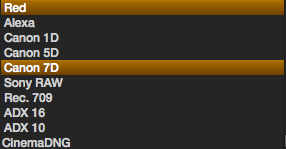
By the way, it's said that these "input filters" are constructed by carefully testing and measuring the cameras sensors, so the image can be correctly processed. The idea is to "reconstruct" the scene that was in front of the lens as accurately as possible. By doing that they can put all cameras on equal footing so they can mixed and matched.
You may already know and were tiptoeing around it, but Red has gone on record as "don't use ACES". I've tried it with the last Epic job I did and it was noisier down low than using their own Redgamma/Redcolor. So much so it wasn't viable.
Red says ACES needs work. In some ways, it still does, the RRT continues to undergo revisions. But I'm not convinced that Epic looks bad in ACES because the Academy has screwed up the Epic IDT. I suspect it's because Red tunes out sensor shortcomings with Redcolor and Redgamma.
It is a giant LUT for people like you and me, but for the folks it's intended for, it's a framework for asset interchange in heavy iron post.
Movies in post have to do a lot of sending shots back and forth from editorial and FX, and there's a few ways it's been done in the past. Cineon Log (log encoded 10 or 12 bit) vs. OpenEXR (linear, floating bit I think), etc etc. Then there's taking the product and making sure it translates correctly from Rec709 to web to film prints to whatever else. That's a goal of ACES too, to take care of all that.
I'm all for standards as long as they're open, so doesn't hurt me. It's all not really for guys at their desktops like me anyway. It's just a couple checkboxes that got me where I wanted to go in Resolve (but you knew that).
is this ACES supported only by F65/F55, or are there any other camera could do this?
In Resolve, which you can check out for free, there are Input Device Transforms for:
By the way, it's said that these "input filters" are constructed by carefully testing and measuring the cameras sensors, so the image can be correctly processed. The idea is to "reconstruct" the scene that was in front of the lens as accurately as possible. By doing that they can put all cameras on equal footing so they can mixed and matched.
Imagine what RED would think of with someone elses color science applied to it?
You may already know and were tiptoeing around it, but Red has gone on record as "don't use ACES". I've tried it with the last Epic job I did and it was noisier down low than using their own Redgamma/Redcolor. So much so it wasn't viable.
Red says ACES needs work. In some ways, it still does, the RRT continues to undergo revisions. But I'm not convinced that Epic looks bad in ACES because the Academy has screwed up the Epic IDT. I suspect it's because Red tunes out sensor shortcomings with Redcolor and Redgamma.
From a technical perspective I don't see how this will benefit the image today or make it better because I think of ACES as one giant LUT that just conforms the image from the F55/F65 to meet a certain predefined specification.
It is a giant LUT for people like you and me, but for the folks it's intended for, it's a framework for asset interchange in heavy iron post.
Movies in post have to do a lot of sending shots back and forth from editorial and FX, and there's a few ways it's been done in the past. Cineon Log (log encoded 10 or 12 bit) vs. OpenEXR (linear, floating bit I think), etc etc. Then there's taking the product and making sure it translates correctly from Rec709 to web to film prints to whatever else. That's a goal of ACES too, to take care of all that.
I'm all for standards as long as they're open, so doesn't hurt me. It's all not really for guys at their desktops like me anyway. It's just a couple checkboxes that got me where I wanted to go in Resolve
(but you knew that).
Last edited:
starcentral
Veteran
I had no idea about RED and ACES but I can see why they or anyone would oppose it. It's crazy for us to understand what goes on with an image after its debayered and how much manipulation is needed to make it like look pretty... to "undo" that and work in a space that a camera may not have been designed for is like wearing only your underwear to work without any clothes. :huh:
For you and me there should be no real benefit as I see it.
For you and me there should be no real benefit as I see it.

Grug
Veteran
I had no idea about RED and ACES but I can see why they or anyone would oppose it. It's crazy for us to understand what goes on with an image after its debayered and how much manipulation is needed to make it like look pretty... to "undo" that and work in a space that a camera may not have been designed for is like wearing only your underwear to work without any clothes. :huh:
For you and me there should be no real benefit as I see it.
Red aren't 'opposed' to it, the standard just doesn't work acceptably with redcode at this stage. They say they're working on it.
starcentral
Veteran
reading about it more, interestingly enough in RedCineX you can export into ACES/OpenEXR already.