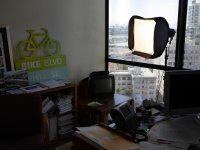
What's a good lighting kit? (that won't break the bank and is beginner friendly)

You really can NOT beat a few Lowel lights with barndoors (2x 1k, 2x 500w, 2x 250w) traveling in medium rolling Arri cases. Spend 1 hour learning how electricity works so you won't trip the breaker and you will have a kit that you will use in almost any situation.

Then as your experience evolves you can start adding things such as LEDs or fluorescent lights.

I wouldn't suggest an open face light for a beginner at lighting. Yes they are cheap to obtain but require way more attention and care to shape and modify. Before anyone gets on my case I'm not saying its impossible or can't be done but I always end up seeing new people at lighting just aim open face lights directly at subjects because at the time it just seems logical to do. You will need a way to diffuse and shape this uncontrollable light and then further consider how to control your spill. A flo bank with barn doors and grid does this all in one and I wish when I first started lighting someone explained this to me. Lowels were my first lights I ever bought over 15 years ago and they still look brand new because I find them utterly useless and moved on to far better lights.

Stick with fresnel or flo as your first lights is my suggestion.


Has anyone handled the Alzo fluorescents AND the Flolight fluorescents? Pricing is basically equal between the two, so I'm just after the better option.

I've heard incredibly positive reviews of the build quality of the Flolights, but the Alzos look pretty comparable.

If anyone could shed some light on how they compare it'd be a huge help.

Flolight is a higher end brand with higher end prices, I have never used their flos' - only Kinos and Alzos. Hopefully someone else can chime in.
 
I wouldn't suggest an open face light for a beginner at lighting. Yes they are cheap to obtain but require way more attention and care to shape and modify. Before anyone gets on my case I'm not saying its impossible or can't be done but I always end up seeing new people at lighting just aim open face lights directly at subjects because at the time it just seems logical to do. You will need a way to diffuse and shape this uncontrollable light and then further consider how to control your spill. A flo bank with barn doors and grid does this all in one and I wish when I first started lighting someone explained this to me. Lowels were my first lights I ever bought over 15 years ago and they still look brand new because I find them utterly useless and moved on to far better lights.

Dealing with electricity, diffusion and shaping the light is something one learns in 2h when i give lighting classes at universities. It really only takes that long to comprehend. My answer still stands. I assume i'm talking to people who are serious about the craft and want to spend a tiny bit of time to educate themselves about it. If 2h is too much for them then you are right my answer is not for them.

(9 years in the business and I still bring Lowels - along with other instruments - to almost any shoot)
 
Just thought I'd let you know about a new LED option, the Fiilex P360s. My friend is the co-designer of these lights and I've shot with them a few times. A 3-light kit (with stands) fits in the equivalent of a Pelican 1510 rolling case - they are amazingly portable and efficient. The output is a bit low (300W hotlight equivalent I think), however as cameras keep getting more sensitive this isn't too much of an issue, especially if size and weight are important factors. On the plus side, they are high-cri and color tunable - very nice to be able to turn a knob to match the ambient light or add a cool or warm splash.

Here's their website:
http://www.fiilex.com/products/P360.php

Interview on Oliviatech:
http://oliviatech.com/the-fiilex-led-lights-for-photo-and-video

Available at Samys (I don't think it mentions it, but I believe it comes with a great rolling case from Seahorse):
http://www.samys.com/p/All-Products/FLXK301/P360-LED-Light-Kit-3-P360s/119324.html

Here's one in use to add some warm fill to an interview:
P1010048_small.jpg
stillframe.jpg

Hope that's helpful!
 
I would try the YN-300 a led lamp that cost 70$. Add a NP-F970 battery for 30$ and you can get 4 of them for 400$
There is a new model now , the YN-300 II that has different temp led mixed.
check on ebay for YN-300
 
I would try the YN-300 a led lamp that cost 70$. Add a NP-F970 battery for 30$ and you can get 4 of them for 400$
There is a new model now , the YN-300 II that has different temp led mixed.
check on ebay for YN-300

I have a whole bunch of the YN-300's and love 'em. What is the difference between the YN-300 and the YN-300 II?

Edit: from what I read on the ebay descriptions, basically the YN-300 II are the bi-color versions of the YN-300, with all the attendant advantages/disadvantages. Personally, I'm not that jazzed by any bi-color LED lights which achieve their color by dedicating half their LEDs to one temperature (3200 + 5600), because that just cuts down on the brightness by half. This is what happens here 150 LEDs are tungsten, and 150 are daylight. Meh.

Of course there may be other differences, and since I only have the YN-300, if anyone here has both, perhaps they can chime in.
 
Last edited:
What are basic interiors for you? As I would likely choose different lighting instruments depending on the job. Are you shooting sit-down interviews, kitchen cooking shots, design & architectural, narrative films?

David,
could you please explain what lighting you would suggest for the different scenarios that you've listed.
 
I know this may sound vague, but it really depends. That's why I have tried to put together what I consider a well rounded kit consisting of both Tungsten and daylight balanced, as well as hard and soft sources. The overall feel you are trying to convey on a particular scene will many times be key in determining which lighting instruments you select, as well as the environment in which you are shooting. Having a good selection of light modifiers and stands is also a must have in my book. A single light can be made to convey a number of different feels depending on how it's used.
 
Back
Top