What makes film look like film?

View attachment 86835

View attachment 86834

Here's a couple of examples of, just by grading differently, have something look like video or towards film. These images from a corporate video I shoot two weeks ago. The first one spot on and correct and the second one tweaked to make something that wasn't there in the first place. There's lots of things between these that looks different. Is the second one true to life? No, there's a distinct look added to it. It is not reallity but an artistic representation of reallity. Video vs film.
 
The problem there is, for most Hollywood productions a digital intermediate is used, and as such is digitized to some resolution, thus 'losing' all of the subpixel (which I think for 2K and above, is voodoo...) 'silver halide' variation.

The significant difference with scanned film DI is discrete frame scan, no compression, high bit depth, wide gamut DCI-P3 RGB color space. Typically at least 12 bit gamma encoded. Very different from encoded REC709 video. Grayscale resolution exceeds the resolution of human vision. Grading should be done in a theater projection environment with a wide gamut 3-chip DLP or LCOS digital cinema projector. There are not many monitors that can actually display the full gamut.
 
Last edited:
The significant difference with scanned film DI is discrete frame scan, no compression, high bit depth, wide gamut DCI-P3 RGB color space. Typically at least 12 bit gamma encoded. Very different from encoded REC709 video. Grayscale resolution exceeds the resolution of human vision. Grading should be done in a theater projection environment with a wide gamut 3-chip DLP or LCOS digital cinema projector. There are not many monitors that can actually display the full gamut.

When discussing 'hollywood productions', why would one think that one is discussing using DSLRs... that would be about the same as discussing Hollywood productions and using 16mm or 8mm Film film for the basis. I believe the Alexa series can compete with 'deep bit depth', 'raw', and as such can be 'graded' to a number color spaces.

For me, most DSLRs look pretty much like Film film... Slide Film film... but film none the less... with obvious 'exceptions' for certain rasterization artifacts that may be more apparent or less depending.

I don't fetishize Film film it should be noted, since for the most part, I have only viewed Film film prints in theaters where for the most part only modest of care has been made for the projection system and the print may have passed through many machines by the time I saw it.
 
To me Film simply looks more "beautiful". It's like comparing a Painting with a Photo. The photo may be sharper and have a lot more detail, but the painting simply looks more artistic, colors are more vivid and realistic, and detail and texture are more pleasing to the eye.

219qtyo.jpg
 
Last edited:
When discussing 'hollywood productions', why would one think that one is discussing using DSLRs... that would be about the same as discussing Hollywood productions and using 16mm or 8mm Film film for the basis. I believe the Alexa series can compete with 'deep bit depth', 'raw', and as such can be 'graded' to a number color spaces.

For me, most DSLRs look pretty much like Film film... Slide Film film... but film none the less... with obvious 'exceptions' for certain rasterization artifacts that may be more apparent or less depending.

I don't fetishize Film film it should be noted, since for the most part, I have only viewed Film film prints in theaters where for the most part only modest of care has been made for the projection system and the print may have passed through many machines by the time I saw it.

I think digital projection, certainly the current gen 4k digital cinema projectors, far exceed the quality of film print projection in every sense. But a film original digitally finished and projected still stands out from anything shot on a digital camera so far unless the two are mixed and intentionally graded to look alike, meaning reducing the film gamuts. DSLR's, at least as far as motion capture is concerned, don't even make it to high quality video standards to me, much less film. Raw stills are a different matter, as is the raw hack of the Canons by ML. The video is definitely hampered by high compression and mediocre color encoding. Not that you would ever see much difference in net streaming applications.
 
( Painting on the left by artist Jill greenberg )

Not sure what you mean by calling Jill Greenberg's studio photo of a crying child a "painting". ( lots of manipulation with both lighting and post, which I am sure Jill Greenberg could do this with almost any medium, as it's her personal "look" )
 
film is film
digital (video) is digital

keep both competitive and evolving

Definitely. To me it isn't about making digital look like film, it doesn't. I am more interested in exploring the aesthetic possibilities of the digital medium.

But there is a definite distinction to me between conventionally encoded and recorded video and working with raw digital negative originals. They are very different media in an artistic sense with very different aesthetic possibilities.
 
Thanks for the clarification TheDingo. In my defence, Jill has a backround in painting, sculpting and visual arts as well as Photoshop, so it's more of an artist than a photographer.
I should have posted one of Ruben Belloso's artworks to illustrate my point.

33avr88.jpg


2zi5tav.jpg


This is the look 35mm film reminds me of.
 
Last edited:
This is the look 35mm film reminds me of.

Digital is so flexible that I imagine you could get any look you want out of it with the right combination of camera work and processing.

Personally I think the big "turn-off" with digital is that people aren't spending enough time to master their camera work and post-processing to get the look they want.

Film is a lot easier as the range of analog manipulation is pretty small compared to the "ocean" of digital options available.
 
In other words... you're pretty much stuck with what you got with Film film...

I don't think that is the way to look at it since film negative has broader color gamut and DR so far than anything coming out of an encoded video camera at any price. Raw digital cinema cameras like the Alexa and Red Dragon are pretty much getting there though. Film is still the top of the food chain for original acquisition quality, even if it is digitally processed from the original negative scan on.
 
I don't think that is the way to look at it since film negative has broader color gamut and DR so far than anything coming out of an encoded video camera at any price. Raw digital cinema cameras like the Alexa and Red Dragon are pretty much getting there though. Film is still the top of the food chain for original acquisition quality, even if it is digitally processed from the original negative scan on.

It is not that simple really.
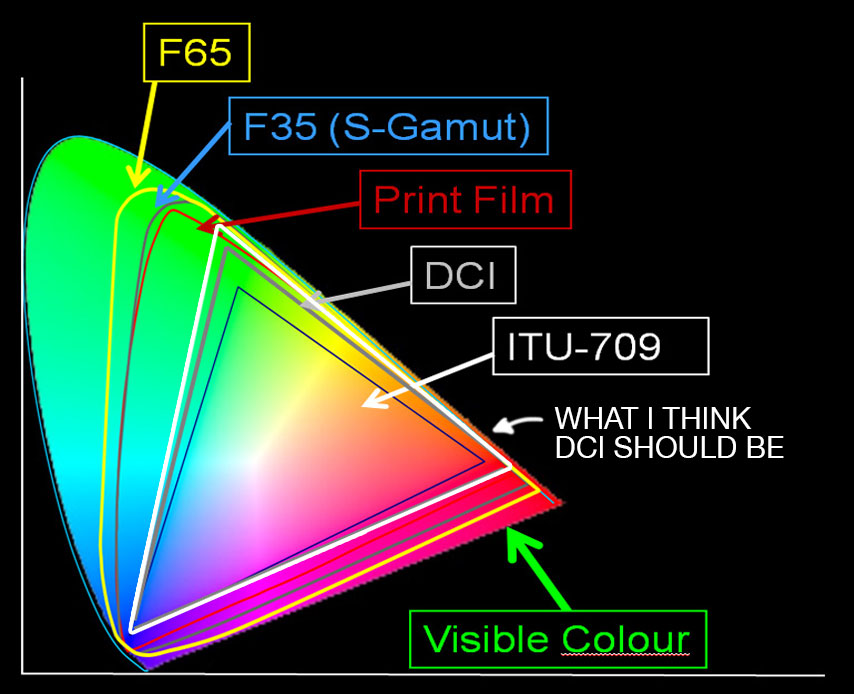
Film has broader gamut at some brightness levels (darks). At others it is the other way around. And very wide gamut cameras like F65/55 maybe already exceed film's gamut.
Also, once you get to digital projection or display you lose a lot of this gamut, because no digital projector or display can show deep yellows or cyans the way they are projected through print film.
 
i work in advertising and film saves a ton on post work…which is a good thing!!!

something I want to mention which is really important if you want to work in high end advertising or features…SKIN TONES…MAKING THE ACTOR OR MODEL LOOK GREAT AND THAT'S FILM!!!
 
i work in advertising and film saves a ton on post work…which is a good thing!!!

something I want to mention which is really important if you want to work in high end advertising or features…SKIN TONES…MAKING THE ACTOR OR MODEL LOOK GREAT AND THAT'S FILM!!!

Thats odd, I work in advertising too, and we pretty much stopped using film a few years back due to the extra time and expense needed with film.

I'll also say that I have seen my fair share of sickly skin tones shot with film.
 
It is not that simple really.
Film has broader gamut at some brightness levels (darks). At others it is the other way around. And very wide gamut cameras like F65/55 maybe already exceed film's gamut.
Also, once you get to digital projection or display you lose a lot of this gamut, because no digital projector or display can show deep yellows or cyans the way they are projected through print film.

True, I thought this color gamut comparison chart was interesting.

brucecolorprimaries_compared.jpg


And the new REC2020 color gamut

gamut_rec_2020_dci-.jpg
 
Perhaps instead of trying to make video look like film, we need to first try to make film look like video. Once we take that as far as we can, compare the results with video that was meant to look like film and see how they differ. The difference is what makes film look like film and video look like video.

...I'm feeling lazy though so I'll just stick with video
 
Back
Top