What light meter are you using these days?

I have a significant number of gripes about the stupidity of the user interface on the Sekonic L-758 Cine I use. However they're not quite as frustrating as carrying round separate incident and spot meters, so I put up with it.

It's not perfect, but it is a workhorse. If you don't need a spot meter, there are certainly smaller, simpler options available.

I also have a L-758 Cine and find its GUI very straightforward. In these multiple camera option days I find it very handy since I can store multiple camera profiles and immediately see where every camera clips white and crushes blacks.
 
I bought my Spectra Pro back in the late '60s and have used it ever since. Had the movement replaced by the old Spectra shop in the late '70s. It's still accurate at 16 footcandles and up!
Selenium cell, no batteries=classic goodness.
Ken
 
The Spectra Cine 4 is most likely my last light meter, since it is both a workhorse and I pull it out so infrequently these days that it should last as long as I do...!
 
The Spectra Cine 4 is most likely my last light meter, since it is both a workhorse and I pull it out so infrequently these days that it should last as long as I do...!
I'm in the same boat. I also have a Gossen foot-candle probe meter which is a ridiculously accurate but impractical meter. .05fc measurements, anyone?
 
I recently purchased a Sekonic L-758 Cine and so far am very happy with it. From my fairly minimal research it seemed to be the best choice on the market today for filmmaking. A little pricey but seems worth it.
 
I'm in the same boat. I also have a Gossen foot-candle probe meter which is a ridiculously accurate but impractical meter. .05fc measurements, anyone?

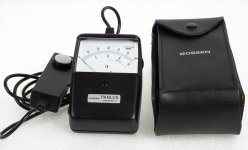
Some people asked me about my crazy Gossen meter, so I dug up a photo. It's called a Gossen Panlux Electronic 2, and was really designed for scientific and engineering work as opposed on on set production. Can you imagine walking around with this crazy probe thingy? I used to call it my Tricorder. But it's INSANELY accurate, with a wheel on the side that allows you to set the range of foot-candles being read. Set it all the way down to just TWO FOOT-CANDLES and each little tick mark on the lower scale represents .05fc. That's nuts.
 

Attachments

  • DSC_2888_panlux2_100.jpg
    DSC_2888_panlux2_100.jpg
    81.7 KB · Views: 0
Some people asked me about my crazy Gossen meter, so I dug up a photo. It's called a Gossen Panlux Electronic 2, and was really designed for scientific and engineering work as opposed on on set production. Can you imagine walking around with this crazy probe thingy? I used to call it my Tricorder. But it's INSANELY accurate, with a wheel on the side that allows you to set the range of foot-candles being read. Set it all the way down to just TWO FOOT-CANDLES and each little tick mark on the lower scale represents .05fc. That's nuts.


I love this. Not only can you use this to measure the light, you can use it as a prop for a ghostbusters type movie. ��
 
My daughter incorporated it into a Halloween costume one year.

Amazing.

On a more serious note. I am looking for a light meter. From what I gather from this thread the cheaper sekonic seems like a safe bet.

I'm looking to better understand and be able to repeat ratios. Are there any meters that help you do the math for figuring out lighting ratios?
 
Amazing.

On a more serious note. I am looking for a light meter. From what I gather from this thread the cheaper sekonic seems like a safe bet.

I'm looking to better understand and be able to repeat ratios. Are there any meters that help you do the math for figuring out lighting ratios?

If you get the Sekonic L-308DC you can read out in Footcandles or lux, and then get the ratios of the incident reading. My Minolta spot had ratio capability... it's no longer made. I'd imagine the fancier Sekonics would have something like a 'memory' and give +/- ratios in stops or EV values.

I think the L-308DC is about 200-300.
 
I think the L-308DC is about 200-300.
A lot of good comments about this model. I don't own one at the moment and I was looking for the Sekonic L-478 for a little while, which runs for about 350$ CND in local photo store.
I never used one before, and I'm still asking myself if I should invest in one or not. I'd also like to invest (and cry!) once rather than trying to sell a cheaper model to buy a better one later. What would be your recommendations?
 
A lot of good comments about this model. I don't own one at the moment and I was looking for the Sekonic L-478 for a little while, which runs for about 350$ CND in local photo store.
I never used one before, and I'm still asking myself if I should invest in one or not. I'd also like to invest (and cry!) once rather than trying to sell a cheaper model to buy a better one later. What would be your recommendations?


I would recommend the L-308DC. It has the ability to do incident readings, and yield exposure in 'f-stops' and has cine frame rates and degrees for shutter spreeds. It also has a footcandle read out which is useful for gauging how much light you 'really have' and knowing when your camera's image starts to get 'crackly' with noise...

You would do well to look at the 'how to calibrate' tutorials on the web... to yield a 'persona' ISO value for your camera/lens combo...

Once you do that when you are scouting a location you can take meter readings quickly and along with your stills, can get a very good idea on how you can light or if you 'need' lights at all... that doesn't mean you don't use bounce, or shape existing light... just means you don't have to bring in a truck load of lights 'just in case'... well if you had a truck load of lights...
 
I also have a L-758 Cine and find its GUI very straightforward. In these multiple camera option days I find it very handy since I can store multiple camera profiles and immediately see where every camera clips white and crushes blacks.

Really? How? The number of combination button presses that require finger gymnastics is ridiculous. I only use the most basic features of the meter, because it's too complex to reset things back to their default modes if you try to get fancy with the feature set. I have to permanently carry the manual with me on my phone in order to feel safe with the damn thing.
 
Thanks! I'll have to check this out a bit more seriously then!

I've been reading user reviews on what I can afford until going cross-eyed. I was about to order the L 308DC until I stumbled across one fact about the Kenko KFM1100. I'd been trying to decide between the Sekonic L 308DC and the L 478D but a couple of comments on the fragility of the latter's LCD turned me off. I really liked the design but kept wishing the Minolta Autometer designs were still available. I kept remembering those a couple of my studio colleagues had and how the instructors at seminars we all attended would borrow theirs to demonstrate with. Seemed I was always on a "shoestring" budget so the flashmeters I had were Wein and Vivitar. For ambient work I had a Sekonic L 28c I bought on Okinawa in 1970 on the way home from a Vietnam combat tour (just found that 46 year old "relic" and it still works!).

Anyway a couple of reviews on the Kenko KFM1100 mentioned it was the old Minolta Autometer IV brought back to life, seems Kenko bought the Minolta meter line and is producing it again supposedly in a stronger case build.

Mine will be here in two days.

The L 398A is a modern version of the L 28c I got in Dec 1970 but with a much easier to read set of scales. I ordered the Kenko because my L 28c with it's tiny scales is pretty hard for me to read these days with "old" eyes but the fact mine is still working and accurate after all these years is a great testament to that design. Just doesn't do flash...

The one I have seems to be a direct copy by Sekonic of the Norwood Director that used to be found on all Hollywood sets in the 1950's and 1960's.

But the L 308DC should be a very good and reliable meter. The only complaints I saw on it were it seemed very light and potentially fragile but I take those comments with more than a grain of salt. Find a good protective case for it, put a neck lanyard on it and you should be fine.
 
Last edited:
I bought my L398 in the mid 70's. Still quite accurate and the sensitivity matches my D16 pretty well. I also use for measuring ambient light levels and video projector light output in projection environments.
 
Still using my Minolta 4F which I purchased as a replacement for a missing meter some 20 plus years ago when I shot everything on film. As a matter of fact I used it today to spec a restaurant location for a future commercial shoot. It's always nice when you can check ambient light, color temp, and location power in advance. Something I don't always get the chance to do these days.
 
My 4F has been severely abused & AFAIK still works fine.

Used to get it checked annually at Quality Light Metric & it never required recalibrating. Was the defacto meter in the still photography market, & I've seen all sorts of nasty things happen to them, including dropped from height, & dunked in the ocean, but nothing that caused one to fail.

Sekonic stole Minolta's thunder when they offered an internal Pocket Wizard wireless flash trigger, but I'm confident my 4F would work fine if I replaced it's battery.

Imagine my Autometer III would fire up also but it's button batteries are too much a hassle to bother with.
 
I've been using the $30 APP called Cine Meter II by Adam Wilt.

Yeah...it's an iPhone app...but it frikkin' WORKS.

Only cons: Only runs on iPhone. You still need another meter to calibrate it - although I've used the meter within Magic Lantern to do this so far because it gives not only color temp but the green/magenta shift too, and it's been very good so far.

http://www.fdtimes.com/2014/06/29/adam-wilts-cine-meter-ii/

http://adamwilt.com/cinemeter/

http://nofilmschool.com/2014/07/cine-meter-ii-app-replace-light-meter
 
I have the SEKONIC L-508 Zoom Master that starcentral recommended here. I don't use it much because one of the things I used it for was to check that the incident measurements I get are exactly identical to those that my camera gives me in spot mode. So 95% of the time I just carry a grey card. But when I need it, it works great.
 
Back
Top