What Lenses Are These? (Vintage Lenses)

Hey guys! I came across these two vintage lenses that I have some questions about and I was hoping someone here could tell me more about them!

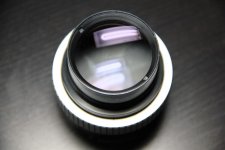
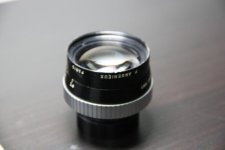
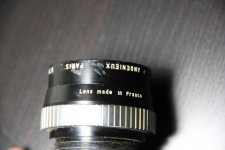
The first is a P. Angenieux lens. I am unfamiliar with the mount it has on it. The markings is has are: P. ANGENIEUX PARIS F. 75 1:1.8 TYPE 56 . I am really confused as to what mount it would attach to.

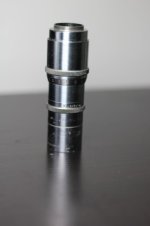
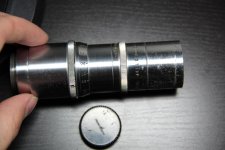
The second lens is a Bell and Howell 4 inch, F 4.5, C-mount lens. I'm more curious as to why it's branded as a "4 inch" lens right on the barrel. It has no indication of focal length, that is why I am confused.

If anyone has any clues on either of these lenses let me know! I have scoured the internet for answers but nothing comes up! Thanks!
IMG_2536.jpgIMG_2546.jpgIMG_2533.jpgIMG_2523.jpgIMG_2526.jpg
 
Hey there!

I hope you find this.

That looks like a 75mm F/1.8 Angenieux looks like a C-mount lens for a 16mm camera. All Angies are made in France.
The other is a Bell and Howell F/4.5 C-mount lens. 4-Inch is the focal length... it's a really old way of naming lenses. If I remember correctly, it's a 100mm lens... also for 16mm cameras, it appears.

25mm= 1 inch
50mm= 2 inch
75mm= 3 inch
100mm=4 inch
 
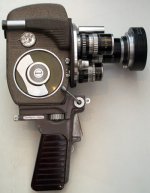
The 100mm(4 inch) B&H was used on the Filmo 16mm cameras. Either the 50ft. magazine loading ones or the more "pro" Filmo 70 series (a staple of film schools back in the day).

The cameras had screw in optical finders matched to the focal length of the lens. The 70 series had a 3 lens turret, making lens "swapping" a whole lot easier. The glass elements in most of these older lenses were uncoated, resulting in a greater amount of internal flare than modern lenses. Even if the interior is "cloudy" (dirt or fine scratches on the glass), you could still use it for some kind of vintage effect look.

Ken
 
Reminds me of a wollensak raptar I had. 3 inch, long enough to use on a gh1 without vignetting. I loved that thing. Bought it off someone here on dvxuser, patterson I think... I thought that was a wollensak till I read rpo's post.
 
I have been using old lenses back in the 1970s on 8mm and 16mm film cameras, now those lenses were NEW then, but from looking back there now, they are considered old. I guess an old, "legacy" type of lens will work great on a matching old, legacy camera that it was designed for. Not sure how the old lens will work on any new digital camera/camcorder, however. These days, the camera and the lens like to communicate bilaterally with each other -- even the Cooke electronic cinema lenses can do this now with various film cameras, and most of the digital cameras can communicate at least one-way with the lens if not bilaterally. For me, if I get a 2013 model camera/camcorder today, I certainly would want the lens I have on it to be made made specifically for it, or maybe a lens that is 1-2 years old out that will be guaranteed to fit it w/o any issues.

But I heard that using these old, "legacy" optics on modern cameras is really something rather popular today, that is amazing. Are these old lenses considered "better" optically and mechanically than the new variants, or is it that they are so much less pricey to obtain than the new optics? Thanks!

Best quality film lenses I used back then on 16mm gear were made in East Germany (GDR/DDR), Czechoslovakia, and the USSR/Soviet Union. Those you could get anywhere in Eastern Europe, but surprisingly you could also get West German Zeiss, Angenieux, even Bell & Howell lenses.
 
The 100mm(4 inch) B&H was used on the Filmo 16mm cameras. Either the 50ft. magazine loading ones or the more "pro" Filmo 70 series (a staple of film schools back in the day).

The cameras had screw in optical finders matched to the focal length of the lens. The 70 series had a 3 lens turret, making lens "swapping" a whole lot easier. The glass elements in most of these older lenses were uncoated, resulting in a greater amount of internal flare than modern lenses. Even if the interior is "cloudy" (dirt or fine scratches on the glass), you could still use it for some kind of vintage effect look.

Ken

Agree, that brings back the memories. I always had though that light weight C-mount lenses on film cameras selectable by the turret they were mounted onto were a great idea. I could swap between 2 or 3 lenses inside of 1 second, all you had to do is grab and turn the turret, and you new lens was lined-up front of the gate, pronto. It just clicked. No way to allow pollutants, smoke, filth, dust onto the film gate area. Why these turrets went away, and now you have to do open sensor surgery on cameras to switcharoo out the lenses manually, I haven't a clue. I guess it just made too much sense?
 
Agree, that brings back the memories. I always had though that light weight C-mount lenses on film cameras selectable by the turret they were mounted onto were a great idea. I could swap between 2 or 3 lenses inside of 1 second, all you had to do is grab and turn the turret, and you new lens was lined-up front of the gate, pronto. It just clicked. No way to allow pollutants, smoke, filth, dust onto the film gate area. Why these turrets went away, and now you have to do open sensor surgery on cameras to switcharoo out the lenses manually, I haven't a clue. I guess it just made too much sense?

Really wide range zoom lenses made turrets loaded with small primes largely obsolete for smaller 8mm and 16mm cameras, and also introduced a mechanical problem in that the heavy zoom put more strain on the turret mechanism and made it more difficult to insure precise back focus alignment between the lens and the film plane. A single lens mount firmly attached to the frame of the camera can almost always handle more weight (or actually torque) from a heavy lens and insures more precise tolerances. In the amateur market and many professional applications (e.g. newsgathering), the convenience of a zoom lens far outweighed the image quality compromises compared to using primes, so turrets started passing away starting in about the late 1960s.

Among newer designs, I think the Digital Bolex may be a prime candidate for a lens turret in some later variation.

The first TV camera I ever used was an old RCA B&W studio beast with a 3" image orthicon tube and a turret with four Cooke primes on it. The lenses were in fixed mounts and you focused by moving the IO tube itself fore and aft. Aside from not having the fine control over shot composition that you could get with a zoom lens, if you weren't extremely careful, the turret would make a tremendous "thunk" sound every time you racked from one lens to another, which could easily end up on the soundtrack of a studio show. (Man, this makes me sound old ...)

- Greg
 
Really wide range zoom lenses made turrets loaded with small primes largely obsolete for smaller 8mm and 16mm cameras, and also introduced a mechanical problem in that the heavy zoom put more strain on the turret mechanism and made it more difficult to insure precise back focus alignment between the lens and the film plane. A single lens mount firmly attached to the frame of the camera can almost always handle more weight (or actually torque) from a heavy lens and insures more precise tolerances. In the amateur market and many professional applications (e.g. newsgathering), the convenience of a zoom lens far outweighed the image quality compromises compared to using primes, so turrets started passing away starting in about the late 1960s.

Among newer designs, I think the Digital Bolex may be a prime candidate for a lens turret in some later variation.

The first TV camera I ever used was an old RCA B&W studio beast with a 3" image orthicon tube and a turret with four Cooke primes on it. The lenses were in fixed mounts and you focused by moving the IO tube itself fore and aft. Aside from not having the fine control over shot composition that you could get with a zoom lens, if you weren't extremely careful, the turret would make a tremendous "thunk" sound every time you racked from one lens to another, which could easily end up on the soundtrack of a studio show. (Man, this makes me sound old ...)- Greg

Sankyo Double 8mm Film Camera Lens Turret.jpg

Turrets really came in strong when the normal range zoom lenses came online, as you could have a zoom there to cover 80-90 percent of perspectives, but then you could also have a WA or UWA that could go wider then the zoom, and also have a telephoto there that could go further than the zoom lens could in its tele setting. So, for most of the range you were able to use the zoom, and then you had the two additional options for perspectives that the zoom could not deliver. In many ways, that was a more sensible system than putting on those large, heavy, distorting WA adapters and tele adapter lenses on the front element of your zoom optic. That is how we do these things with fixed zoom lens cameras, don't we?

Turrets on cameras did not start "passing away" in the 1960s, as camera makers were building film cameras using them well into the 1970s. I used a Czechoslovakian built Meopta 16mm film camera that weas mfr's in 1973, I believe, and came with a turret and C-mount primes. I agree with you though that a very heavy zoom lens on a turret would not have made much sense, but then again, these were not very heavy zooms (C-mount mostly) to start with, were they? And the other thing being, usually you could remove the entire turret assembly buy one or two set screws, and then twist in your C-mount lenses directly into the camera if you wanted to.

I think what eventually killed the turret mount design is that lenses became bayonet mountable. Remember, with a C-mount, you actually had to twist out and then twist in the new lens every single time, that took time and was a hustle, so the turret design sped up the lens changing process tremendously. But today..... you are either stuck with a turret-less interchangeable lens camera that requires you to swap in and out lenses all day.... or else you are using a fixed zoom lens camera/camcorder and then if the perspective is not sufficient, add a WA adapter/converter lens onto the front of it. Less of an issue with the tele converters these days, perhaps, as many of these newfangled jobs do pretty neat intelligent zooming and dynamic zooming, extending the reach of the camera w/o much of an image deterioration.

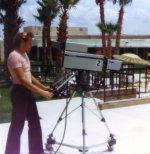
Here is a link to a TV studio B&W tube camera w. a 4-lens turret that was used by Hungarian Television in the late 1960s and early to mid 1960s. That sounds like something you had used as well, right? Then a photo of me manning a Hitachi cam in Las Vegas in the late 1970s.

http://www.youtube.com/watch?v=mIekULyhjII

Cameraman 1977 @ KVVU TV Channel 5 in Las Vegas.jpg

 
I think what killed turret cameras was the development of high quality motion picture zoom lenses for all formats of film.
 
I have been using old lenses back in the 1970s on 8mm and 16mm film cameras, now those lenses were NEW then, but from looking back there now, they are considered old. I guess an old, "legacy" type of lens will work great on a matching old, legacy camera that it was designed for. Not sure how the old lens will work on any new digital camera/camcorder, however. These days, the camera and the lens like to communicate bilaterally with each other -- even the Cooke electronic cinema lenses can do this now with various film cameras, and most of the digital cameras can communicate at least one-way with the lens if not bilaterally. For me, if I get a 2013 model camera/camcorder today, I certainly would want the lens I have on it to be made made specifically for it, or maybe a lens that is 1-2 years old out that will be guaranteed to fit it w/o any issues.

But I heard that using these old, "legacy" optics on modern cameras is really something rather popular today, that is amazing. Are these old lenses considered "better" optically and mechanically than the new variants, or is it that they are so much less pricey to obtain than the new optics? Thanks!

Best quality film lenses I used back then on 16mm gear were made in East Germany (GDR/DDR), Czechoslovakia, and the USSR/Soviet Union. Those you could get anywhere in Eastern Europe, but surprisingly you could also get West German Zeiss, Angenieux, even Bell & Howell lenses.

I shoot with a Sony FS-100 and I have put together a lens kit that is, with the exception of a new Sony 16mm f2.8 E-mount lens, made up of all vintage lenses. I have a prime set, 20mm, 24mm, 35mm, a couple of 50mm and a 100mm that are all vintage manual Nikor lenses. I also have two Vivitar Series 1 zoom lenses that I love. My go to lens is a Vivitar Series 1 (Kiron manufacture, I think) 28-105mm f2.8 - 3.5 zoom. I also have one of the "Classic" Vivitar Series 1 (Cosina manufacture, I think) 70 -210mm lens. I originally went with the vintage lenses for their cost. I just can't afford to put together a full set of high quality contemporary lenses. Since I have been working with the vintage lenses, I am actually glad that I had to go down that path. The vintage lenses are not "Better" than modern lenses of comparable quality in quantifiable technical specs. However, the lenses I have bought were top of the line photography lenses, in their day, and still make great images. I do think that compared to modern still lenses, the vintage Nikors and Vivitars that I have have much better build quality as they are all metal and all of them are built like the proverbial tanks. What I really like about them is something that I like to call "Image Mojo". These lenses on a modern large sensor HD camera make images that are more pleasing to me, with a little lowered contrast and a sharpness that is not razor sharp like modern lenses. I hate to use the term "Organic", which is bantered about a lot these days, but the vintage lenses that I have do have a quality about them that I like... Image Mojo.

Here is a screen grab of a shot I made with the Vivitar Series 1 28-105mm zoom on the FS-100, using G-Log A, at about 105mm, stop probably at F4 and the only color correction is in FCP 7 with 3 way color. I attribute most of this look to that great lens.

MSP 3.9.13 .jpg
 
I think what killed turret cameras was the development of high quality motion picture zoom lenses for all formats of film.

Zoom optics have been around since the 1930s, and high-grade zoom optics started with the 10x range Angenieux zooms in 1958 or thereabouts. Anyhow, I am not sure what a type of fast access lens mount has got to do with single focal and zoom lenses. You can put either of those types on a turret for fast access and change-out,. We have plenty of prime and zoom lenses today that survive and thrive -- but we have precious little turret or any other type of fast changing mounting options.

The quickly mountable bayonet mount lens is what probably killed the C-mount twist-in types of old school lenses and the revolving turrets they were usually parked and carried in, come to think of it.
 
Back
Top