It's been a long time since I've asked a question. I apologize if I've asked this same question before. What is a great, good, or decent microphone for picking up sounds from an instrument like a piano? If it's not too expensive, I like to purchase one. Any suggestion is much appreciated.

Navigation
Install the app
How to install the app on iOS
Follow along with the video below to see how to install our site as a web app on your home screen.
Note: This feature may not be available in some browsers.
More options
You are using an out of date browser. It may not display this or other websites correctly.
You should upgrade or use an alternative browser.
You should upgrade or use an alternative browser.
What is a good mic for recording piano?
- Thread starter Lor
- Start date
PZM mics are usually used for pianos. Applied Microphone Technologies makes a mics specifically for pianos: http://www.appliedmicrophone.com/portfolio/amt-m40/

Throwback
Well-known member
Omni mics are often used not least to cope with the low bottom end on a piano: you probably are not after 'one' but a pair. That's what I always use. The type of music and location will have a huge influence on how you approach such recording: this SOS article and all the sound samples provide an excellent introduction to recording the piano http://www.soundonsound.com/techniques/piano-recording, and the NT55 mics (esp with the omni caps) they use for the tests fare pretty well. Line Audio CM3 (wide cardioid) or OM1 (omni) mics are well (very often better) thought of and cheaper alternatives.
Cheers,
Roland
Cheers,
Roland
Last edited:

Bruce Watson
Veteran
It's been a long time since I've asked a question. I apologize if I've asked this same question before. What is a great, good, or decent microphone for picking up sounds from an instrument like a piano? If it's not too expensive, I like to purchase one. Any suggestion is much appreciated.
First, you don't want one, you want two. Recording piano in mono is, well, many would consider that a sin.
Second, piano is about the most difficult single instrument to record well. How you record it really depends on the room it's in, the piano itself, the person playing the piano, and the music they are playing. For example, classical piano (Bach, Beethoven, Mozart, etc.) typically sounds best in a big hall with plenty of space around. If you're in a good hall with nice sounding reverb, many people will point you to a pair of omnis in AB configuration, spaced anywhere from 20-40cm. People will put these typically at the curve of the piano high enough up so that they are basically in the plane of the lid (to keep from getting any reflections off the lid). Another popular place to put your array is off the tail end in what's called Decca Tail position (this position is reputed to come from Decca Records long ago). There are myriad other positions of course.
Another example might be jazz, where close micing is generally used. This will take a pair of mics (people use anything from omnis to figure 8s, the whole gamut) between the strings and the lid. A lot of people will use cardioids for this so they pick up less lid reflection and more strings / dampers / hammer sound. If you do this you'll probably be doing some post processing on it, some EQ, compression, and some reverb to create the sound of the hall that you've intentionally avoided recording (because jazz is typically recording in a small room such as a studio or small club).
There are mics designed specifically for close micing piano; I believe one set has been mentioned already in this thread. You can of course use boundary mics on the inside of the lid (if you can get permission to attach them). I've heard good and interesting recordings of boundary mics on the floor directly underneath the piano. It's not a bad sound at all usually.
Here's the thing about omnis and pianos. The bottom strings on an 88 key piano are typically tuned to 27.5 Hz. Everything but an omni is going to roll off this bottom end.
Best typically commercially available omnis for recording piano IMHO are the Schoeps CMC6-mk2. The mk2 is one of the most beautiful sounding capsules around. There are a bunch if others, like the Gefell M221, the Neumann Km133D (there's an analog version of this mic too, using the same KK133 capsule), etc.
Your best bet if you want really good sound is to hire someone who's got some experience recording piano and already has the equipment for it. Really. Piano has a real learning curve, your first efforts aren't going to be pretty. Some of us work years before we get to pretty. Just sayin'.

Rick R
Veteran
I concur with Bruce. It's one of the most difficult instruments to record, and most sound engineers have their personal mic & placement preferences depending on the style of music (and the instrument itself). If it's important, hire a pro. Placement is crucial.
That said, If the lid (absolutely) has to be closed, I've had good results using a pair of Crown 160 boundary mics taped to the underside of the lid.
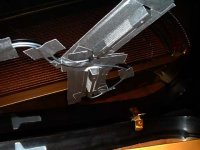
Otherwise I prefer HQ LDC mics. I used to have a matched set of C414s that sounded real good of most.
That said, If the lid (absolutely) has to be closed, I've had good results using a pair of Crown 160 boundary mics taped to the underside of the lid.
Otherwise I prefer HQ LDC mics. I used to have a matched set of C414s that sounded real good of most.
Rick R
Veteran
I concur with Bruce. It's one of the most difficult instruments to record, and most sound engineers have their personal mic & placement preferences depending on the style of music (and the instrument itself). If it's important, hire a pro. Placement is crucial.
That said, If the lid (absolutely) has to be closed, I've had good results using a pair of Crown 160 boundary mics taped to the underside of the lid.
View attachment 123488
Otherwise I prefer HQ LDC mics. I used to have a matched set of C414s that sounded real good of most.
That said, If the lid (absolutely) has to be closed, I've had good results using a pair of Crown 160 boundary mics taped to the underside of the lid.
View attachment 123488
Otherwise I prefer HQ LDC mics. I used to have a matched set of C414s that sounded real good of most.
combatentropy
Veteran
HQ LDC mics
I had to stare at the acronym for a beat. I believe that stands for high-quality, large-diaphragm condenser mics, for those of you watching from home.

Michael Thames
Carbonite Member
I've had good results with a pair of Oktava MKI-12's. there was a mic shoot out on gearslutz a few year ago recording piano showing the mic placement etc. of course the Schoeps were the best but cost $3500. The Oktavas held up well for around $500 a pair. Perhaps do a search on gearslutz for the sound files and post. Personally, my forte is recording guitar, and I find omni's a bit anemic sounding in most cases.
Bruce Watson
Veteran
Thank you all for the wealth of information. I'll take them into consideration when purchasing.
That wasn't a wealth of information. This is.
 The original article had a huge amount of sound samples with it (so you could hear how the slight differences in technique changed the sound), but my very brief search didn't find them; some things have been missing since SOS started their website upgrade. Sigh...
Throwback
Well-known member
Bruce,
The samples are still there, via a link in the 2nd paragraph of the SOS article that I posted early on in this thread (which is the same one you link to): to go straight there it is at http://www.soundonsound.com/techniques/piano-recording-media
What I can't find, however, is the more detailed information that was originally available - not in the SOS article itself - which had many more photos, annotated to make things clearer. You have to work a bit harder now to relate the samples to setups, but at least they are all still there.
Cheers,
Roland
Bruce Watson
Veteran
The samples are still there, via a link in the 2nd paragraph of the SOS article that I posted early on in this thread (which is the same one you link to): to go straight there it is at http://www.soundonsound.com/techniques/piano-recording-media
What I can't find, however, is the more detailed information that was originally available - not in the SOS article itself - which had many more photos, annotated to make things clearer. You have to work a bit harder now to relate the samples to setups, but at least they are all still there.
Right you are. I don't know how I missed it. Probably the same way I missed your initial posting of the URL to the article -- trying to move too fast. Sigh...
The original was an awesome thing, all the information you need in overwhelming detail, and yet all it really gives you is a place to start and some idea of how to proceed. I suspect you have to do quite a lot of piano recording to get good at it. I don't know that I ever will, it's an endless challenge.
Throwback
Well-known member
Certainly is. Recorded a Kawai baby grand in a bar today (not really satisfactory), then will be recording the same piece on a Steinway in a 14th-century gatehouse on Saturday, which should be better (both with video too): nothing ever seems the same!it's an endless challenge.
Cheers,
Roland
Braindead@70
Well-known member
I use a very good black PZM which is taped (black tape) to the underside of the lid on a concert grand close to the low end. A black Oktava mic is clipped to the side of the piano close to the low end strings. The Oktava is pointed at the high end strings. The Oktava capsule is pretty tight so I get very good highs.
I agree with the other guys....gotta use two mics. I actually use three mics. My backup is a good PZM which I painted black. This mic is on the floor under the piano. The sound surprised me....decent but it does not mix well with the other mics.
Technically, I am sure my setup is not kosher but it works for me.
Last edited: