What gels do I need to convert 5500K daylight to 4300K fluorescent?

Imamacuser

Veteran
I want to double check with you guys to see if I got the formula correct for gelling daylight to common fluorescent light (such as found in office buildings). Near as I can figure, I need 1/4 CTO & 1/2 plus green to convert 5500K to to 4500K-ish fluorescent, is that correct?

I’m using daylight Yongnuo LED lights, which are closer to 5000K and have a slight green cast. I know some guys on here also use Yongnuo lights, and I’m curious if I’m better off with 3/8 or 1/2 plus green when gelling to fluorescent. I guess ideally in that situation, I’d use a bi-color LED light with a plus green gel, but I’d like to use the lights I have for now.


I would like to suggest a sticky that covers what gels to use when converting one color temperature to another, as it can be rather confusing.
 
how critical is it that it match very closely? and are you dealing with the same flurescents all the time? If you're jumping between various offices, you may see a pretty wide range of flourescenet quality and tint.
 
I'm approaching this from a general circumstance angle, but I'd like to get my lights color temperature as close as possible in camera, so that way I only have to color correct a shot when there's mixed lighting from outdoors.

I read somewhere that fluorescent is usually 4300K, but I guess it can also be closer to 3200K or 5500K. In your experience, what Kelvin color temperature does fluorescent generally seem to be?
 
My feeling is that the fluorescent conversion is quite simple and tested, but LED conversion is more troublesome, as the characteristics of LEDs at continuously changing. Buying the same model three months later will almost certainly look slightly different. Your ideas are a starting point, but having a few roles of all sorts of conversion gel helps. Matching an entire office will be a pain, because I bet thee are differences in the colours of their everyday tubes too!
 
No two locations may be the same. Get yourself a full kit of color correction gels and be done with it. That way you have them on-hand and are covered.
 
No two fluorescent tubes may be the same. If there aren't a lot of fixtures you might consider bringing your own color balanced tubes say 3200k and re-lamping them and correct from there. Hopefully there are no flicker problems.
 
I'm approaching this from a general circumstance angle, but I'd like to get my lights color temperature as close as possible in camera, so that way I only have to color correct a shot when there's mixed lighting from outdoors.

I read somewhere that fluorescent is usually 4300K, but I guess it can also be closer to 3200K or 5500K. In your experience, what Kelvin color temperature does fluorescent generally seem to be?

This has a potential to bite you in the rear - "I only have to color correct a shot when there's mixed lighting from outdoors" - how are you planning to only correct (in post) or change the color from one source or direction in a multi source, multi-direction environment? Unless you're very very lucky, it's pretty much impossible to do it well. Light goes all over the place; how will you fix a face that has flo on one side and daylight from another? Mask it? Animate the mask? You'll tear your hair out and then give up.

There's no one flo temperature - for a decade now, flos have evolved to evoke colors to a "good enough for the eyes" level (our eyes correct all kinds of mixed lighting into a cohesive whole). There are cool whites, warm whites, "gallery" bulbs, and every manufacturer is different. There's no one standard. In most businesses I have shot (short of warehouses) the flos and ballasts have been upgraded for energy efficiency reasons (and for discontinuation of some old-school ballasts and starters) and they are often very close to daylight; if I can't light for some reason, I can usually WB to a well-maintained office and it looks very good, may need a tweak in post. (The NX1 has, what, three or four white balance presets for various types of fluorescents alone? What does that tell you?)

If the lighting is mixed, you need to either gel all of one type of source, or bring in lights to override the existing fixtures, and if there's prominent window light, gel the fixtures to match that (often you're talking some level of CTB if your fixtures are daylight - window light is often blue-gray by the time it gets to your set).

I know people starting out these days love LEDs - there's a perception that they're the latest-greatest must-have tech - but as key lights, they're abysmally weak in most cases, unless you're in a waaaay post-yongnuo budget. I love them for rim/hair or picking out a piece of background, since I can take several in the space of one Kino or fresnel. They're great when there's absolutely no access to power. But as your main keys? Maybe when you're doing a low-key shot and don't mind shooting at ISO 800 or what have you. But get a window in the location and they may not even read as more than a quarter stop.
 
As noted above there is not a single formula or even a small set of formulas to convert daylight to fluorescent, since fluorescents all have their own signature as do your LED's. Even traditional color temp meters have a hard time reading and providing trustworthy calculations in this regard.

My methodology is to change out the in-house tubes whenever possible. But for situations where that isn't possible, we'll go through a on-camera process at the beginning of the shoot day to work out the formula. With the Alexa, I take a white balance under the existing lighting and the camera gives us the color temp and green/magenta shift. We'll then take our best guess at the appropriate amount of CTO/CTB and plus-green, place it on a reference lighting instrument and then take another white balance (making sure to flag off the ambient light), adjusting the gel pack as required until the numbers match up to the existing lighting. I actually use a combination of the camera's readout and a vectorscope to ensure consistent results.

This is unquestionably slow and clunky and I sure wish there was a modern color temp meter that could do the same job more efficiently, but there isn't yet (the Sekonic C700R looked like a winner on paper but appears to fall down in critical ways).
 
Last edited:
As noted above there is not a single formula or even a small set of formulas to convert daylight to fluorescent, since fluorescents all have their own signature as do your LED's. Even traditional color temp meters have a hard time reading and providing trustworthy calculations in this regard.

My methodology is to change out the in-house tubes whenever possible. But for situations where that isn't possible, we'll go through a on-camera process at the beginning of the shoot day to work out the formula. With the Alexa, I take a white balance under the existing lighting and the camera gives us the color temp and green/magenta shift. We'll then take our best guess at the appropriate amount of CTO/CTB and plus-green, place it on a reference instrument and then take another white balance (making sure to flag off the ambient light), adjusting the gel pack as required until the camera's results match up to the existing lighting. I actually use a combination of the camera's readout and a vectorscope to ensure consistent results.

This is unquestionably slow and clunky and I sure wish there was a modern color temp meter that could do the same job more efficiently, but there isn't yet (the Sekonic C700R looked like a winner on paper but appears to fall down in critical ways).

^-- THIS --^

This.

And also this.
 
The only effective solution is a computer and one of these:

https://www.xrite.com/i1pro-2-color-calibration-profiling-solutions

Must be the i1 pro for spectrophotometer, though some of the "Display" products can do this now. With the proper software you can see the spectral curve, and get a "color temp." reading.

In theory, you could sample the ambient light, then point the spectrophotometer at your other light, and hold strips from a Rosco or Lee filter book over the spectro until you find the closest matches. Then it would still be down to pointing a camera and looking with one's eyes at the viewfinder or monitor and probably a vectorscope. But it might speed up the process for those that don't have a lot of experience. Experience will still always beat the electronics to a solution because you can start with a narrower choice of gels because you know what worked last time.
 
Charles' solution - reading color temp and tint values - can get you very very close, close enough for rock n' roll as they say.

Poor man's way: If you can take a laptop on set, shoot a raw still of a gray card and open in PS or lightroom, and play with the temp and tint sliders; check the RGB values until they're within a couple points of each other (IE R125 G125 B125, depending on the density of the gray). You can usually eyeball the temp & tint and know the ballpark CTO/CTB and plus/minus green that the software is using. Gel the fixtures and take another shot, rinse and repeat.

It's a surprisingly accurate way to zero out a fixture to a target color temp.
 
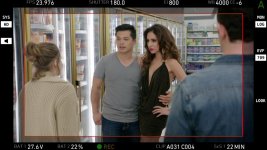
I was thinking about a supermarket we shot in last summer--too many tubes to change and we used the method I detailed above. Below is a frame grab showing the color temp as 4000K and -6 points of green as we read it from the fluorescents above. Most of the instruments I used in the scene were bi-color LED so we dialed them to approximately 4000K, added 1/4 CTB to any tungsten units, plus 1/4 green on everything.

cxgep2.jpg

You can see some of the finished scene in this promo--apologies that this clip isn't also on Youtube and there are ads etc. and may not play in other countries.

http://www.cwtv.com/shows/crazy-ex-...n1/?play=364c7f68-9e91-4dd9-995a-f102972cebfc
 
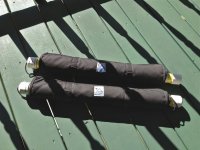
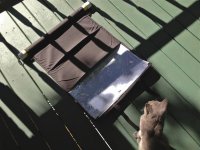
Here is a great way to keep your gels organized for transport.
 

Attachments

  • Gel roll 01.jpg
    Gel roll 01.jpg
    89.5 KB · Views: 0
  • Gel roll 02.jpg
    Gel roll 02.jpg
    87.5 KB · Views: 0
Back
Top