
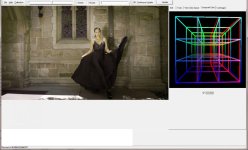
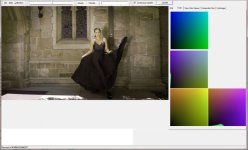
I few years ago I wrote custom software to do 3D color correction (for stereoscopic 3D images). The 3D color cube was directly displayed and could be edited, and it was also possible to render color swatch slices to check for issues with clipping (cube elements outside the unit cube space) or other mapping issues (such as color merging leading to banding/quantization).
Color cube display (unedited / unit-normalized cube shown (actual distorted cube for current color correction not shown)):
Color swatches (cube slices) showing range/clipping issues:
It may be possible to fix the S-gamut color mode issue by creating a 3D LUT which fixes the green/yellow splotches in skintones and perhaps also the magenta splotches in shadows. Since green and magenta are color complements, it kind of has the feel from physics describing a form of instability. That is, the system is stable in a narrow range, and when outside that range it becomes unstable, going extremely green or magenta, depending on which side of the parabolic curve center the color(s) are on.
Color cube display (unedited / unit-normalized cube shown (actual distorted cube for current color correction not shown)):
Color swatches (cube slices) showing range/clipping issues:
It may be possible to fix the S-gamut color mode issue by creating a 3D LUT which fixes the green/yellow splotches in skintones and perhaps also the magenta splotches in shadows. Since green and magenta are color complements, it kind of has the feel from physics describing a form of instability. That is, the system is stable in a narrow range, and when outside that range it becomes unstable, going extremely green or magenta, depending on which side of the parabolic curve center the color(s) are on.