
Navigation
Install the app
How to install the app on iOS
Follow along with the video below to see how to install our site as a web app on your home screen.
Note: This feature may not be available in some browsers.
More options
You are using an out of date browser. It may not display this or other websites correctly.
You should upgrade or use an alternative browser.
You should upgrade or use an alternative browser.
GH5 Vintage Lens vs Hollywood Black filter
- Thread starter sgttom
- Start date

NorBro
Major Contributor
It's personal preference...many people recommend what you're asking. Technically, Master Primes can be considered vintage by now, ha.
Choosing glass is a beautiful thing about filmmaking...so many options/looks/characteristics/pros/cons.
Personally, I just wouldn't want to use too old/soft of a lens to lose a lot of detail unless that's what I'm going for.
Choosing glass is a beautiful thing about filmmaking...so many options/looks/characteristics/pros/cons.
Personally, I just wouldn't want to use too old/soft of a lens to lose a lot of detail unless that's what I'm going for.

Bern Caughey
Veteran
If your only trying to take the edge off a lens without adding too much of a look test Black Diffusion FX filters.
https://vimeo.com/97712664
For a lesser effect consider Digital Diffusion FX.
https://vimeo.com/162597544
https://vimeo.com/97712664
For a lesser effect consider Digital Diffusion FX.
https://vimeo.com/162597544
It's personal preference...many people recommend what you're asking. Technically, Master Primes can be considered vintage by now, ha.
Choosing glass is a beautiful thing about filmmaking...so many options/looks/characteristics/pros/cons.
Personally, I just wouldn't want to use too old/soft of a lens to lose a lot of detail unless that's what I'm going for.
That's true. Lenses are a lot of fun.
The Digital Diffusion 1/2 looks pretty good. Too many options hahaIf your only trying to take the edge off a lens without adding too much of a look test Black Diffusion FX filters.
https://vimeo.com/97712664
For a lesser effect consider Digital Diffusion FX.
https://vimeo.com/162597544
Last edited:

JPNola
Veteran
I know a lot of people are recommending the use of filters like the Hollywood black magic to make modern glass look more appealing. Are there any downsides to this over just using vintage glass to begin with?
I suppose that in purist terms there is a "downside" in that you are introducing more glass into the optical path when you use any sort of glass "filter" externally. A practical downside is that lenses of different focal lengths are impacted by the filter unequally. Same when on a zoom and you change focal lengths. In simple terms, if the filter is a bunch of black micro-dots the different focal lengths will be looking through a different number of micro-dots. All that said, I regularly see diffusion filters being used on big-budget film productions. Some DP's will, at times, when using diffusion filters in front of the lens, switch the strength of the filtration according to the focal length of a lens.
Diffusion is better applied at the rear of a lens. In doing so the amount of filtration is consistent regardless of focal length. But applying rear filtration isn't practical for most of us or even always possible, as a result of the lens choice. On 2/3" video cameras it was fairly common to use a ring that held net / hose material in place at the rear of the lens, between the rear glass element of the lens and the CCD. Anyone else here remember purchasing "Fogal Noblesse" from a store ( and being the only male in the ladies hosery department )? Remember the "I-Ring"? They had the "i-" thing way before Apple!
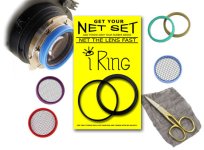
I still have an I-Ring or two laying around. I think one has been in the center console of my Suburban for over a decade now. Because, well...you know, just in case.

CharlesPapert
Director of Photography
Yessir...I too had one of those rings, in a plastic baggie along with snips, snot tape and a hunk of that very same Fogal Noblesse. I bought it at the Fogal store in Beverly Hills. When I walked in the door, the woman behind the counter sized me up for a flash and asked "cinematographer?" And she brought me right to that product. Hilarious.
JPNola
Veteran
Yessir...I too had one of those rings, in a plastic baggie along with snips, snot tape and a hunk of that very same Fogal Noblesse. I bought it at the Fogal store in Beverly Hills. When I walked in the door, the woman behind the counter sized me up for a flash and asked "cinematographer?" And she brought me right to that product. Hilarious.
And weren't you proud to answer "why, yes, I AM indeed a cinematographer." And then a beam of light cast down on you from out of nowhere and there was the sound-effect of a choir singing. All in the store stopping to behold and be impressed. :engel017:
To think that those little plastic ring sets cost $23.95. Filmtools still has them listed on their website.

Thomas Smet
Veteran
Using a filter to take the edge off of an otherwise beautiful piece of glass is not the same as using an older vintage lens that is an older design, older manufacturing process, only meant to resolve so much detail from 35mm film, totally different levels of acceptable lens coatings and so forth. Using a filter is not meant to replicate the look of an older piece of glass and using an older piece of glass is not a filtered alternative to a modern well built lens. Apples and oranges.
Using the proper filter is about taking that high quality lens and dialing down one aspect to take some of the edge off. It doesn’t jack up the lens coatings or suddenly make the lens look old. The filters are about controlling what hits the sensor. The vintage lens is about take what you get, cross your fingers and hope it looks ok. If the vintage lens gets you the exact look you want then you are golden but it will never be able to drift from that look either and you are stuck with that look forever. You can’t add a filter to make an old lens look modern.
Using the proper filter is about taking that high quality lens and dialing down one aspect to take some of the edge off. It doesn’t jack up the lens coatings or suddenly make the lens look old. The filters are about controlling what hits the sensor. The vintage lens is about take what you get, cross your fingers and hope it looks ok. If the vintage lens gets you the exact look you want then you are golden but it will never be able to drift from that look either and you are stuck with that look forever. You can’t add a filter to make an old lens look modern.
joe12south
Veteran
It's worth learning a little bit about what "diffusion" actually is, what it does. It's not the same as focus/blurring. Yes, they both soften detail, but in very different ways. Diffusion is a unique look, especially in how it reduces contrast by allowing light to "bleed" into shadows. And then, of course, there are a wide variety of ways to diffuse, each with different looks. What's appropriate for a landscape may not be appropriate for a close-up of an actress' face.