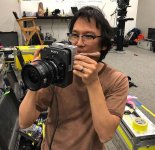
VENICE: Avatar 2 & 3

Is this really that surprising? The flexibility that Venice offers for 3D rigs using the tethered sensor block is a BIG deal. There's no other way to get that level of compactness, and image quality into a 3D rig.
 
I do not have a reply. I was mainly commenting on the Sony love going on in the video. Anytime I see one entity gushing over a corporation it starts to feel like an advertisement instead of a testimonial. I should not have posted in the first place. Please disregard...
 
No worries. Just curious if there was something better out there. I got to seenit in person at trade shows a couple times. Pretty cool camera. Image is more aesthetic than what sony has been doing lately. Detaching the head seems better than the Alexa M solution, longer cable runs, smaller head (flatter), Built in ND’s, fullframe or s35, and it becomes a normal camera again at the end of the day. And for 3d it is still lighter than the Red or Arri mini options.

Idk, has a lot going for it, except maybe alexa has a stop or two extra in the highlights? Probably not a problem for a CGI heavy big budget film. Add to it that Sony is directly developing a camera with you, and, well that is kind of cool.

FullSizeRender 2.jpg
 
Last edited:
VENICE can and will compete with the Alexa LF at the top of the game.

Sony can produce VENICE quality at the A7 scale if it so chooses.

The illusion of large heavy cameras = best quality is coming to an end.
 
^^^^^
I agree with this sentiment, however I think the form factor will remain for large cinema cameras because of their workflows. Lots of hands and eyes need access to lots of settings, being jostled during operation and transit, temperature extremes etc.

A similar argument was being made when mirrorless were becoming popular for stills photography. The image quality is there now, and so is the focus capability (and even frame rates)...however, when you go out into the field and HAVE to get the image, it's still the full-frame pro bodies, even though they're large and heavy in comparison. They can operate in widely variable temperature and environmental extremes, they can be operated while wearing gloves.

Professional-grade doesn't mean the quality of the image...it really means the whole capture chain.
 
Human factor access to buttons and controls is important, though using a phone or iPad to wirelessly control settings is even more efficient vs. buttons on camera in a pro setting with ACs. Wireless FF is also pretty common now. A large body with the mass concentrated at the ends (maximize inertia tensor to dampen rotations) was and is useful, however a pro level IBIS will allow tiny cameras to have even more stable capture. Current top cinema lenses (even compact primes) are still fairly large, so that’s a future market opportunity which will arise when the tiny pro cameras come to market.

Red’s getting their feet wet in tiny prosumer cameras with the Hydrogen cellphone. Sony and Samsung/Fuji can easily make pro level cameras of that scale. Optical shallow DOF would require exotic lens tech (not on the market yet but possible). Farther in the future is computational imaging from multiple lenses/sensors where DOF can be computed live or in post. What’s cool about this tech is any kind of lens can be simulated. In other words, you could swap a Cooke for a Leica... in post!
 
Would be marvellous for a handheld-heavy show. Carry the camera body on a backpack style rig (to spread the load over both shoulders), or better yet, have a grip handle it. And just handle the sensor block on your shoulder.

The reduced chiropractic costs alone would pay the camera off much faster!
 
Would be marvellous for a handheld-heavy show. Carry the camera body on a backpack style rig (to spread the load over both shoulders), or better yet, have a grip handle it. And just handle the sensor block on your shoulder.

The reduced chiropractic costs alone would pay the camera off much faster!

I could see having the body on a backpack style rig that puts the bulk of the weight mostly on the hips. Less dealing with coordinating with a grip for movement heavy scenes. And yes, definitely saving money on chiropractor.
 
VENICE can and will compete with the Alexa LF at the top of the game.

Sony can produce VENICE quality at the A7 scale if it so chooses.

The illusion of large heavy cameras = best quality is coming to an end.

Already overseas, the idea of big is seen as outdated. I had a big camera, and at first people were impressed, or at least curious, but then all i had to do was say it was old and full of rocks, and then they would scrunch their face and frown. Then they’d go drool over the 5d mark whatever. Haha.
 
Already overseas, the idea of big is seen as outdated. I had a big camera, and at first people were impressed, or at least curious, but then all i had to do was say it was old and full of rocks, and then they would scrunch their face and frown. Then they’d go drool over the 5d mark whatever. Haha.

I use the Canon C300 II almost exclusively on the tripod. If I did video production for a living (or was a camera operator), I'd have to invest in a lot of gear to make carrying that camera around all day not cause health issues (especially if flying it on a gimbal). Still way too big and heavy (though still impressed with the IQ over the smaller cameras so far). Working in the software / camera hardware / AI hardware industry it's clear to see that in 2018 cellphone sized cameras can create 'class A' image quality if manufacturers chose to create such products. For example, > 1TeraOps in < 1 Watt chips have been available for some time. So when we see these gargantuan cameras come out, including some with noisy fans and massive power requirements, it seem like a kind of joke. Yet the iPhone X with Apple's best camera system seems to have taken a step back from the color science on the iPhone 5S. Will be interesting to see how Red's 8K Hydrogen looks. iPhones have been used for commercial theatrical productions (mostly as a marketing stunt). If a phone-sized camera can at least produce artifact-free IQ and low or no RS with decent DR, they'll be useful tools.

If the Sony VENICE and Alexa LF are currently the top cameras you can purchase (Alexa 65 = rental only) for image quality, what are the top cameras which optimize quality and size at the same time (including some form of IBIS and decent AF)? Sony A7 III, Panasonic GH5(s)? I still prefer the color (skintones) and IQ of the 1DX II over the smaller cameras (422 8-bit is ok when shooting for an in-camera look) and use the 1DX II for stills. What I'd like to see is the A7S III getting 10-bit 422 or better (ideally RGB 444 and/or ProRes RAW), the VENICE color filters and color science, and better than A7 III IBIS, then I'd get back into the Sony ecosystem. That would be a so-called game-changer camera, especially if skintones can match or exceed Canon: one camera to shoot both video and stills with 6K => 4K True 4K (alias and artifact free), high DR, low RS, usable AF, awesome lowlight, small files, and 'no excuses image quality'.
 
Not everyone wants to shoot with a tiny camera, regardless of image quality. They have their uses and advantages, at times. But being a largely handheld guy, I want a camera that sits on my shoulder, balances properly, has a real VF in the right place and a real lens(ENG style). I'm not saying that there's not an advantage to having the bulk of the electronics in a backpack and a small "sensor block with a lens" that you could easily hold in one hand to swing around for certain things, but those would be pretty specialized/unique situations.

Maybe I'm just a dinosaur and stuck in the old days, but I'd rather have a shoulder mounted ENG style camera and lens almost any day of the week. It's gonna work for my style of shooting the best 90%+ of the time.
 
@run n gun

I think if a dslr sized camera could manage a sufficient motion stabilization, i might prefer that. But other wise, between audio a proper evf, batteries and what ever other aks, i have to agree, a good body that cam sit on the shoulder is still the best.
 
Back
Top