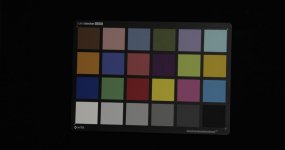
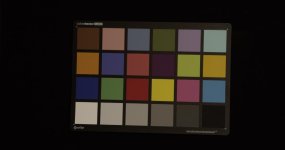
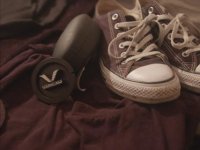
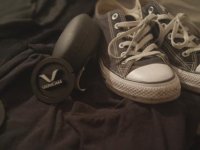
Varicam LT IR pollution - Clean Blacks.

Hi guys. As promised I went away and tested various sources with and without ND etc and I think I have found the answer to your issue.

Methodology

Lamps used: (Control) Arri 1K - (Variables) Dedo DLH4 / Dr Fischer 500w / Tungsten Practicles / Osram R80 Consumer Lamps you find at hardware stores

I Shot each lamp 4 times per the following.

1/ Manual WB / ND Clear
2/ Manual WB / ND 0.6
3/ Dialed WB to 3200 / ND Clear
4/ Dialed WB to 3200 / ND 0.06

Other Camera settings:

ISO 800 (also did a quick check at 5000 ISO for each, but 0 difference in image).
24 fps
180 shutter

Results

All the images rendered pretty much as you would expect, without IR pollution and were similar to the control . The result did not change between ND CLEAR or ND 0.6. There were mild colour shifts in the dialled WB as it wasn't accounting for the full spectrum, but nothing drastic. Nothing drastic that is until I hit the R80 lamps.

This first image is: R80 / Manual WB - 2660+0.7 ND Clear. Apart from a little under exposure, it's what you'd expect and is accounting for the additional magenta this lamp obviously emits.

R80 A.jpg

This next image is: R80 / WB dialled in to 3200. Clearly it's not accounting for the magenta here and that's resulting in a magenta looking image.

R80 B.jpg

Whats clear is the R80, whilst tungsten, is emitting a lot more magenta than the other sources I tested which were all professional grade lamps. I of course don't have the particular lamps you shot under to include here, but I suspect they are doing something very similar. The only way to gauge this with 100% surety however would be for you to side by side with an Arri 1k (or similar control unit). In summary, I think your'e image is being vandalised by shitty lights. I'd seriously consider a colour meter for source colour confidence and use the manual wb in future when you're not confident in the source light. It is quite possible that at the location all the lamps are the same except 1 which is older / worn out / different type of lamp altogether.
 
Although not professional lamps for professional lighting instruments, something I have run into with "regular tungsten household light bulbs", is that some are not regular tungsten with a "normal" piece of tungsten filament in them, they have a small halogen lamp inside the normal light bulb. There are also hybrid bulbs out there with halogen and cfl or led elements inside the bulb together. I'm presuming it's an effort to make it more energy efficient with cfl/led doing the brunt of the work, but using the halogen element to try to get the color/feel of the light closer to what we are used to with tungsten bulbs.
 
Not surprised. I think the "manually dialing in the white balance" feature is the source of so much pain in the videography world. The world is overrun with low quality cheap lights, and the manual dialing white balance cannot and will not correct for poor-spectrum light rendition. Taking an actual sampled white balance is the only reliable way to get accurate color rendition on ANY video camera.

So, to Noel's point, I'd ask everyone who's encountering this issue: did you do a manual white balance off a white card? Or was it done under preset? Because if it's the preset (either p3200, p5600, or dialled in) then the preset cannot account for the shift in colors due to poor quality lights. It can't. It's not possible. You have to do a manual sampled white balance to account for that. So if you get the exact same results whether it's preset or sampled, and both cases are "wrong", then it may be IR pollution or the camera. But if the results are different between sampled and dialled-in, then the fault is almost certainly not with the camera, it's with the lights.
 
So, to Noel's point, I'd ask everyone who's encountering this issue: did you do a manual white balance off a white card? Or was it done under preset? Because if it's the preset (either p3200, p5600, or dialled in) then the preset cannot account for the shift in colors due to poor quality lights. It can't. It's not possible. You have to do a manual sampled white balance to account for that. So if you get the exact same results whether it's preset or sampled, and both cases are "wrong", then it may be IR pollution or the camera. But if the results are different between sampled and dialled-in, then the fault is almost certainly not with the camera, it's with the lights.

You should see what I get back from students when checking the gear back in, I've seen some really red looking 5600K white balances when I fire them up in my office with sort of 3400K lighting. Had a green 4200K come back today and had to wonder where they were shooting. At least I know they are using the "auto-white" function when I see this.
 
Not surprised. I think the "manually dialing in the white balance" feature is the source of so much pain in the videography world. The world is overrun with low quality cheap lights, and the manual dialing white balance cannot and will not correct for poor-spectrum light rendition. Taking an actual sampled white balance is the only reliable way to get accurate color rendition on ANY video camera.

So, to Noel's point, I'd ask everyone who's encountering this issue: did you do a manual white balance off a white card? Or was it done under preset? Because if it's the preset (either p3200, p5600, or dialled in) then the preset cannot account for the shift in colors due to poor quality lights. It can't. It's not possible. You have to do a manual sampled white balance to account for that. So if you get the exact same results whether it's preset or sampled, and both cases are "wrong", then it may be IR pollution or the camera. But if the results are different between sampled and dialled-in, then the fault is almost certainly not with the camera, it's with the lights.

It has become more of a problem recently with all of the different lighting technology, than it was when I first had the feature on one of my Betacams in the early 2000's. I see a lot of people that just don't get that "dialing in" the WB isn't the same. Some times it does work well, but other times, not. It's just more or less adjusting up or down cool/warm and not taking into account any green/magenta shifts. I've also seen cameras, like the C300, which has preset 3200, 4300 and 5500 as well as a "kelvin" setting not have identical looking presets and "kelvin settings". For some reason the "Kelvin Settings" are green compared to the "Preset" under the exact same lighting.
 
I think the conversation is shifting towards accurate White Balancing which is not the original topic. The question is whether the VaricamLT sensor is sensitive to Infra Red light or not. Testing with color charts would not be very productive here. IR light typically manifests itself as a problem when reflected off particular dark fabrics. Check my post above with two shots with almost exactly the same WB yet the blue shirt is reddish on only one of them. Also check the shot of the black pants being more reddish than the similarly black top (from Alex’s post). If it were a WB problem, then both the pants and the top would have the same color since, as Alex attests, they are of the exact same color in real life. They look different because one fabric is reflecting more IR than the other. A sensor not sensitive to IR would show them exactly the same. So that shot of Alex indicates an Infra red sensitivity problem rather than WB problem.
It is also very unusual for Tungsten or Incandescent lights to exhibit Magenta or Green shifts. Any $2 incandescent bulb from Home Depot should have a CRI of 97 or above and should be of very high quality. That is the beauty of Tungsten. You can test them yourself with a color meter. They can have different temperatures or shift towards warm as they age, but their CRI should remain very high. So I don't believe that a "low quality" bulb is behind this problem.
 
I hear what you guys are saying. But with proper IR filtration I'm thinking you can shoot under any light source and not have contamination. Which is basically a documentary shooter's dream.

Here is a quick test I did tonight with and without the SO 680 cut, at WB 3200K preset, 24fps, 5000ISO. These are the crappy consumer tungsten bulbs in my apartment, where I first noticed that my blacks were looking ruddy. To my eye, the SO filter pretty much does the trick, and I am happy with the results.

The image might be a little greenish, but I think this is the look of the SO filter. I was using a Hoya on the Ursa Mini and it was very neutral compared to the SO.

Internal IR filter
No-filter.jpg

Schneider Optics 680 IR Cut filter + Internal IR filter
680-filter.jpg

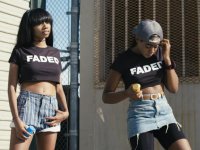
Also, I don't think we can place blame singularly on lighting instruments, I also noticed IR contamination in broad daylight on this poly blend fabric. I knocked out a lot of the redness in resolve with a quick adjustment to the red channel, but you can still spot the different between the girls tights and the tops, both of which were the same hue as the tights. So there is some IR contamination going on in sun light.
daylight.jpg

I'm sending these clips and more to Panasonic's engineers so they can react accordingly.
Hopefully, they can just increase the range of IR cut on the user replaceable IR filter, it seems like their filter is the weak link.

I'll try and test the SO tomorrow in daylight to see how that goes.
 
I wasn't planning on sharing these, I'm a little embarrassed about how horrendous it looks, but I want to keep contributing to the convo...This is the shoot I had issues with. Wide shot is the LT, CU is the GH4. If dialing-in WB is the culprit, how come the GH4 doesn't exhibit the same pink curtains? There's a little pink on the highlights of the curtain, but nothing like what the LT shows. I dialed in both WBs side by side. In any event, I'll definitely pick up a grey card and start balancing with that. I did get that Hoya filter, and I'll probably use that under tungsten light just in case. I'll try to do my own tests with it next week.

LT CU 2.jpg

GH4 Curtain.jpg
 
The following is general IR theory, and is not meant to be a specific statement on the VariCam LT's sensor and IR cut filter. This is still being examined.

IR cut is a misnomer. IR can be remediated, but it cannot be simply cut out like a cancer without effecting other wavelengths. The more one mitigates IR, the more one also reduces various red frequencies in the visible spectrum. One must be careful there as that gets immediately into skin tones. So while one can use a filter to knock down IR frequencies more and make fabrics appear more neutral, such filtration may also negatively alter skin tones. Don't just test by pointing at black objects; try some faces.

IR is heat. A quartz halogen cinema light is 3200 Kelvin and a higher efficiency of visible light to heat output compared to a household tungsten filament light bulb, which is typically closer to 2700 Kelvin and puts out more heat relative to its visible light output. A warmer color temp light will extend that balance of frequencies into the IR range. So effectively, given the same lumens, household bulbs will output more IR than cinema halogen fixtures. They spit out a lot of IR.
 
Posts 29 and 30 are examples of IR pollution, not bad white balancing. There are some fabrics that definitely reflect/reveal more IR than other fabrics, that curtain backdrop is a prime example.

Regarding IR sources -- tungsten lamps do put out a ton of IR. Under daylight, it may or may not be an issue, frequently depending on how much ND you're using. In terms of the ratio of visible light to daylight, if there's no ND involved, the amount of IR is generally low and not usually much of a concern. But the more ND you pile on, the more you change the ratio of IR to visible light; ND will block visible light but generally won't block IR, so the amount of perceived IR will rise when more ND is used.

And Mitch is spot-on with his explanation of IR overlapping into the visible red spectrum. IR has been and will always be an issue with certain high-end cameras, for that reason. In cinema, the answer would never be "put an IR cut filter on", the answer would be "change out that fabric for one that looks black to the camera." Of course, event shooters don't have that option, so an external IR-cut filter is probably the best solution. Leave it off whenever you can, and use it when you must...
 
I wasn't planning on sharing these, I'm a little embarrassed about how horrendous it looks, but I want to keep contributing to the convo...This is the shoot I had issues with. Wide shot is the LT, CU is the GH4. If dialing-in WB is the culprit, how come the GH4 doesn't exhibit the same pink curtains? There's a little pink on the highlights of the curtain, but nothing like what the LT shows. I dialed in both WBs side by side. In any event, I'll definitely pick up a grey card and start balancing with that. I did get that Hoya filter, and I'll probably use that under tungsten light just in case. I'll try to do my own tests with it next week.

Agreed. I did a few more tests with multiple black fabrics and was able to replicate the effect on some of those fabrics. Im not shooting events and am usually in fairly controlled environments, hence why I havent seen this rear it's head before and for that matter, havent shot a lot of blacks either. The day I did the colour chart, its background was a cutter with a high quality duventyne, hence why it wasn't visible there either.

Below is the test video that I shot last night. You can clearly see it effects some things more than others. These are all shot V-Log and have the straight V-Log LUT applied within FCPX. Originated in 4K and exported here in 1080. Think someone mentioned here its visible on wider apertures. That certainly seems the case here with it all but disappearing at T8.

https://vimeo.com/213631892/20a66a656d
 
The following is general IR theory, and is not meant to be a specific statement on the VariCam LT's sensor and IR cut filter. This is still being examined.

IR cut is a misnomer. IR can be remediated, but it cannot be simply cut out like a cancer without effecting other wavelengths. The more one mitigates IR, the more one also reduces various red frequencies in the visible spectrum. One must be careful there as that gets immediately into skin tones. So while one can use a filter to knock down IR frequencies more and make fabrics appear more neutral, such filtration may also negatively alter skin tones. Don't just test by pointing at black objects; try some faces.

IR is heat. A quartz halogen cinema light is 3200 Kelvin and a higher efficiency of visible light to heat output compared to a household tungsten filament light bulb, which is typically closer to 2700 Kelvin and puts out more heat relative to its visible light output. A warmer color temp light will extend that balance of frequencies into the IR range. So effectively, given the same lumens, household bulbs will output more IR than cinema halogen fixtures. They spit out a lot of IR.

You are right about all that Mitch. And any IR cut filter will have negative effect on skin tones (though I hear great things about the Formatt filters). Any digital sensor has IR sensitivity. However, typically the sensitivity to visible light is much, much more than to IR waves. So the problem only manifests itself when using heavy ND filtration (which cuts visible light waves but not IR waves and therefore alter the ratio between the two types of waves). But we are seeing this problem with the Varicam without any ND filtration at all. And that is very unusual. The issue is even more strange. From Noel's test clip. The IR pollution is the same for Clear ND and +2 ND. That is astonishing. And it actually confirms my tests long time ago. I tested all the ND settings from clear to max and found no IR pollution. But, back then I used LED lights. There is some strange interaction between Tungsten lights and this sensor. I can't even explain it.

It would be also great if you can find out for us what the "native" WB of the sensor is. Typically Digital sensors perform best at 5000K. Can you find out what that number is for the Varicam. Maybe we have to light differently for this camera.
 
I watched the OA on Netflix and found it ultra purple. I guessed it was some artistic/props/sets choices. Then I watched "13 reasons why", also shot on the Varicam, and I noticed the same general purpleness. When I grade I always increase the hue or use the Varicam LUT, both solutions giving well balanced Alexa-like colors. But by default it looks like the general hue had been pushed too much toward purple. Not saying that it will solve the thread specific problem but I always found this default hue shift, making some blue tones totally purple and skins yellower, weird.
 
Last edited:
Purple Haze :-P

Re:
I watched the OA on Netflix and found it ultra purple. I guessed it was some artistic/props/sets choices. Then I watched "13 reasons why", also shot on the Varicam, and I noticed the same general purpleness. When I grade I always increase the hue or use the Varicam LUT, both solutions giving well balanced Alexa-like colors. But by default it looks like the general hue had been pushed too much toward purple. Not saying that it will solve the thread specific problem but I always found this default hue shift, making some blue tones totally purple and skins yellower, weird.
 
I haven't encountered the IR issue, but I only use LED lights. I've used the LT twice together with my FS700 on events and didn't notice it then either, but I didn't shoot close-ups of people with black clothes, as far as I remember.

Regarding the purple look in the Oa, I guess it's a deliberate choice. I haven't noticed any specific purple look in my footage.
 
Also on the purple look. Apparently Netflix has an Alexa emulation LUT that was used on 13 reasons*, and possibly the OA. Possibly it is introducing some of the purple colors. But I think on OA, it was a deliberate choice, because pruple is used very often in the art direction. Master of None and Orange is the New Black have very balanced and naturalistic colors. Surely its not a limitation or problem of the sensor.

Also I did a quick test of my Schneider Optics 680 cut on skin tones. With the filter in place there was a very slight shift towards green, which many users report is part of the look of the filter (and some people like). I suspect the Hoya is more neutral, as it is very popular for Ursa Mini shooters. I'm looking to test one on the Varicam sensor asap.

But for me, its really not as big a problem as when I initially saw it. But I will keep one in my bag for those odd situations where I have no control over the lighting at all. The slight green shift from the SO 680 cut would be quicker to fix in post than trying to power window IR contamination.

I'm still going to pool all of my tests and send them to Panasonic for review. I'm sure when they were developing and testing the sensor they didn't test against scrappy consumer lighting. The more information they have the better.

Cheers!

* - http://www.panasonicforbusiness.com/2017/04/andrij-parekh-13-reasons-why/
 
Back
Top