Using a generator or house power on a one-location shoot?

Craig_Tarry

Active member
Hello, I'm doing preliminary budget estimates for a month long, one-location shoot in an old farm house. I don't know at this point how good the house power is, but I suspect that running production lights off the house power would be too much.
This is a character driven drama, no special effects, except for one shot simulating morning sun through a door that changes and moves into afternoon sun (an HMI on a tracking dolly )
So, my questions are:
1. Do I need a generator to power a standard sized light package?
2. What size generator would be needed? (again, I'm just looking for an estimate)
3. Do I hire a special operator for the generator, or do the electrics run it?
Please excuse my ignorance; this is not my area of study.
Thanks for any info.
Craig
 
1. What is your definition of a standard light package?
2. I would suggest a honda 7500w generator, but it really depends on what you're using. Don't forget about power corrected ballasts for the hmi's!
3. The electrics should be able to handle it.
 
Do you have a DP onboard this project? It'd really help you to get someone on soon so you can ask them all these questions. So many of the questions are very specific to that location and your specific lighting package...again, a "standard lighting package" varies from person to person and that's going to change what size genny you need, and depending on the size of the genny, you may or may not need to hire a genny operator. (Not that I think you'll need to hire one, but I think you catch my drift.)

In the end this could all be irrelevant depending on the locations power situation and your lighting package. We're just sorta guessing out here.
 
1. What is your definition of a standard light package?
2. I would suggest a honda 7500w generator, but it really depends on what you're using. Don't forget about power corrected ballasts for the hmi's!
3. The electrics should be able to handle it.

Thanks guys, and yes, this is all premature. David Mullen ASC put this on his thread at Red User.net, when asked about a "generic" lighting package:
Quote:" I don't know if there is a "generic" lighting package -- other than finding out if the location needs both daylight and tungsten lighting, the determining issues, assuming you only have vague details, are the size of the crew to handle the size of the package (no point in getting a 12K HMI if you only have one guy helping you) and the power situation (no point in getting a 12K HMI if you don't have a way of powering it) and the budget (you can't afford that 12K HMI anyway...)

If the restrictions were: (1) house power only; (2) mix of daylight and tungsten; (3) small crew, I tend to favor Kinoflos as part of the package, since they are low in power consumption, switchable between daylight and tungsten, and are naturally soft sources without a lot of grip work needed. Usually I'd carry a couple of 4' 4-bankers. Besides that, there might be a tungsten kit of a couple of 650w and 1K's in a case, maybe some Chimeras for those.

Besides the medium tungstens and the Kinos, then I might add some smaller HMI's if the budget allowed, like 575w and 1.2K HMI PAR's. LED panel lights could also serve some of the same functions as the Kinos.

At the other end of the scale, there might be some smaller tungstens, like Dedolights or Peppers.

If I needed a punchy light that was really bright but under 20amps, besides the 1.2K HMI PAR with a narrow lens, you could get a 1K PAR64 tungsten with a spot or narrow spot globe (the VNSP globes are called "firestarters" I believe.)

I'd also bring some Chinese Lanterns and an assortment of light bulbs."

So, l guess there's only so much you can anticipate in advance -
Thanks - Craig
 
Many farm houses have a 220 tap for things like welders available.

Also it might be cheaper to hire an electrician to add what you need to the location, rather than renting a generator for a month.

Good Luck!

Dave
 
Many farm houses have a 220 tap for things like welders available.

Also it might be cheaper to hire an electrician to add what you need to the location, rather than renting a generator for a month.

Good Luck!

Dave

That's actually a great idea! My neighbor's a licensed electrician who's currently out of work. That would be a big headache out of the way.
Thanks Dave - CT
 
Many farm houses have a 220 tap for things like welders available.
.. Also it might be cheaper to hire an electrician to add what you need to the location, rather than renting a generator for a month.

You don't need to hire an electrician. As David points out there is probably a 240 receptacle already. Since most farms use electrical appliances (as opposed to gas) there will likely be a 240 dryer receptacle or range plug. If so, you can use a step-down transformer to convert the 240 to a single large 120V circuit that will be capable of powering larger lights, or more smaller lights, than you could otherwise – effectively eliminating the need for a generator or an electrician to do a tie-in.

If you look at the breaker of a 240V circuit on a building service panel that serves these loads, you will notice that they use two pole breakers - either 30A or 50A. Each pole of the breaker is in a sense an independent 30A or 50A 120V circuit. That is, if you measure the voltage from each pole of the breaker to ground it will be 120 volts, and if you measure the voltage between the two poles of the breaker you will notice that it is 240 volts. As illustrated below, the 120 volts of the two poles adds up to 240V because the 120V circuits are on opposing legs of a single phase service and 180 degrees out of phase with each other. In residential settings, this is how higher voltages are supplied to household appliances like Dryers, Electric Ranges, Air Conditioners, as well as Motors, etc. that require more power than can be reasonably supplied by a single 120V circuit.

Voltage_Adds_to_240-Volts.jpg

The voltage of opposing legs of a single phase circuit add while the current carried on the legs subtract.

Now if you feed the 240 Volt output of the generator to the primary side of a transformer, on the secondary or load side of the transformer it will be converted to 120 Volts in a single circuit that is the sum of the two single phase legs (as illustrated above.) Now that you have a larger (60A usually) 120V circuit, you can operate larger lights like 4k HMIs or 5k Tungsten lights that you could not operate before without a generator. Smaller lights you can plug directly into standard wall outlets.

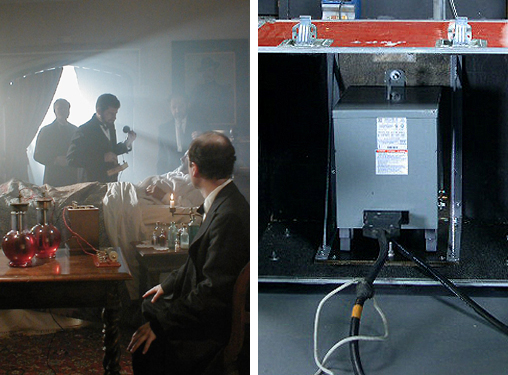
You might want to consider an approach that I have used with great success over the years when the production budget is particularly tight - that is use a package consisting of two transformers and one modified Honda EU6500is generators. I use one transformer to access more power through a 240V circuit on location to run lights inside; while the other I use on the Honda EU6500is generator to bring larger HMIs in the windows from outside. This approach eliminates the need for a dangerous tie-in or expensive tow generators. I have used this same combination of wall outlets, 60A step-down transformer distros, and Honda EU6500is generators to eliminate the need for tie-ins or a tow genny on many of the historical documentaries I have gaffed. For example, I have used this same package repeatedly at a historical mansion in Easton MA called the Ames Estate.

Transformer-Distro_Sam1.jpg

(Scene from "Unsolved History" powered from 50A/240V range outlet through step-down transformer/distro at the Ames Estate)

A popular state fee free location, the Ames Estate, like many historical house/museums, does not permit tie-ins and the electrical wiring in the house is so antiquated that it is unusable. Fortunately, they have a 50A/240 volt circuit in the carriage house for a welder they use to repair the mowers they use at the park. Our standard mode of operation when shooting there is to run 250V extension cable from the welding receptacle to a 60A Full Power Transformer/Distro placed in the entry hall of the house. Using a 60A Siamese at the Transformer/Distro, we then run 60A 6/3 Bates extensions, down to the library, to the second floor, and back to the maid’s pantry. At the end of each run we put another 60A Siamese. A 60A snackbox on one side of the Siamese gives us 20A branch circuits. The other side we leave open for a large HMI or Tungsten Light. Now we can safely plug 1200 - 4000W HMIs (or even a 5k Quartz) into our own distribution anywhere in the house to balance the interior levels to the exterior. A good example of this approach is an American Experience program titled “The Most Dangerous Women in America” about Typhoid Mary that I lit for PBS. For part of her life Typhoid Mary was quarantined on an island in New York's East River.

tmfilmstrip1lg.jpeg

(Typhoid Mary in quarantine on an island in New York's East River. Note the view out the window of the East River shoreline at the turn of the century.)

Because New York’s East River today looks nothing like it did when she was in quarantine, we used a 30' blowup of a picture of the East River at the turn of the century rigged outside the windows of a house in Arlington MA. As you can see by the production stills I have attached, the requirements of this production were very similar to the “Pirate Ship Live” production I described earlier. We had to strike a delicate balance between the interior and exterior levels. We wanted to overexpose the exterior by one stop so that it would look realistic and hide the fact that the exterior was a blow-up. As you can see in the production still of the exterior of the actual location used for the quarantine island, we rigged a solid over the porch windows and the blow-up to keep the sun off both. That way we could light the blow-up and interior so that it remained consistent even though the sun moved on and off the porch in the course of the day. To take the edge off the blow-up, we used a single scrim outside the window to help throw it out of focus.

tmfilmstrip2lg.jpeg

(The actual exterior of Mary’s cottage was the backyard of a house in Arlington Ma with a 30’ blow up of a picture of New York’s East River shoreline at the turn of the century.)

To maintain continuity between shots, we brought a 4kw HMI Par in a window on one side of the room as a sun source and a 1200 par through a window on the other side as a northern light source. We powered both heads off a dryer plug in the laundry room of the house using one of our transformer/distros. The two 2.5k Par lights used outside to light the blow-up were powered by a Honda EU6500is through a second 60A Full Power Transformer/Distro. Since the Honda EU6500is could be placed right on the lawn, we were saved from running hundreds of feet of feeder back to a tow generator.

tmfilmstrip3lg.jpeg

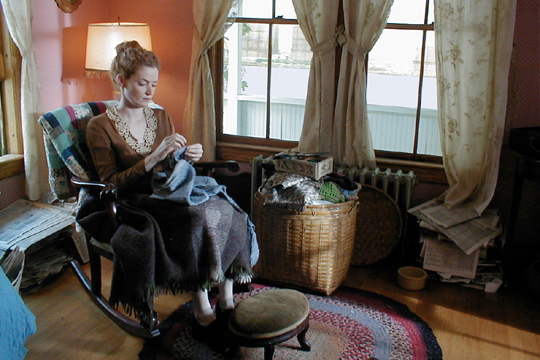
(A child dying of Typhoid Mary filmed in a bedroom of the Ames Estate)

We have been able to use this same basic package at numerous museums and historical houses throughout New England including Sturbridge Village. Fortunately for us, to make ends meet, many historical houses rent themselves out for events and weddings. For that reason, they usually have at least one updated service with 30 or 50 Amp 240 volt circuit for the warming ovens of caterers.

tmfilmstrip5lg.jpeg

(The New York City Health Inspector filmed in the library of the Ames Estate)

Use this link - http://www.screenlightandgrip.com/html/HDPP_Transformer.html - for more production stills of PBS and History Channel historical documentaries shot entirely, or in part, this way. Or, use this link for more details about using step-down transformers on set: . By giving you safe and legal plug-in access to more house power through common 240V house outlets, a transformer can quite often eliminate the need for tie-ins or generators.


Guy Holt, Gaffer, SreenLight & Grip, Lighting Rental & Sales in Boston
 
You don't need to hire an electrician. . If so, you can use a step-down transformer to convert the 240 to a single large 120V circuit that will be capable of powering larger lights, Guy Holt, Gaffer, SreenLight & Grip, Lighting Rental & Sales in Boston
You seem to be assuming that a indy filmmaker is going to have the knowledge of properly bonding and grounding a transformer. I would totally not recommend this to somebody that was not familiar with potential dangers of a separately derived system. From your picture it looks like several clear violations of the National Fire Protection Act. Derek - Oregon Licensed Supervising Electrician , Washington Licensed Supervising Electrician, California Licensed Journeyman Electrician.
 
You seem to be assuming that a indy filmmaker is going to have the knowledge of properly bonding and grounding a transformer. I would totally not recommend this to somebody that was not familiar with potential dangers of a separately derived system. From your picture it looks like several clear violations of the National Fire Protection Act. Derek - Oregon Licensed Supervising Electrician , Washington Licensed Supervising Electrician, California Licensed Journeyman Electrician.

Thanks Derek, I’d never attempt to do wire something like that myself. Like I said, my neighbor’s a licensed electrician. He’d check it out for a favor. Leave it to the pros, I always say - CT
 
Guy, thanks for a very detailed and informative reply. I never considered that farmhouses would run appliances off electric power, but it makes sense. So, yeah, what you wrote sounds great. I’d have an experienced gaffer or electrician wire it up though. I’d never pin the production power on MY electrical skills. (I’m the Producer/Director)
I have two questions for you:
1. I’d thought about shining lights through windows to simulate sunlight and assuring continuity when shooting daytime interiors. The stills you posted makes it look entirely possible.
Would care to guess what size of lights that would take?
2. Since this would be 24 day, one location shoot, with a 90 page script, do you think that 3 Electrics and 3 Grips would be enough to comfortably do the job?
I’m thinking that since the owners would be gone for the month, we could leave lights set up til each room was finished, None of the set-up-tear-down- set-up, that usually goes on. The whole cast and crew would be less than 30 people on a day to day basis.
Thanks again - Craig
 
What size truck are you planning on getting? Just a 1 ton or something a little bit bigger? Either way I think 3 on 3 might be a little much. I just wrapped a 2 location 70 something page feature in oakland a while ago with Arthur Freyers 1-ton. We just had a Gaffer and a Key Grip and for the most part we did well, it was only until we started doing lots of little mini moves around the second location that we could have used one more guy.

So, if this is a small indie thing with a 1 ton, a Gaffer and Key would be fine, a swing too wouldn't be a bad idea. On the other hand if you have extensive rigging in all the rooms, a 3+ ton truck and a tow along genny, then 3 on 3 might be more of what you're looking for.
 
What size truck are you planning on getting? Just a 1 ton or something a little bit bigger? Either way I think 3 on 3 might be a little much. I just wrapped a 2 location 70 something page feature in oakland a while ago with Arthur Freyers 1-ton. We just had a Gaffer and a Key Grip and for the most part we did well, it was only until we started doing lots of little mini moves around the second location that we could have used one more guy.

So, if this is a small indie thing with a 1 ton, a Gaffer and Key would be fine, a swing too wouldn't be a bad idea. On the other hand if you have extensive rigging in all the rooms, a 3+ ton truck and a tow along genny, then 3 on 3 might be more of what you're looking for.

Well, that’s another question that’s hard to answer at this point. This will probably be a Red Camera shoot. I’m told the crew for the Red is a lot like shooting 35mm, generally you have your DP/operator, 1st AC, 2nd AC and DIT. We’d be aiming for a high quality film-look with good saturation and natural skin tones, very high production value.
I’ve heard that sometimes grips and electrics double up (they’re called swings?) but, I wouldn’t want to short change the crew just to save a few bucks.
I’m also a little confused about the cost of a 1 or 3 ton truck. (This is the problem trying to do budget estimates this early in the game).
This is the way I understand it: When they list a 1 ton truck for 175/day, that’s just for the truck rental. Then, they list all this gear as “includes”, but it depends on what you need that makes up the actually rental tally, correct?
From the way people talk, saying you need a 1 ton or 3 ton gives you a good idea of what’s in it. Do you agree?
Thanks Craig
 
You seem to be assuming that a indy filmmaker is going to have the knowledge of properly bonding and grounding a transformer. I would totally not recommend this to somebody that was not familiar with potential dangers of a separately derived system. From your picture it looks like several clear violations of the National Fire Protection Act. Derek - Oregon Licensed Supervising Electrician , Washington Licensed Supervising Electrician, California Licensed Journeyman Electrician.

In his post above Derek raises several questions about the suitability of our Full Power Transformer/Distros in a specific application depicted in a picture in one of my posts. Below is our off thread exchange in regard to his conerns.

- Guy Holt, Gaffer, ScreenLight & Grip, Lighting Rental & Sales in Boston

Hello Derek,

On dvxuser.com you say in reference to a picture of mine "it looks like several clear violations of the National Fire Protection Act." Can you elaborate on what picture and what violations you are referring to. Our Transformer/Distros have passed the scrutiny of many an electrical inspector, but if there is something that concerns you, then it may concern an inspector somewhere, in which case we would like to correct it. I would appreciate it if you would respond off-thread.

Thanks, Guy Holt, ScreenLight & Grip

nwstudios said:
Lack of ventilation space at back of transformer. Usually 5 inches minimum Case and frame you have transformer in need to be ground bonded. Xfmr need to be bonded to to the houses service ground NEC 110-3 "Not intended for the purpose" Xfmr has been modified outside of manufactures design. UL Blue Book Also is the breaker you have them hooked to rated for this type of load? All breakers are not the same. Best, Derek

Hello Derek,

I gather that you are referring to the picture from the "Unsolved History" Production. That picture is actually not from that production and in fact it is not from one of our productions. While we provide an operations manual, unfortunately, we cannot control how the end user uses the equipment. While your concerns are for the most part valid as they pertain to the photo, we are exempted from some of the code requirements you reference by NEC Article 590 (Temporary Power Installations.) To respond to each of your concerns individually:

1) "Lack of ventilation space at back of transformer. Usually 5 inches minimum Case and frame you have transformer in need to be ground bonded."

The style of transformer we use is designed for wall mounting and so does not require rear clearance. We do not recommend mounting our Transformer/Distros in road cases as pictured (it is not a option we offer) and specify the necessary clearance prescribed by the manufacturer. While we provide a manual for safe operation, unfortunately, we cannot control how the end user uses the equipment.

2) "Xfmr need to be bonded to to the houses service ground NEC 110-3"

We provide a ground lug for the purpose of grounding the transformer as required as a "secondarily derived system." Our transformers are Bonded Neutral

3) ""Not intended for the purpose" Xfmr has been modified outside of manufactures design. UL Blue Book"

While UL listing is mandatory in some situations (as you correctly point out in another thread in permanent electrical installations in the state of Minnesota), the film industry in general is exempt from such requirements by NEC Section 590 (Temporary Power Installations) because we deal in portable power applications. In fact, very few of the product lines commonly used in motion picture applications are UL listed. For instance, while Arri lights carry a CE listing (because they are made in Germany) they do not carry a UL listing. Even American made Mole Richardson lights are not UL listed. Of the four primary lines of portable power distribution equipment, only one (ACPower Distribution) is UL listed. While municipal codes can amend or nullify Section 590, most do not. It is a common practice in this industry to modify equipment, such as transformers, for purposes other than those the manufacturer intended. While such use invalidates its' UL listing, as long as it conforms to NEC requirements for portable power distribution as covered in NEC Sections 520, 530, 540, and 590 it is permissible.

4) Also is the breaker you have them hooked to rated for this type of load? All breakers are not the same.
The breaker that we install for secondary over-current protection is rated for that application. The breaker of the portable generators are likewise rated for use with transformers.

While I would not suggest an indie filmmaker to do an electrical tie-in, I do think they are capable of safely operating a transformer - especially when transformers specifically configured for such applications are readily available from film rental, power generation, and equipment tool rental companies. Available in a "cord-and-plug-connected" configuration, our Transformer/Distros are no more beyond the capacity of indie filmmakers to safely operate as a "separately derived system" as it is for them to use portable generators as a "separately derived system" (which incidentally are exempted from NEC Article 250.52 by NEC Article 250.34.) I hope have addressed your concerns to your satisfaction. Please do not hesitate to let me know if I have not.

- Guy Holt, Gaffer, ScreenLight & Grip, Lighting rental and sales in Boston.

nwstudios said:
Hi Guy,

Thanks for clearing that up. Hard to tell from the small picture that it was a wall mount. A lot of these are going to vary due to the "authority having jurisdiction" as you are aware. Washington and Oregon tend to be on the stricter side on temporary power.

My biggest concerns with a DIY film crew would be the proper grounding and bonding on the XFMR. I have a lot of experience with burnt up stuff...

Best,

Derek

Hey Derek,

I understand your concerns, but I wouldn't underestimate the capacity of the readers of this forum. Like Craig, they know their limitations, and don't go outside their comfort zone when it comes to electrical issues. I would like to post this exchange in the thread "Using a generator or house power on a one-location shoot?"

- Guy Holt, Gaffer, ScreenLight & Grip
 
You don't need to hire an electrician. As David points out there is probably a 240 receptacle already. Since most farms use electrical appliances (as opposed to gas) there will likely be a 240 dryer receptacle or range plug. If so, you can use a step-down transformer to convert the 240 to a single large 120V circuit that will be capable of powering larger lights, or more smaller lights, than you could otherwise – effectively eliminating the need for a generator or an electrician to do a tie-in.

If you look at the breaker of a 240V circuit on a building service panel that serves these loads, you will notice that they use two pole breakers - either 30A or 50A. Each pole of the breaker is in a sense an independent 30A or 50A 120V circuit. That is, if you measure the voltage from each pole of the breaker to ground it will be 120 volts, and if you measure the voltage between the two poles of the breaker you will notice that it is 240 volts. As illustrated below, the 120 volts of the two poles adds up to 240V because the 120V circuits are on opposing legs of a single phase service and 180 degrees out of phase with each other. In residential settings, this is how higher voltages are supplied to household appliances like Dryers, Electric Ranges, Air Conditioners, as well as Motors, etc. that require more power than can be reasonably supplied by a single 120V circuit.

Voltage_Adds_to_240-Volts.jpg

The voltage of opposing legs of a single phase circuit add while the current carried on the legs subtract.

Now if you feed the 240 Volt output of the generator to the primary side of a transformer, on the secondary or load side of the transformer it will be converted to 120 Volts in a single circuit that is the sum of the two single phase legs (as illustrated above.) Now that you have a larger (60A usually) 120V circuit, you can operate larger lights like 4k HMIs or 5k Tungsten lights that you could not operate before without a generator. Smaller lights you can plug directly into standard wall outlets.

You might want to consider an approach that I have used with great success over the years when the production budget is particularly tight - that is use a package consisting of two transformers and one modified Honda EU6500is generators. I use one transformer to access more power through a 240V circuit on location to run lights inside; while the other I use on the Honda EU6500is generator to bring larger HMIs in the windows from outside. This approach eliminates the need for a dangerous tie-in or expensive tow generators. I have used this same combination of wall outlets, 60A step-down transformer distros, and Honda EU6500is generators to eliminate the need for tie-ins or a tow genny on many of the historical documentaries I have gaffed. For example, I have used this same package repeatedly at a historical mansion in Easton MA called the Ames Estate.

Transformer-Distro_Sam1.jpg

(Scene from "Unsolved History" powered from 50A/240V range outlet through step-down transformer/distro at the Ames Estate)

A popular state fee free location, the Ames Estate, like many historical house/museums, does not permit tie-ins and the electrical wiring in the house is so antiquated that it is unusable. Fortunately, they have a 50A/240 volt circuit in the carriage house for a welder they use to repair the mowers they use at the park. Our standard mode of operation when shooting there is to run 250V extension cable from the welding receptacle to a 60A Full Power Transformer/Distro placed in the entry hall of the house. Using a 60A Siamese at the Transformer/Distro, we then run 60A 6/3 Bates extensions, down to the library, to the second floor, and back to the maid’s pantry. At the end of each run we put another 60A Siamese. A 60A snackbox on one side of the Siamese gives us 20A branch circuits. The other side we leave open for a large HMI or Tungsten Light. Now we can safely plug 1200 - 4000W HMIs (or even a 5k Quartz) into our own distribution anywhere in the house to balance the interior levels to the exterior. A good example of this approach is an American Experience program titled “The Most Dangerous Women in America” about Typhoid Mary that I lit for PBS. For part of her life Typhoid Mary was quarantined on an island in New York's East River.

tmfilmstrip1lg.jpeg

(Typhoid Mary in quarantine on an island in New York's East River. Note the view out the window of the East River shoreline at the turn of the century.)

Because New York’s East River today looks nothing like it did when she was in quarantine, we used a 30' blowup of a picture of the East River at the turn of the century rigged outside the windows of a house in Arlington MA. As you can see by the production stills I have attached, the requirements of this production were very similar to the “Pirate Ship Live” production I described earlier. We had to strike a delicate balance between the interior and exterior levels. We wanted to overexpose the exterior by one stop so that it would look realistic and hide the fact that the exterior was a blow-up. As you can see in the production still of the exterior of the actual location used for the quarantine island, we rigged a solid over the porch windows and the blow-up to keep the sun off both. That way we could light the blow-up and interior so that it remained consistent even though the sun moved on and off the porch in the course of the day. To take the edge off the blow-up, we used a single scrim outside the window to help throw it out of focus.

tmfilmstrip2lg.jpeg

(The actual exterior of Mary’s cottage was the backyard of a house in Arlington Ma with a 30’ blow up of a picture of New York’s East River shoreline at the turn of the century.)

To maintain continuity between shots, we brought a 4kw HMI Par in a window on one side of the room as a sun source and a 1200 par through a window on the other side as a northern light source. We powered both heads off a dryer plug in the laundry room of the house using one of our transformer/distros. The two 2.5k Par lights used outside to light the blow-up were powered by a Honda EU6500is through a second 60A Full Power Transformer/Distro. Since the Honda EU6500is could be placed right on the lawn, we were saved from running hundreds of feet of feeder back to a tow generator.

tmfilmstrip3lg.jpeg

(A child dying of Typhoid Mary filmed in a bedroom of the Ames Estate)

We have been able to use this same basic package at numerous museums and historical houses throughout New England including Sturbridge Village. Fortunately for us, to make ends meet, many historical houses rent themselves out for events and weddings. For that reason, they usually have at least one updated service with 30 or 50 Amp 240 volt circuit for the warming ovens of caterers.

tmfilmstrip5lg.jpeg

(The New York City Health Inspector filmed in the library of the Ames Estate)

Use this link - http://www.screenlightandgrip.com/html/HDPP_Transformer.html - for more production stills of PBS and History Channel historical documentaries shot entirely, or in part, this way. Or, use this link for more details about using step-down transformers on set: . By giving you safe and legal plug-in access to more house power through common 240V house outlets, a transformer can quite often eliminate the need for tie-ins or generators.


Guy Holt, Gaffer, SreenLight & Grip, Lighting Rental & Sales in Boston


Just had to Mention that your work is EXCELLENT! Please check your Pms.... Thanks
 
Back
Top