HPX250: Up their sleeve?

firehawk

Veteran
So with the new ac90 on the way.. and p2 micro as well plus the new p2 cards to support avc ultra...
What are the odds that panasonic will bring out a newer hpx250 style camera utilizing the improved image stabilization, back lit sensors, pixel shifting that up the image to 4k then down to 1080 like the ac90, but in an avc ultra p2 camera that utilizes the advantages of the higher rate codec. And can finally support 1080 /60p also?
I'd say it was pretty likely it was I'm the works if the 250 and 160a weren't so new and they need to produce them long enough to turn sufficient profits.
Any thoughts?
 
I see diminishing returns on using AVC Ultra 200 on these 1/3" CMOS cameras w/ stock lens. So far AVC-I 100 has pretty much consumes every possible detail out of the HPX-250. I see not so great optical performance at the widest end and closest zoom ranges even all of the hidden CAC circuits are kicking in to compensate for the lackluster optics. The HPX 250 camera's DSP can't deliver its fullest at the $5K price range. Somehow there must be a breakthrough in the DSP & better optics at lower cost. Swapping the current $60K HPX3700's DSP to a $5K HPX250 will boost the quality. But I doubt Panasonic will ever going to do this nor is it possible to put it in a small form factor body.

I rather wait years for a breakthrough. 720-1080p was a good breakthrough, for example. It took them almost 5 years fr. the HVX200 w/ 720p all the way to the HPX-250 w/ 1080p. I'll probably jump in when there's a no-compromising 1080/60p at full raster quality.
 
Last edited:
There is no reason or benefit for that matter in utilising such a strong codec in a camera that uses a 1/3 sensor. As lonewolf said "So far AVC-I 100 has pretty much consumes every possible detail out of the HPX-250." And it's argued that even the AVCintra codec should be 8bit instead of 10bit. Those extra 2bits only encode the grain that much better. The bandwidth of the extra 2 bits would be better spent on widening the image compression.

Anyway IMHO Panasonic should really be thinking or developing for that matter an S35 camera that uses a sensor design for S35 and not a DSLR sensor. They are loosing big time. For instance I have an HPX171 with lots of extra stuff, including P2 cards. I want to move to S35 sensor, but I want to retain atleast my P2 cards. Currently there is no such option and I doubt that there will be one in the near future. I'll have to switch brands (probably Canon) and sell all my P2 cards (which is a totally unnecessary loss in funds).

So my answer is NO. I don't expect that. I would rather be expecting an S35 sensor camera using the P2 system.
 
There is no reason or benefit for that matter in utilising such a strong codec in a camera that uses a 1/3 sensor. As lonewolf said "So far AVC-I 100 has pretty much consumes every possible detail out of the HPX-250." And it's argued that even the AVCintra codec should be 8bit instead of 10bit. Those extra 2bits only encode the grain that much better. The bandwidth of the extra 2 bits would be better spent on widening the image compression.

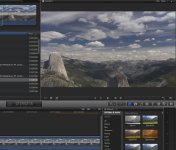
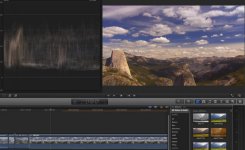
I'm experiencing "encode the grain that much better" first hand with the HPX250 as I'm editing and grading footage shot @ Yosemite. Some screen shots fr FCPX are included for reference. Quality lens, sensor size, and camera's DSP matter and any shortcoming gets magnified as color grading is applied. I can get the colors on both cameras to be pretty close, but undesirable side effects, in particular - grain & noise on the HPX250 footage are increased ~20-25%. The sharpness detail is impaired even the shooting is within the HPX250's zoom sweet spot (not@ extreme wide nor close). On the other hand, the 2/3" footage remains very robust - grain, noise level are all very low and sharpness & detail are still as good as the original.

Background: HPX250 was shot at AVC-I 100. f/stop was within f/2.8-4.0. Focus is sharp. Verified via the red display. Panasonic's new FLAT scene file was used.
HPX3100 and 3700 footage were shot at AVC=I 100/ and with very high quality Fujinon HA series lenses. f/stop was fr 5.6-8. Film Rec gamma @ 600%, factory default color matrix were used.

Subjectively, the grain and impaired sharpness are noticeable when viewing it with a large 42-80" monitor. But when viewing on a small 14-24" LED, CRT & YouTube, it's very hard to discern unless one freezes the frame and analyze. I'd say for the most part the $5K HPX-250 performs pretty good when intercutting w/ 2/3" cam footage minus the grain and uneven sharpness on the image plane (due to stock lens & limited DSP). The good news here is that Panasonic finally have a mature 1/3" cam that can be used in a variety of situations.
 

Attachments

  • HPX250-3100gradingFCPX-1.jpg
    HPX250-3100gradingFCPX-1.jpg
    85.1 KB · Views: 0
  • HPX250-3100gradingFCPX-2.jpg
    HPX250-3100gradingFCPX-2.jpg
    72.1 KB · Views: 0
Last edited:
The good news here is that Panasonic finally has a mature 1/3" cam that can be used in a variety of situations.

Agreed. Finally! But it's about 1 and a half year to late:) But nonetheless, it's here and that is a good thing!

Is the 250 really that sensitive/picky regarding IQ in different zoom ranges and F stops? Is there a big difference?

If the 250 is good enough for web and if you can intercutt it with the big boys then I guess for all intends and purposes it's doing what it's meant to do.
But using such an expensive recording system in such a low budget camera is still a mismatch if you ask me.

8 bit 120Mbs 4:2:2 AVC I frame coupled with CF cards or those small SSD 1,8" disks. This would be perfect.
 
I have concrete lens data on 2/3" broadcast lens fr Fujinon as they provide me upon special request. But for the HPX250, I can only eyeball it. Like most other stock lens, it doesn't perform well extreme wide or extreme close. Somewhere 20% into and before the max zoom is the sweet spot. I don't know the exact lpm on the HPX250. But for a typical high end 2/3" HD lens, it's high in the 85-100 lpm range. For the HPX250 w/ its smaller 1/3" sensor, the built in lens has to be able to resolve at least 190-200 lpm to get the same quality as the 2/3". In other words, it's demanding greater quality optics w/ smaller sensor. I can clearly see this problem when watching HPX250 footage shot at unfavorable lighting condition. I suspect that it's not economically viable to mass produce premium high quality zoom lens for 1/3". Fujinon has a new PL zoom w/ servo zoom motor that costa about $90K! That's a lot of $ just on the lens. Getting that $90K quality down to $5K will be a miracle. Not sure if it can happen within the next 10-20 years.


As for optimal f/stop, Barry stated f/4 to be the max optimal aperture before diffraction kicks in and impair it. Shooting at f/4 can get quite difficult for certain scenes where I want full sharpness (in case of scenics). I occasionally go to f/5.6 to f/8 to ensure larger depth of field for scenics.
 
I just provided our HD fly pack with 2)Sony HXC-100 and 1)HPX250, 1)HPX255/EC4 for a concert. Yes, the HXC-100 triax HD camera chains looked superior, these are $60K camera systems, one of them had a Fujinon 42x HD stabilized lens. They were cleaner and sharper than the 250/255, but not a big difference and I was watching on a 100" front projection 1080P DLP system. The 250/255 is actually cleaner and sharper than our HPX2700 P2 Varicam, but doesn't have the highlight handling of a 32-bit DSP with Film-Rec gamma--but the 250/255 does handle highlights better than any other Panasonic palmcorder.

Having AVC-Intra 100 is great for green screen compositing, I've never seen a compression artifact with Intra 100, sure can't say that about DVCPRO HD. All of our clients love this camera and the addition of the 255 with paint box really adds to the power of this camera series. The new HPX600 looks interesting, but I agree that Panasonic should have continued with its AF100 P2 based successor. At this point, it seems as if Panasonic has retreated back to small sensor cameras, which is counter to where the other manufacturers are putting their efforts. Because of this, we had to buy a Canon C300. I would loved to have a Panasonic S35/P2 option, but it wasn't to be.

Future is uncertain w/ 720p. Many broadcasters still use this, so it'll be around for years. Heck, I still see Betacam SP shooting, mastering and distribution. These people either totally oblivious to HD or don't care as they can't broadcast in HD. The late 80s technology format is still alive and still going strong in 2012! We may be taking 1080p for granted as many others are still using analog 4x3 Beta SP.
 
Last edited:
Future is uncertain w/ 720p. Many broadcasters still use this, so it'll be around for years. Heck, I still see Betacam SP shooting, mastering and distribution. These people either totally oblivious to HD or don't care as they can't broadcast in HD. The late 80s technology format is still alive and still going strong in 2012! We may be taking 1080p for granted as many others are still using analog 4x3 Beta SP.

Ha! That does put 4K into perspective, doesn't it?
 
I just had to shoot with a sony pmw 200 and it was awful. the lens is not wide angle, the led monitor is low res, the codec is 8 bit. the reason why I had to? the 1/2" sensors!!! If panasonic would either move the af100 to a better codec and p2 or if we got 1/2" sensors at least, I would be happy for a long time. the wide dof of the 250 is the only problem I have. everybody wants a shallow dof these days!
 
Excessive shallow DOF is becoming a distraction. Tired of the excessive shallow DOF shots found w/ many productions these days. It's way overdone especially w/ indie music video productions. It's a fad w/ these new big sensors. Just take it easy on the shallow dof effect. No need to show off that you're using big sensors.
 
Well, we may have 4K or even 8K televisions, however, the cable systems are struggling with streaming content now and they are not always coming in at 1080P or 1080 for that matter. Unless there is some revolution in recording and in transmitting 4K and 8K files, then we may see some strange stuff. All this talk about 4K and 8K make me wonder if I should just unload my 250 now.
 
My estimate is at least another 20-25 years before 4K or 8K is realized to the mass public. Broadcasting at 4K is another story. Who will invest new private satellites to accommodate 4K? I haven't see 1080p 3D really take off yet. If the production is cinema or episodic/dramatic TV, I think 4K makes logical sense as a future proof format. But live TV, events, documentary and other non-dramatic productions, it doesn't make any logical financial sense for 4K. A decent PL mount servo zoom lens to fully take advantage a 4K camera sensor is about $90K. Alternatively, one can buy a starter Zeiss Master primes set for a bit over 100K. Anything less lens wise, subjectively is not really 4K. I'd say more like 2K due to lackluster optics. When a real 4K lens is within $20-30K like 2/3" for 1080p, then it'll gain wider acceptance.

4 Tb SATA HDs are just not cheap ($400/each) enough for 4K workflow now. But when 14 Tb hds cost about $100 each, then I'll jump into the 4K production rush.
 
Last edited:
Surely it needs the market to want high quality pictures. They don't want high quality sound, CDs are out and IPod etc is in. Picture wise no one has rushed to BluRay, no one actively moans about TV quality in vast numbers so change could be along time, and money is tight. Hopefully the HPX250 will have quite a few years life in it before we have to change.
 
I just provided our HD fly pack with 2)Sony HXC-100 and 1)HPX250, 1)HPX255/EC4 for a concert. Yes, the HXC-100 triax HD camera chains looked superior, these are $60K camera systems, one of them had a Fujinon 42x HD stabilized lens. They were cleaner and sharper than the 250/255, but not a big difference and I was watching on a 100" front projection 1080P DLP system. The 250/255 is actually cleaner and sharper than our HPX2700 P2 Varicam, but doesn't have the highlight handling of a 32-bit DSP with Film-Rec gamma--but the 250/255 does handle highlights better than any other Panasonic palmcorder.
I just shot a concert trying to mix the 250 with the 2700. The 2700 blew the 250 away!!! I mean not even close. What lens do you have on it and were you at full zoom??? I learned from this shoot that you can not match these cameras. Maybe if the 250 is just used for wide shots.... but sharpness and its terrible in low light response in concert lighting (which is hard on any camera especially those LED lights using congo blue) was really disappointing. I like being able to jam timecode/genlock, shoot AVC Intra, and the small footprint the camera takes up....but honestly thats about it. I'll rent the higher end stuff for now.... and if by January, Panasonic doesn't release anything better (meaning at least a 1/2sensor for low light)... "F" them! Time to jump to Sony. I mean look at this board....we are all sick of Panasonic not keeping up and blowing us away like they use to. We keep holding on...but very very soon its time to let go. Enough is enough
 
I just shot a concert trying to mix the 250 with the 2700. The 2700 blew the 250 away!!! I mean not even close. What lens do you have on it and were you at full zoom??? I learned from this shoot that you can not match these cameras. Maybe if the 250 is just used for wide shots.... but sharpness and its terrible in low light response in concert lighting (which is hard on any camera especially those LED lights using congo blue) was really disappointing. I like being able to jam timecode/genlock, shoot AVC Intra, and the small footprint the camera takes up....but honestly thats about it. I'll rent the higher end stuff for now.... and if by January, Panasonic doesn't release anything better (meaning at least a 1/2sensor for low light)... "F" them! Time to jump to Sony. I mean look at this board....we are all sick of Panasonic not keeping up and blowing us away like they use to. We keep holding on...but very very soon its time to let go. Enough is enough

Sorry, don't agree with any of your points. First, are you using PAP1 or PAP2? PAP1 makes the HPX250 quieter and much better in low light. SN ratio is superior to the 2700, real resolution(not detail circuit) is superior. Now, with the HPX255, you can shade a palmcorder from a proper paint box. Having 1/2" sensors is no big deal at all to me. Yes, 2/3" sensors are worthwhile over 1/3" or 1/2" and the fantastic control of matrix, knee, slope, color correction(multi-matrix), gamma of an HPX2700 with it's 32-bit processor, but the HPX250/255 look amazing for their price point--fantastic green screen cameras, great lens reach with very little CA. Sony PMW-200 has an inferior codec, 14x lens and is overpriced, 1/2" sensors just don't mean too much. I've had an EX1 for years, good camera for its time, but I'll take the 250/255 anytime.

Yes, Panasonic has turned its back on large sensor cameras for now, but the PMW-200 vs. HPX250/255 really isn't a contest, IMO. The rental volume of our 250 and now 255 speaks volumes to me. If you haven't shot with a 250 in PAP1 mode, you're missing out on what the camera is really capable of.
 
With limited budget for an identical HPX-3100, I'm stuck w/ a 2nd HPX-250 for rear cam for a recent concert shoot. Under tightly control lighting condition (all indoor@3200K lighting), the HPX-250 @ wide & HPX-3100 w/ 22x broadcast 2/3" lens for tracking shot, they are both pretty much similar. However, the following day I shot the exact performance but at an outdoor venue w/ very contrasty lighting condition. The HPX-250 is not able to handle extreme contrast fr the stage's uneven lighting. It can't do DRS w/ 1080-30pN. Servo zoom and focus control are so so w/ HPX-250 vs servo zoom found on 2/3" EFP/ENG lenses. 60i w/ DRS for the HPX250 looks too news like for the producer's visual taste. Tried PAP 1 & 2. No luck. The stock lens for some odd reason just doesn't like outdoor. Didn't zoom all the way to minimize optical impairment. It has a very hard time capturing fine detail of the dark stage. This is where I appreciate a $40K 2/3" vs cheap stock HPX-250 lens. It makes less than ideal lighting condition look ideal.

On a side note, if I have a chance to to back and do it all over, I'd have the HPX250 to shoot MS-MCU and let the 2/3" shoot the wider shot. The outcome would be much better as I maximize all of the cam's strong points. Unfortunately the budget didn't allow for 2nd cam op and I didn't feel too excited w/ the HPX-250's built in servo zoom control.

I suspect JamesVibe may be shooting under less than ideal condition. It's the fact in the real-world w/ live events - especially concert. This is where 2/3" w/ quality DSP and broadcast grade lens make a considerable difference. One can save a considerable amount of equipment costs $ if he knows ahead of time that the lighting is near perfect, then HPX-250 can be used w/ fewer risk. If it's not, I'd use 2/3" for critical main shot and HPX-250 for B-roll to save the production from demanding client. Overall it's a hit or miss w/ the HPX-250. Sometimes the footage looks awesome. Other it's disappointing piece of $#@$ for live event shoot w/ variable & unpredictable lighting.

It's a matter of choosing the right camera for the job. Research, lots of test shootings and experiences with 1/3" & 2/3" Panasonic cams will result in a pleasant end product. Failure to prep these cameras prior will not be so pleasant.
 
Last edited:
I agree that controlled lighting is going to make any palmcorder better. I've had clients tell me, "when we have a bigger budget and shoot in a studio, we'll rent your HPX2700 instead of a palmcorder". That's the opposite of how the P2 Varicam with FilmRec gamma should be used--it excels in uncontrolled, doc style shooting. Palmcorders don't have the latitude due to small sensors and limited DSP's. The high-end 2/3" camera will do a better job with shadow detail, highlight handling(the HPX500 is the exception due to it's 18-bit processing hardware). However, I will maintain that the HPX250 is the best Panasonic palmcorder to date latitude wise, due to lower noise floor of AVC-Intra 100, 20-bit processor, Cine D with the option of Knee in Low position. The Sony EX1/EX3 have more image control parameters than the Panasonic palmcorders, but a 1/2" sensor just isn't a big deal sensitivity wise with Panasonic having 3D NR, and doesn't offer a big difference in DOF.

So, let's compare apples to apples, a $20,000-60,000 2/3" HD camera with an $8,000-25,000 HD lens will have an advantage over a $5K palmcorder, as well it should, but nowhere near what the price difference would suggest for camera or lens. The HPX250, when compared to a Sony PMW200 at $1K more, looks very good indeed and not that far off of a high-end 2/3" camera, under proper conditions. I love shooting with our HPX2700 P2 Varicam for doc style, much more so than with our C300 PL, HPX250/255, EX1, AF100, but the HPX250/255 can do a whole lot of things well for normal corporate or event shooting.

HPX250 in PAP1 and Cine D/Low Knee is on a whole different level from previous Panasonic palmcorders, IMO.
 
Back
Top