Tube Camera Composite out to HDMI Converter to Atomos Ninja, can this be done?

Fascinating read, he talks a lot about the amount of light the tube camera need which will be of great use.

Recorded onto Nnovia DV recorders, I can't find any of these for sale or even how much they sell for second-hand, aren't the newer Blackmagic/Atomos/AJA recorders with the correct converter a better option ?
 
We have a bunch of BM convertors, but I have never tried to run composite to SD-SDI or HD-SDI. I've used an Atlona composite to HD-HDMI which looked pretty good compared other upscalers and I think it would put black bars on the sides or stretch if you were using anamorphic SD (which we are).

So you think the 'Atlona Composite Video (BNC) + Stereo Audio to HDMI Video Format Converter and Scaler' would be a better option than the Kramer at this point?

We do run SD component into the BM convertors to get SD-SDI and they work great for this, I'm not familiar with your specific cameras, but I would guess that you have a 14 or 26 pin output on the back, and you might be able to get RGB off of that connector. If not, you should be able to steal it from test points on the encoder board, full level but only sync on green (typically) or separate sync. Most of my tubes days were spent on Hitachi cameras and some even older Ikegami Plumbicon cameras. I would grab an o-scope and check the test points on the encoder card and build up an adapter to get RGB, the quality will be much better and then you can use the BM convertors to get SD-SDI out.

The Panasonic WV-555 does have a 26 pin out, i've looked everywhere to see if anyone knows or can make me a custom cable with the Component out from this but I'm not sure if its even possible? Anyone?
 
We have a bunch of BM convertors, but I have never tried to run composite to SD-SDI or HD-SDI. I've used an Atlona composite to HD-HDMI which looked pretty good compared other upscalers and I think it would put black bars on the sides or stretch if you were using anamorphic SD (which we are).

So you think the 'Atlona Composite Video (BNC) + Stereo Audio to HDMI Video Format Converter and Scaler' would be a better option than the Kramer at this point?
 
Fascinating read, he talks a lot about the amount of light the tube camera need which will be of great use.

Recorded onto Nnovia DV recorders, I can't find any of these for sale or even how much they sell for second-hand, aren't the newer Blackmagic/Atomos/AJA recorders with the correct converter a better option ?

Hiya.

The 1900's being older gen Saticons, they required more light than the Plumbicons of that era so chances are good that your Panasonics may not be as light-thirsty. The Nnovias were like the more readily available Firestore products, although I don't recall if those offered a composite video input like the nNovias. One advantage was that I could build the whole thing into a self contained unit if desired with the recorder onboard, which is a little more challenging when you are using a convertor box as well as the recorder. Outside of that, the workflow you have designed seems like a good one, although there are clearly some issues with the HDMI aspect which can probably be solved with a composite to SD-SDI converter (such as the Blackmagic) and an SDI recorder.

I'm sure you know the pitfalls of working with tube cameras but the hardest one to remember is to avoid pointing at lights for extended periods, and never point at the sun or anything that could reflect the sun. Working the ND wheel that "caps" your camera (or a physical lens cap) is a habit you have to get into every time you put the camera down. 30+ years ago I put a camera on the ground pointing away from the sun for a minute while I made an adjustment elsewhere, and I came back to find a substantial burn across the tube. Playing back the tape revealed the sun glinting off a chrome bumper of a nearby car. I got in a lot of trouble for that and (obviously) never forgot it! And of course, you need to register the tubes with chart and tweaker before every shoot (pretty quick process). I had an old timer broadcast engineer paint my cameras to match, he found it quite nostalgic but it was a formidable process.
 
Hi Charles,

thanks for your insight & input.

its taken me a while to get this far as for some reason there really isn't much into out there on 3 x tube cameras in any type of modern day use.

I've also got two KY-1900E's but both have very bad burn marks on the Saticon tubes. I opted for the Panasonic WV's as like their look and they resolve close to 600 lines, the JVC 's are closer to 400 I believe. The WV-V3 has Newvicon tubes that are better in low light and less prone to burns, as you mention heard some horror stories with bright lights.

So you second the Composite to SDI converter before HD up-res route, less HDMI handshake problems? I really don't think it's possible to get component out from the camera 26 pin output?

I'm hoping the blackmagic video assist will be perfect for this from the SDI converter?
 
Ok, further testing today . . .

I've managed to get rid of the green cast and the Ninja is now showing full colour while monitoring, when I select record it also records in full colour. After recording playback appears to be correct but when I switch back to monitoring the green cast is there again, this can be solved by pulling out the HDMI cable and putting it back in to achieve another 'handshake' between devices.

I'm not that happy with this process and it's far from professional, also I've realised you can't monitor on the Ninja while recording which is dreadful, I was hoping to bypass the poor viewfinder.

As far as my recent finding are concerned would an SDI converter/scaler still be a better more reliable solution?
 
So you think the 'Atlona Composite Video (BNC) + Stereo Audio to HDMI Video Format Converter and Scaler' would be a better option than the Kramer at this point?

Maybe, it has some quirks in regards to losing signal, but I think that was just if it loses video, the audio doesn't return when the video returns. I don't suppose you are located anywhere near me so you could test it are you?
 
This link may have what you need:

http://www.google.com/url?sa=t&rct=...orhBWtelR8v4ovI4Q6ixxbA&bvm=bv.98717601,d.aWw

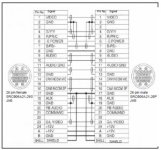
Then again it is google extended so who knows. It is a PDF that shows the pinout of various Panasonic cable. In some modes, there is RGB available, in other modes you have Y/C, and in some other modes you get Betacam component. Hopefully this will attach to a post
26p_connector.jpg

Pins 4, 5, and 7 (G, R, B) and shield on 2.

Then using an component to SD-SDI should give you a very good signal that you can do things with. There might be a couple more pinouts for different cameras, I know Sony used two different flavors of their 26 pin cables for different cameras.

That said, there will be test points on several of the cards that have RGB video, it might be easier to solder thin coax to these test points and run them put through any opening you can create. Might need a card extender to get to them to check for signal level, but it should be standard video levels somewhere in the encoder, and probably mixed with sync in the encoder too. A service manual would be worth some gold on this project.
 
Last edited:
Maybe, it has some quirks in regards to losing signal, but I think that was just if it loses video, the audio doesn't return when the video returns. I don't suppose you are located anywhere near me so you could test it are you?

Unfortunately not, I'm in the UK.
 
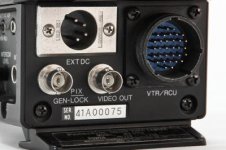
It's actually a 32 pin out, I'd love to be able to get component from the 32 Pin then to SD-SDI, here's a picture of the VTR out.


PANASONIC WV-555 CONNECTIONS.jpg
 
What year is that camera from? I've never seen a 32 pin ccu cable before, just wondering if it came after I made the leap to triax.

Unless that cable is specifically from Panasonic cameras, then I would say no.

I don't have any contacts at Panasonic or I would see if I could get the pinout, have you tried calling the nearest pro/broadcast service center? I'd be willing to bet that if they can find a service manual, they will get you the info you need.

Can you get a picture of the left side of the camera, and one more with the left side cover removed? I could probably steer you to the Encoder board, and then maybe the test points would be labeled R, G, and B. On most of the cards there will be rgb in and rgb out from the card, but the Encoder normally only has the input. From there the betacam and composite signal are created. If you could find the output, a simple continuity between card edge and ccu cable might give you what you need. Be a lot easier if I was standing there with the camera.

I'll try to contact a service place I know and see if they might have a manual for that old camera. It's a remote chance, but still a chance.

Many thanks Greg, think I may have found the correct cable for a store in the US. Sent them an email and will report back with my findings.
 
It's a cool project but considering that you are looking to emulate a dated vibe with the cameras as opposed to their original objective which was to deliver the best quality video possible, it may not be worth it to go through the scramble of trying to squeak component video out of the camera vs composite. However I will be curious if you do get it together what the visual difference will be when all is said and done, so please come back and post some test of both outputs when you have all that going!
 
It's a cool project but considering that you are looking to emulate a dated vibe with the cameras as opposed to their original objective which was to deliver the best quality video possible, it may not be worth it to go through the scramble of trying to squeak component video out of the camera vs composite. However I will be curious if you do get it together what the visual difference will be when all is said and done, so please come back and post some test of both outputs when you have all that going!

Will do, I'll give more away nearer the time of shooting but the films subject matter lends to the cameras image also. I'm hoping to get the best image possible from the cameras and the tubes 'quirks' will hopefully add to the story. Just in the process of trying to source a Component cable from the VTR/RCU that apparently exists.
 
Just had this suggested to me. .

I record straight from the Composite of the tube cameras to a Sony GV-HD700 then offload the footage and grade/sharpen in post? Would this be a good idea? Could I achieve a professional look to the footage? Would this be better than a converter/scaler and HDMI/SDI portable recording device?
 
Going to a DVCam deck was one of the suggestion I made up towards the top. If you have that other recorder, and it looks good, I would use it.
 
Going to a DVCam deck was one of the suggestion I made up towards the top. If you have that other recorder, and it looks good, I would use it.

Thanks Greg, I don't have a Sony GV-HD700 but see them selling for reasonable prices these days. The friend that suggested it like you mentioned there is only one unit as opposed to two in the process so less chance of things being out of sync or non compatibility. Would the GV-HD700 be any better that a GV-D1000 (Standard def)? If I went this direction I'd do everything else in post.
 
Well it is a standard definition camera, so I would want to make certain that the HD deck would record SD signals.

We have a pile of the Sony DSR-1500 decks at work, they would be a decent choice for you with the FireWire interface to bring it into a computer for editing. Also have a pile of the JVC BR-DV3000 decks that if you found one that had the tape drive still in functional condition, would be a good and cheap choice. We had to ditch the JVC because the tape drives were failing, forced us to move to SD card cameras sooner than we wanted.
 
When we used the KY1900's I would often back up the external hard drive recorders with DVCAM decks (which I still own) in case we had issues with the files.

Along these lines you can also capture the composite video straight into a laptop via the Blackmagic Intensity products.

I don't think there is a ton of difference capturing SD and upscaling to HD later, vs doing a real-time upscale, depending on the quality of the scaler involved. Given the nature of 30 yr old cameras, there's a lot of forgiveness there.
 
Back
Top