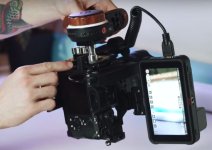
Tilta-Nano Wireless FF

David Evans

Well-known member
Anyone tried this wireless follow focus? I've been reading good things about it. Does it deliver? I'm ok with some workarounds. For the price range, it looks pretty sweet.

Thanks
 
I have one and I do like it.

It’s cost-effective and is easy to learn and use. The only big “con” for me is powering of the receiver/motor. It’s micro-USB. That’s easily adapted to camera power supplies (my V-Mount distro actually has a USB port), but that micro USB connection is not the most robust. I’ve bent a cable connection before.

Minor gripe: the transmitter/control uses a good and widely-available battery, but the magnetic charger that comes with the kit is a little chintzy. I bought a better charger. And an extra couple of batteries. When the battery gets low, the follow focus will start behaving strangely. On the plus side, when things go wonky, it’s most likely a low battery in the controller.
 
It's pretty damn good at a ridiculously low price. So cheap there's no reason not to have it in your kit, even just as a backup. A few notes:

- The displays on both the motor and the controller are TINY. This limits info as well as requires a magnifier just to read. Refer to the instructional videos to learn how to adjust settings.
- For about $8 I got a knockoff Nano-Clamp so that I could mount the controller anywhere I wanted (front rod, pan arm, etc.). This mounts in place of the O-ring clamp that's designed to fit a gimbal tube. Both Tilta and SmallRig sell additional mounting plates for the controller if you'd like to be able to quickly move it from spot to spot.
- The included plate to mount the motor is only good for use on a DSLR or mirrorless camera. Plan on buying a baseplate & rods for anything larger.
- The included motor is only powerful enough for small, low-resistance lenses. If you want a motor with more oomph, the Tilta M motor will work with it as well and I think is around $250.
- The system is bluetooth, so in theory there are limitations on range and interference. In practice I have not seen any issues.
- Don't power the motor from 5v. Even though it is a USB input, the functioning voltage range is something like 4v-17v. At 5v the motor is very slow and has trouble pushing even medium-sized lenses. If you feed it 12v then the little Nano motor is quite responsive. So power it off a 12v P-Tap.
- The opposite is true for the controller. I don't use the included battery because there's no indicator as to drain and when it might fail. instead I power it off of USB but in this case it can ONLY accept 5v power. So if you want to power from P-Tap then you need a cable with a regulator in it. This is the opposite of the cable you want for the motor.
- IndyPro Tools makes (at my request) these cables. 24" cables that are both P-Tap to MicroUSB, one with a 5v regulator and one without.
 
So power it off a 12v P-Tap.
- The opposite is true for the controller. I don't use the included battery because there's no indicator as to drain and when it might fail. instead I power it off of USB but in this case it can ONLY accept 5v power. So if you want to power from P-Tap then you need a cable with a regulator in it. This is the opposite of the cable you want for the motor.
- IndyPro Tools makes (at my request) these cables. 24" cables that are both P-Tap to MicroUSB, one with a 5v regulator and one without.

Mitch, are these the links for the cables?

https://indiproco.com/?term=&s=Nano&post_type=product&taxonomy=product_cat

Jim Arthurs
 
I have one and it is great. (for my manual nikkors and pulling zoom on some AF lenses)

You need to get your head round the best power options outlined above.

Dont use the controller on the inbuilt battery (IMO)
 
Now if Tilta would just release a Left Handgrip Controller that can operate two motors. Weird, because it is mentioned as an option on at least one retailer website and even in their manual, but it doesn't exist. Only the Right Controller can do this (which is the hand I would need to use to access iris control and other functions on my camera's stock grip).
 
Last edited:
Thank you all for your input, guys. I'll mainly use Zeiss Contax lenses with this FF, but even though most of them have very smooth focus, the 28mm F2 is a beast. Will powering the FF with 12v be enough? I think I saw a video somewhere of a guy who could pull focus on the 28mm Zeiss Contax with the regular motor powered by the 12v, instead of 5.
 
I have both the Nucleus Nano and the Nucleus M.
I have not tried powering the Nano motor via USB, but can say it works well powered via D-Tap from my V-Mount batteries.
 
Follow focus frame grab.JPG
I get a chuckle out of self-declared experts on YouTube who clamp the focus controller to the side of their camera, they're clearly missing the point of a wireless follow focus. You can get a decent manual follow focus pretty cheap these days, so I think it makes sense to use a manual FF for general shooting and use wireless when it's warranted, like for crane, steadicam, or gimbal shots.
 
View attachment 138232
I get a chuckle out of self-declared experts on YouTube who clamp the focus controller to the side of their camera, they're clearly missing the point of a wireless follow focus. You can get a decent manual follow focus pretty cheap these days, so I think it makes sense to use a manual FF for general shooting and use wireless when it's warranted, like for crane, steadicam, or gimbal shots.

So you are saying that if someone already owns a wireless follow focus setup and is working as a single operator, they should spend more coin on a manual follow focus rather than use what they already own?
 
I think it's fine to hard mount it to the camera as the delay is nothing and the mount has a quick-release so that it can be used remotely in a second.
 
Thank you all for your input, guys. I'll mainly use Zeiss Contax lenses with this FF, but even though most of them have very smooth focus, the 28mm F2 is a beast. Will powering the FF with 12v be enough? I think I saw a video somewhere of a guy who could pull focus on the 28mm Zeiss Contax with the regular motor powered by the 12v, instead of 5.

12v is most likely fine for that lens.
 
I think in a lot of cases it's more practical to use a manual FF, as it's one less thing to keep powered, and has less failure points, which can save you time and money in the long run. My post was meant to deride YouTubers who over hype a product for the affiliate link profits without understanding its intended use. It's not a sin to clamp a wireless FF controller to the side of your rig, but a manual FF is better tool for that application. I could understand it if money is extremely tight, but the again, a second hand Fotga DP500 FF will get the job done, and runs about $40-$70, which is quite cheap as far as filmmaking gear is concerned.
 
Many of us are powering everything including camera from a single V-Mount / AB battery so power is a non-issue.
A manual follow focus has a fixed mounting position on your rails. The wireless controller can pretty much be mounted anywhere convenient.
The wireless controller can be used with reverse direction focus lenses at the push of a button, can quickly set A-B points, and can expand control of lenses with very short focus throw.
Just saying.

I also own a manual follow focus.
 
Back
Top