THE WEATHER CHANNEL SELECTS PANASONIC HVX200 CAMERAS FOR
LIVE COVERAGE AND FIELD PRODUCTION
* Cameras Hit the Road to Record Breaking Weather News and Features,
Easily Withstanding Tornado Gales and Sub-Zero Temps *
SECAUCUS, NJ (July 12, 2006) - Although the videographers working for The Weather Channel (Atlanta, GA) are exposed to harsh weather conditions, the forecast for their new Panasonic AG-HVX200 DVCPRO HD P2 camcorders is clear and sunny. The cable network currently uses six HVX200s for live coverage and field production, including shows such as Storm Stories, Forecast Earth, Evening Edition and more.
“The cameras have worked splendidly,” said Nathan Smith, vice president of broadcast operations for The Weather Channel. “When we were shopping for new cameras, we considered Panasonic and Sony cameras. One of the major deciding factors that made us choose Panasonic was the HVX200’s easy interface with our Apple Final Cut Pro editing systems in the field and at our facility.”
Other appealing aspects of the HVX200 include affordability, maneuverability, variable frame rate capability, and a path to HD acquisition. While The Weather Channel’s videographers shoot predominantly in DVCPRO50 standard definition, the network is already embarking on plans to move to high definition. “We plan to start gathering all content for our Storm Stories and Forecast Earth series in HD to build an archive of material for our eventual migration to the format,” said Smith.
The HVX200 uniquely combines multiple high definition and standard definition formats, multiple recording modes and variable frames rates, and the vast benefits of P2 solid-state memory recording in a rugged, compact design. This DVCPRO HD P2 camcorder offers contribution-quality acquisition with independent intra-frame encoding, 4:2:2 color sampling, and less compression, making content easier and faster to edit and more able to stand up to image compositing versus long GOP MPEG-2 systems.
“People might not think of using the HVX200 for live applications as we do, but we’ve outfitted the cameras to give them the look and feel of traditional shoulder-mounted cameras,” said Smith.
”Locating third-party gear was essential in supporting the HVX200 cameras in live applications,” said John Thayer, senior manager of broadcast operations at The Weather Channel. “BEC Group's brackets and mic/IFB mounting gear were huge finds for the live environment. Anton/Bauer's STATIS shoulder-mount power support system allows photographers to use the same batteries they used with their larger gear, which literally provides camera power all day with the use of one battery. The Anton/Bauer QR DVX power taps allow a
photographer to belt clip a battery to his side and go hand-held. Other essential support gear includes Camplex Camera Adapters, which allow the cameras to plug into our satellite trucks, supporting video, audio, IFB and return video from one cable no larger than a typical coaxial.”
The HVX200 in Tornado Alley
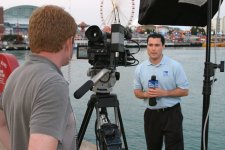
Brad Reynolds, a videographer and satellite truck operator in The Weather Channel’s Chicago bureau, covers daily news stories about storms and tornadoes with on-air talent Jorma Duran for Evening Edition’s block of programming. Joining The Weather Channel after relocating from New Orleans after Hurricane Katrina struck last year, Reynolds had never used Panasonic cameras during his previous years in local news and production, but has been pleased with the quality and size of the camera. His team uses the HVX200 for live shots every day, whether it is a live toss to a story or going live with breaking weather.
“As a part of the ‘tornado team,’ I cover storms and their disastrous aftermaths for 90-second stories that air during Evening Edition,” said Reynolds. “The camera is subject to wildly erratic climate conditions, and we cover the HVX200 with a Portabrace to withstand rain and hail.”
“I travel so much that it’s convenient to have a small camera like the HVX200 that doesn’t take up much space,” Reynolds said. “Some people might look at a camera this size with its new technology and worry about it, but the HVX200 is giving me the same results as a full-size ENG camera. It’s definitely the way technology is headed.”
Reynolds shoots and edits with Final Cut Pro on a laptop and uplinks back to The Weather Channel’s Atlanta headquarters. Reynolds records DVCPRO50 to two 8GB P2 cards.
“At first, I was somewhat intimidated by the idea of the P2 card,” said Reynolds. “However, after playing with it for a few hours, I really didn’t want to use tape anymore. It is much more convenient to use the P2 media than to pack and drag a bunch of tapes around with you.”
“Each P2 card holds about 30 minutes [of DVCPRO50 material], and I usually shoot a story in less time so I don’t have to pop the cards in and out,” he said. “When I’m done shooting, I offload the card onto a portable Lacie hard drive, which plugs into a Macintosh PowerBook running Final Cut Pro. I edit the story, and then run FireWire out of the computer to a Miranda box and out of that to a patch panel in the side of the satellite truck.” Reynolds keeps the raw footage recorded to the camera’s mini DV tape for archiving purposes. He initially thought the P2 workflow would be challenging, but found it to be as easy as shooting to tape and editing.
“I formerly used Sony SX-format ENG cameras and, to me, the HVX200 offers better picture quality. I have more play with the color temperature,” he added. “I like to go to the menu sometimes to get a warmer look for a sunset and give everything a glow. The camera’s color really pops out.”
Reynolds also likes the scene files. “I can set up different white balances for day and night, save them, recall them and know that I will get the exact colors of the day before,” he noted. “Also, 24p is a great asset — I’ve shot some well-lit, sit-down interview vignettes in 24p and they looked terrific.”
Deep Freeze and Beyond
Not only useful in stormy weather, the HVX200 has proven to be an invaluable tool for various extreme weather shoots. For instance, The Weather Channel videographer Rodney Hall took the camera right out of the box and to Alaska. Since then, it has been to Los Angeles, San Francisco, Graceland and FedEx’s Memphis headquarters with Hall, who is assigned to The Road Crew, a segment of Evening Edition.
“We travel to a different city each week and shoot four feature stories on outdoor pastimes – such as rock climbing, white-water rafting and parachuting – all with weather tie-ins,” said Hall, a 21-year video veteran.
In Alaska, Hall took the brand new camera to a military research facility where a cold chamber is used to test product performance at extremely low temperatures. “We went into the -50 degree Fahrenheit chamber to see if antifreeze would freeze and how oil behaves,” Hall said. “We were in the chamber for five minutes and never had any problem with the camera. The HVX200 was not wrapped, yet it behaved just as it would have in warmer temperatures – even though my eyebrows were beginning to frost!”
“When we came out, there was no condensation build-up or fluctuation in the battery; we continued to shoot without missing a beat,” said Hall. “The HVX200 may well be the only camera ever exposed to temperatures that severe.”
As shoots often take place on the road, many times with two or three consecutive stories a day, Hall records to mini-DV and keeps P2 cards on hand as back up. Hall frequently uses the 24p mode, preferring the look for outdoor shoots.
Like Reynolds, Hall had used Sony SX cameras prior to working with the HVX200. “The HVX200 outshoots the SX colorwise,” Hall declared. “The picture is much more sharp and vivid.”
For shoots, Hall often finds himself in confined spaces such as cars, biplanes and acrobatic planes, where the HVX200’s small size is a plus. “I couldn’t shoot in those spaces with a big camera,” said Hall. “Formerly, we would veer away from those types of shots, but now we can accomplish them easily with the HVX200.”
Whenever his HVX200 is set up on location, most onlookers are surprised. “They are so used to seeing big cameras. But I just explain to them that this is what the future looks like.”