The Sony F65, thoughts and feelings of an F35 Addict

JMtheDP

Veteran
Prologue

Okay, this is going to be a long one. I suggest getting a cup of coffee, tea, or whatever your preferred poison is before settling down on this one.

This thread is intended to be my thoughts and feelings regarding the work Sony did with the F65, from the perspective of an F35 user. I am trying to keep this thread more towards the practical and ergonomical side of the camera, rather than an image quality perspective - I find those to be less subjective areas. If you read through this thread I am sure you will see I do not think of the F65 as a winner on all fronts, but I hope this thread will explain somewhat my decision and maybe help inform others whether the move is right for them (or not, as the case may be).

Chapter One - A Little Drama


So I was extremely careful sourcing my F65. I found a well-known broker, dealt directly with the seller, reached a good agreement which included a service and upgrade to V3.00 (actually V4.01, more on the significance of this later). The deal was struck, the camera got serviced, money was exchanged and after a short 48 hours trip, the camera landed on my doorstep.

I fired her up, to be greeted with all manner of flashing lights, a warning reading "Mechanical Shutter NG" and what appeared to be something very stuck in the middle of the sensor. Suffice it to say, I was rather panicked.

29bfxmt.jpg


I threw the camera in a case, rushed off to Top Teks (The UK's Sony authorised repairer) and hoped the fix would be simple. We pulled the camera to pieces but found nothing wrong except three wires which had been crushed when the camera had last been worked on - by Sony LA. The shutter and ND wheel were checked over and appeared to move freely, so we fixed up the cables and put her back together. She fired up, with no error messages. I did learn that the shutters on these cameras can clog up, mist or do many strange things in high mileage cameras - something F35 owners won't have to worry about as we have far fewer moving parts. I got one quick snap of the F65 with the side off and the interior is not dissimilar to any other high end camera.

2wcfi4h.jpg


I am currently in the process of raising this with Sony LA, as I should really replace the crushed loom in the camera in case it breaks in future. I will put updates in this forum.
 
Last edited:
Chapter Two - First Impressions

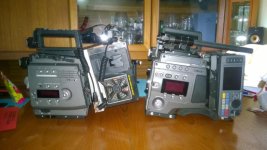
"Blimey, it's bigger" is pretty much the first thing that I expect will come to mind for most people. I think this shot should also highlight the F65 very much comes from the same design ethos as the F23 and 35.
2akb9sx.jpg
Here is my F65 (right), compared with ̶m̶y̶ ̶b̶e̶a̶u̶t̶i̶f̶u̶l̶,̶ ̶f̶a̶i̶t̶h̶f̶u̶l̶ Shridhar's lovely new F35 (left). You'll notice that the body of the F35 is considerably smaller and is sitting flat, where the F65 is sitting leaning back.

This is thanks to the F65's integrated shoulder cushion which, I must say, works brilliantly and is an utter joy. I will post some "operating" pics later when I have some more time with the rig - right now I have had only very basic time hands-on.

The F65 is much taller and has top rods - something I really don't like. They will be coming off very soon. I will probably be buying an Element Technica cheese and side plate, plus a new handle for the top which is easily removed (it removes vital height making it easier to store the camera). My F35 obviously had effectively a built-in screen courtesy of the Cinedeck, whereas the F65 does not. Most of us on this board do not use the SRW-1 deck for our F35s, so most of us have an outboard recorder with some kind of monitor already. The F65 will need a dedicated monitor, or you could use your recorder as a monitor but it seems a bit wasteful.

Weight I would say is very similar. I can't be bothered to put either camera on the scales but there is not much in it with this particular setup. I would say some F35 users with a really lightweight setup may actually have something lighter than my F65 setup. I find much of the criticism directed at the F35 was either based on the original configuration with the SR deck, or just wrong. The F65 gets similar flak.

What I find interesting in any case is that I have recently been dealing with a lot of 35mm cameras and both of these cameras are considerably lighter and more compact than any of those!
 
Last edited:
Chapter Three - Power

Perhaps the most frustrating thing with the F35 was powering it. In reality, it was no more difficult than powering a film camera, but the particular route I chose with my F35 (Cinedeck) did leave me tethered to the battery or battery belt more often than I would have liked. Going block with the F35 and the F65 makes sense, but the layout of the F65 has allowed me to go back to a more traditional setup. In fact, I may soon be able to have a nearly totally cable free setup.

The main thing responsible for this is the fantastic Hawk-Woods Reel Power system. For those who don't know them, Hawk-Woods are a company in the UK who specialise in batteries, cables, etc... for the film industry. All of my batteries and cables get made by them. They can make basically anything. I have a large lithium ion battery from them which costs half of the equivalent Anton Bauer model, is lighter and lasts longer. Their "Reel Power" batteries are a new series of batteries designed for 24v cameras - mainly the ALEXA and Phantom.

But the F65's 12v, isn't it? Yes, it is. Like the F35, the F65 uses the 8-pin LEMO connector which takes both 12 and 24v power. The power draw of the F65, with recorder, is between 100 and 110w depending on who you ask. In 12v terms that's getting on for 10 amps - a fairly chunky draw and one most on-board batteries can't provide. The Reel Power system has an adapter for the F65 which includes a voltage reducer to provide 15V. Being a natively 24v battery, the F65's draw (and F23/35) is easily within the battery's capacity. The only annoyance is the battery adapter is quite large, because it includes a heatsink to dissipate the heat generated.

I can highly recommend the RP system to any fellow F23/35/65 users. It is the only solution I know of which provides ample power and at BOTH 12 and 24v for our cameras. It has revolutionised my setup.

What is interesting to me, though, is that the actual draw of the F65 body is higher than the F35. Not by much, but it is higher. Interesting when one major advantage of CMOS sensors is supposed to be low power draw. Neither camera is frugal on power, however.
 
Chapter Four - First Day on "Set"

imijv8.jpg
The first day with any new camera is always an interesting one. The first job I had with the F65 was something very unusual for me. It was a video to help promote a lady's new wedding hire business - supplying decoration, favours, etc...

Not normally the sort of work I take on, but I was referred by a guy I've worked for in the past who was good and reliable, plus on these things I edit myself so I thought it would be a good chance to get used to the new workflow.

Initially, I had planned to use the camera's HD capture mode. One of the major draws for me of the F65 was the choice of recording modes. I will summarise as follows:

HD:
1920x1080 4:2:2 10-bit @ ~220mbps (SR-Lite)
1920x1080 4:4:4 10-bit @ ~440mbps (SR-SQ)
1920x1080 4:4:4 10 or 12-bit @ ~880mbps (SR-HQ)

The above bitrates will be pretty familiar to anyone who ever used HDCAM SR tape. On SR tape you had those choices (although not 12-bit). The codec used in the F65 is Simple Studio Profile MPEG-4 (SStP) - precisely the same as used on HDCAM SR tape - a very well known, very flexible format which will be familiar to most post houses. When recording in one of the above modes, you must choose to burn in a look-up-table of some sort. This will most likely be one of the new versions of S-Log (2,3 and 3.cine - more on those in another chapter). You can also use 709 and Hypergamma LUTs but I cannot think why you would buy or rent an F65 to shoot this way.

If you want to go for gold and shoot top quality, there are two main RAW modes. (There is a third that will be discussed another time)

RAW-SQ is 16-bit linear, full sensor data (8192x2160) at approx 3:1 compression (mathematically lossless). This works out at about 2.0Gbps / 250MB per second, or 15 GigaBYTES per minute. Or about Terabyte an hour. Seriously big, BUT not much larger than the equivalent REDCODE (on DRAGON) or ARRIRAW 4:3 - which is only 12-bit (but totally uncompressed).
RAW-Lite is a second option, that differs only in having a stronger compression ratio - about 1.2Gbps/ 150MBPS, giving you around 9GB for a minute of footage. So a terabyte goes to more than an hour and a half. Still not a small file, but actually smaller than 16:9 ARRIRAW and much higher res and colour depth.

The F55's RAW in comparison, is around 960Mbps - so 80% the size of the lite mode on the F65. These numbers should help anyone thinking they can't afford the data involved in the F65. If they can afford F55 RAW, they can afford F65 RAW.

For fun, the Canon 1DC's codec is about 500mbps shooting 8-bit Motion JPEG (a hideously outdated codec that most of the civilised world left behind long ago).

I decided in the end to go F65 RAW - Lite. I didn't need RAW, at all, but I wanted to use this project to test several things out.

Enough tech banter. How is the camera to operate? In a word, fantastic. Everything pretty much comes naturally after having used an F35. I actually find myself in the menus more often than the F35. A couple of reasons. No 1 - I am still in the honeymoon period. No. 2 - the camera has built-in NDs, operable through the menu on the side of the camera. I do wish the camera had an F35-style assistant panel. I guess they either felt they weren't needed, or it was another victim of trying to make a camera 1/3 the price of its predecessor.

The NDs alone, for me, make this camera a worthy upgrade from the F35. As much as I was a die-hard believer in doing things "the proper way", having lived with a camera with a built-in wheel for two years, that department of the F35 felt a bit like a step back. I'm very glad the F65 has it. It saves so much time. The built-in NDs are proper IRNDs and if nothing else mean that should I change my lenses, or hire in a large zoom, I don't need a new set of IRNDs to go with it. The NDs are 0.9,1.2,1.5 and 1.8. To be honest, I'd rather 0.6,1.2,1.8 and 2.1 but nothing's perfect I guess.

I'm sure there are better cameras in "low light" but at ISO 800 and with lenses that go to T1.3 (but are much better from T1.6 onwards) I really can't think of many situations when I should struggle for exposure. I found with the F35 and my standards, T2.1 @ 400 ISO (what I preferred to rate the camera as) usually got me exposure in any interior. Now I have two stops more flexibility - nice to know it is there.

The ergonomics of the F65 are very similar to the F35, with the exception of the shoulder pad. I've yet to get some proper handlebars on it (sold my shoulder set to Jon) but I will have some soon and I am looking forward to handheld with this camera. It is very well balanced with a good size prime and a lightweight matte box. I am also going to attach a wireless transmitter to the system which means I can be completely cable free - a real revolution. Not something F65 specific, but for me personally this is a real plus.
 
...continued from above

Anyone looking at the picture in the thread above thinking "I don't know what all the fuss is about"..... I can see what you mean. Bear in mind this was a no-lighting, quick shot. I also noticed afterwards my focus was slightly off. Focusing in 4K is stupendously difficult. I am still getting used to the new viewfinder and working out what works best for me when I have to pull focus for myself.

Here is another shot from the same shoot

11b8dnt.jpg


For those desperate to play with full size pics, I am uploading what I can to www.tee2.tk/shared/f65/

For now I am limiting my uploads to single frames - the DPXs are 50MB each!

If viewing these pictures, I recommend checking the detail on the floating heart in the candle pic - the texture captured is quite incredible.

Here is also a quick shot of my setup as it stands right now.

73cv20.jpg


The camera appears quite large... because it is relatively large, but in reality it is not much longer than either an ALEXA loaded up, or even an F5/55 with the RAW recorder on. In fact, compared with an ALEXA "classic", plus CODEX recorder for RAW, this is a downright compact setup. I'm really loving it thus far.
 
James,

What are you using to look at the raw? Resolve? Raw viewer?

Just a heads up to avoid the Rec709 raw decoding options.
 
Hi Guys,

Baddgsx - Thankyou :) It is a joy to use.

Nate. Right now, I am using Sony's RAW Viewer. I am having some difficulties with resolve. I am using the LC709A LUT on the footage.
 
Hi James, congrats on your F65 and finally arriving. Too bad about the initial scare, but sounds like it wasn't anything major anyway. (phew)

Thanks for posting some quick frame grabs. one thing I can attest to is that with exception to the F35, the images coming out of the F3/F5/F55/F65 really do need some good tweaking in grade to bring the images more to "life". I've started several threads on this and admit its been an evolutionary process for me at least. You'll probably find that the LC709A and even 709+Cine LUTs bring the image to a good point of starting the grade. Unlike the F35 which out of the camera with a small tweak is quite phenomenal, these newer cheaper F series CineAlta cameras seem to need some "work".

Hope you don't mind, but I gave a quick go at the two frames you posted and came up with these from your DPX images. If you require that I remove them I will do so immediately.

candle
candle_cc1_1.1.1.jpg


lavender
lavender_cc1_1.2.1.jpg
 
Last edited:
Feel free to tweak to your hearts desire :)

I am certainly no colourist - I agree one of the greatest things about the F35 was the stunning look "out of the box". I am, however, awestruck with the flexibility of the F65 picture. My exposure also needs a lot of work, I feel this is a camera that, like the F35, is going to work best off a lightmeter - the OLED viewfinder is not good for judging exposure (not as good as my Accuscene was!).

I do, luckily, have a tame colourist who will be taking care of any proper stuff I shoot. As and when that happens, you lot will be the first to know.

It is nice for there to actually be easy-to-find proper Sony-authorised LUTs for S-Log 2 and 3 anyway, more than I can really say for S-Log1.
 
Not to state the obvious but regarding exposure RAW will give you much more exposure latitude as opposed to S-Log on these cameras - which has far less exposure latitude and room for error. The F35 seems to get away with it, likely due to internals which give it the "mojo" not found on the newer F-series cameras, but I suspect since the F65 can record S-Log in 12-bit you'll have a little more freedom than its 10-bit counterpart.

I'm sure you are probably already aware but I published an "Ultimate Exposure guide" for the F5/F55 cameras and in reality it's applicable to the F65 as well. It's nothing revolutionary but does explain some "issues" and considerations when working with S-Log and why good exposure becomes so critical. There's also quite a bit on using light meters in the guide, and also if you are using any LUTs for exposure (such as LC709A) be cautious that different LUTs have different mapped reflectance values when exposing for 18% grey or 90% white. For example with LC709A 71% exposure for a white card is actually the right level for S-Log, not 90%. So if you used 90% you'd be 19% IRE over-exposed which is around 2 stops... and LC709A maps 32% grey for S-Log at 40%...

www.cinetiny.com/exposeGuide
 
I'll be sure to give them a look Star. I wouldn't think 10 or 12-bit should give you any more exposure latitude - it is just finer gaps between the shades, not more exposure room?

The original S-Log was designed to hold the information that the F35's sensor could provide, the newer cameras provide more information, so things don't work the same.

It is interesting that with ARRI and ARRIRAW, they state there is absolutely no benefit in terms of dynamic range using ARRIRAW over LogC, but I appreciate LogC and S-Log are not the same.
 
Not to state the obvious but regarding exposure RAW will give you much more exposure latitude as opposed to S-Log on these cameras - - which has far less exposure latitude and room for error.


Wait, wait, wait. Sorry to jump in the conversation Starcentral, but these kind of missconceptions are a bit problematic. If the log curve is done right, it can contain as much dynamic range as the raw file has. Raw is no magic weird science. If the whole data is mapped to a log RGB image/video file, you won't get any extra stuff from the raw source. I keep insisting that this missconception comes from how Camera raw in adobe products works, where you seem to gain extra highlight detail by squeezing the higlights and pushing shadows.

On a different subject, here's an interivew with Thierry Arbogast, a dop whose job I used to like a lot. He won't stop talking about how awesome the F65 for half of the interview:
http://www.fdtimes.com/2014/07/24/luc-bessons-lucy-described-by-thierry-arbogast-afc/

After reading that interview I'm getting the feeling that Mr Arbogast really doesn't know much about cameras, because he keeps insisting on how pretty or ugly the camers are outside, gives quite some contradictory statements, relies on a DIT for exposure, adjusts exposure by playing with the ISO on the camera (which we all know just changes where mid tones are and has no real effect on how the sensor works, either on F65, Alexa or Red) and he doesn't use a lightmeter and just says brighter/darker by looking at a monitor. I don't know, I'm a nobody compared to a guy that has shot a ton of awesome movies, so I shouldn't say much.
 
Last edited:
When I say "exposure latitude" just to keep things in proper context it means any over or underexposure of the image. ie. RAW will give you a little more room in your exposure whereas with S-Log its not the case and you need to be a little more "bang on".

So yes "if the log curve is done right" it can contain the same dynamic range as the RAW file, I don't believe I said anywhere that one can not contain the same dynamic range as the other.

Art Adams wrote an article stating that "Log gives us 99% of the benefit of a raw file in a grade but with much smaller files." He is right that it can hold the same picture information and hence dynamic range. What it doesn't tell you is the difference it will make when it comes to exposure in-camera and later in grading. There are lots of misconceptions out there indeed. It's easy to talk about one half of it and leave out the other half.


@James - I meant 12-bit s-log may provide a little more exposure room than 10-bit but it's unclear just how much as I haven't had the pleasure to work on many 12-bit S-Log images but hopefully now that you have the F65 you will provide some samples. I'd love to play with it and particularly 1-2 over exposed mapped S-Log values.
 
Last edited:
When I say "exposure latitude" just to keep things in proper context it means any over or underexposure of the image. ie. RAW will give you a little more room in your exposure whereas with S-Log its not the case and you need to be a little more "bang on".
QUOTE]


WHY?
 
With S-Log the more you overexpose the more a video-look you are going to end up with because the higlights are falling into a heavily compressed part of the gamma curve. With RAW, its not really the case and even with some overexposure you can still retain a little more of a "filmic" look.

Best example I can think of is taking RAW stills with your DSLR. Overexposed you can pull down your exposure and highlights still look smooth and beautfully rendered. Do that with *most video cameras that don't shoot RAW and it's video-land and clippy REC709 looking highlights.

*The exception again seems to be the F35, Genesis, and ARRI cameras which I'm convinced, highly speculating, and likely is subject to some type of trade secret, that these cameras do some additional highlight limiting and processing in-camera that even if stored using a log based gamma curve still preserve some of that "filmic" look with respect to the highlights.

So with RAW I might "expose to the right"... with S-Log on F3/F5/F55/F65 I wouldn't dare.
 
This conversation is getting pretty muddled, and I think some technical terms are being misused, causing some consternation.

We have several different elements in play here:
- We have the "raw" unadulterated image sensor values, as processed by the A/D DSP. In the Sony F35, these are 14 bit values, I beleive. Assuming there are no illegal values, that means 16,384 possible luma values for every photosite. The F5 & F55 use a 16bit RAW. Assuming the A/D is 16bit with no illegal values, that means 65,536 possible luma values for every photosite.

- We have the encoded data stream fed to the recorded medium. Depending on the camera and recorder this may be "RAW" or video. It may be compressed or uncompressed. It may have either a fixed or a variable bit depth. When the term "RAW" is used we expect this data stream's source be photosite data from a bayer sensor that has not had any curves or processiong applied. It may, however, have been compressed, and may have had the bit depth reduced from that of DSP A/D. In the case of video streams, we expect that the (typically linear) DSP A/D photosite data has been processed and had some sort of curve applied. This video stream will have a bit depth that is typically lower than that of the DSP A/D. This does not inherently mean that any values from DSP A/D have been clipped high or low (although with some curves they are) - it means that the values from the DSP A/D have been mapped to representative levels in the video stream. In the case of the F35 the DSP A/D is 14bit (16,384 brightness values) I think, and the maximum video stream output bit depth is 12bit (4,096 brightness values).

- We have the usable dynamic range of the image sensor, measured in stops. Technically speaking, we can map any number of stops to any bit depth we choose. In a theoretical sense, I could map an image sensor that sees 16 stops of light to a 4 bit (16 brightness values) data stream, and technically, I would have recorded 16 stops of light. Practically speaking, however, as we increase the number of stops the image sensor can see, we need to increase the bit depth of the DSP and encoded data stream to make those light stops available for color grading.

These are all interconnected properties. They're all important. The fact that the F5 and F55 have 16bit encoding gives them an edge (at least on paper) over the F35 with it's 12bit encoding. Not because they see more stops - but because the recorded data stream has a greater level or gradations from 0% to 100%.

If anything, the notion that you need to be "bang on" with the F35 has everything to do with bit depth. The notion that "RAW" doesn't discard stops while S-Log does... I think that's plain wrong.

...

I do think there's a growing problem in production. As technology gets better and better at allowing us to capture wider dynamic range on set, productions are getting lazier about actually lighting and exposing correctly on location. RED once produced a demo clip (for the EPIC I beleive) that showed a long camera shot driving through a sodium vapor lit tunnel and out into daylight, while maintaining exposure in the graded image. It was impressive. But for every shot like this that takes excellent advantage of the technical merits of extended dynamic range, I see about 100 lazy shots where "RAW" is used as an excuse to not rent lights or grip gear, or crew to bring those elements into range.

In my opinion, if you don't light and you don't grip - if you just point the camera and shoot - then let the colorist make the decisions in post - you're not a DP - you're a camera operator.

I don't own an F35 because it's the perfect tool for every situation - it absolutely isn't. I own it because it's an amazing and affordable DP's camera. When I light and rig, it makes those decisions look beautiful, with minimal post work. Everyone's entitiled to their own process. As a DP, when I can, I'd rather make strong choices on set instead of leaving everything to the colorist.

Thanks!
 
With the point I was making about RAW giving more exposure room over S-Log, it's not so much about having more bit-depth as it is the difference in how data (or gradations between 0-100%) gets distributed across the entire tonal range between S-Log and RAW.

ie. S-Log allocates a more even amount of brightness values across each stop throughout the range whereas with RAW it is much more heavily biased towards the brighter tones which goes a long way in preventing ugly crunchy highlights in overexposed images once properly restored in post.

Either way can't wait to play around with some 8K RAW files from James once they become available! Please be sure to get some skin tones in there too if possible! :beer:
 
With the point I was making about RAW giving more exposure room over S-Log, it's not so much about having more bit-depth as it is the difference in how data (or gradations between 0-100%) gets distributed across the entire tonal range between S-Log and RAW.

ie. S-Log allocates a more even amount of brightness values across each stop throughout the range whereas with RAW it is much more heavily biased towards the brighter tones which goes a long way in preventing ugly crunchy highlights in overexposed images once properly restored in post.

That is misleading. A "stop" is a doubling or halving of light quantity. Hypothetically, for a given camera setup receiving 100 photons at T5.6, if only the aperture is adjusted, you ought to receive 200 photons at T4 and 50 photons at T8, for the same period of time.

With that basic rule in mind, and a very quick glance at a log graph versus a linear graph, the linear graph (how camera sensors perceive light, and how RAW records it) is the exactly even distribution of data across stops, where as the Log encoding the lowest 40% of the linear brightness is assigned to nearly 90% of the 110% video signal.

So yes, by comparison, the RAW does distribute a greater percentage of it's bit values to the highlights. But RAW also "allocates a more even amount of brightness values accross each stop throughout the range" because that's exactly what happens when your data distribution is linear.

If anything, the Log gives you more "exposure room" for the darks, while the RAW theoretically gives you more "exposure room" for the highlights. But I don't think you can take that and make a blanket statement that the RAW gives you more "exposure room" compared to Log, without the specific caveat that you mean highlights.

...

And again, if everyone would just expose properly in the first place...
 
Back
Top