The "S35 Wars" and wide angle primes.

yoclay

Veteran
We have all heard about the "DSLR Revolution". A convenient way to describe the shift in the video camera market. When it comes to larger sensors, the genie is out of the bottle.

It seems evident that we are now once again entering a new phase. I think we might call it the "S35 Wars". It does not take a rocket scientist to note that this (or at least somewhere close - let's not get too nitpicking about this folks) will probably become the new defacto sensor standard. I think a kind of consolidation will happen around this format. It seems to be the happy medium between 4/3" and FF 5DMII, and very close to what would be 3 perf 35mm in traditional film terms.

We have seen RED begin shifting away from the emphasis on 2/3" Scarlet with their chatter about the still invisible Scarlet S35 and Sony answer the call. Arri has responded to RED Epic with the Alexa. It will be interesting to see how Canon responds too. The 7D comes closest with it's APS-C sensor.

In the meantime, back at the ranch, anyone who is excited about the changes over the last two years, is equally excited about vintage glass, owning their own equivalent to lens "packages" and the potential interchangeability with everything from PL to still photography glass.

However, for the latter category, the issue remains how to deal with wide angle and fast glass. Zooms are not for everyone in this regard. There are many who prefer primes. Those lenses are being snapped up and a dearth is opening up in the market.

Here is a nice little article J.G. Harding has written about some of the alternatives:
http://jgharding.com/post/1552749400/choosing-a-wide-angle-lens-for-canon-eos-aps-c-cameras

Curently, I have a vintage Olympus 21mm f2, which is wonderful and on par with Leica's legendary 19mm, but APS-C or S35 makes it barely a wide angle. Let's not even talk about what 4/3" would do to that focal length!
Hmmm what to do, if you want wide and fast?

Your contributions are welcome.
 
Last edited:
It seems evident that we are now once again entering a new phase. I think we might call it the "S35 Wars". It does not take a rocket scientist to note that this (or at least somewhere close - let's not get too nitpicking about this folks) will probably become the new defacto sensor standard. It seems to be the happy medium between 4/3" and FF 5DMII, and very close to what would be 3 perf 35mm in traditional film terms.

I do understand the context of your post, as these new sensors are available to a greater amount of filmmakers, like the majority here at DVXuser, but it's still funny to see an old cinema standard become a 'new' standard or 'compromise' for those using very nonstandard sensor sizes to begin with.

How many successful video or cinema cameras offer either FF or 4/3"? I can only think of one for the former and two for the latter. Funny S35mm is replacing them as a standard, in the opinion of some.

Arri has responded to RED Epic with the Alexa. It will be interesting to see how Canon responds too. The 7D comes closest with it's ASP-C sensor.

I thought it was very talented of Arri to respond to something before-the-fact. :) Sarcasm. If I had to pick which came first, I'd say it was the Alexa. Point being, I find it hard to believe while playing with a functioning Alexa over four months ago, that it was the 'response' (meaning a technological rebuttal) toward a competitor that has still yet to put it's camera into production at the time of this writing.
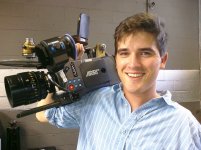


This is me messing with a working Alexa around about 14 weeks ago.
35978_636284489017_39602619_36430128_3797504_n.jpg

However, I'm a sucker for talking glass. It's been hashed out, rearranged, and served up many times here in these threads. However, as cool as vintage glass may be for getting different looks, know what you are buying and what stop you need to have it at for acceptable exposure.

Sure some lenses can open to a F/1.4... but then again that does not mean they operate ideally at those stops.

I just bought an Angenieux 10x S16mm PL zoom. It is an amazing 12mm-120mm. It's also an amazing T/2.2. That would be about an F/2, if you had an F/2 lens.

However.... although this was a very well made cinema lens at the time (more like field production lens) it is shockingly soft at T/2.2. I don't find it's sharpness acceptable for normal cinema production until I stop down to a T/5.6. At a T/2.2, I'd best be shooting a dream sequence or the PoV of a glaucoma patient.

Take a look below:
PLEASE NOTE THESE ARE NOT FULL RES NOR UNCOMPRESSED IMAGES. HOWEVER YOU CAN STILL SEE THE RESOLVING DIFFERENCES.

EDIT: ok... DVXuser shrank these images down. Doesn't really show a big difference when so tiny. I'm going to post a thread in the cinematography section later next week, so I guess see it then.

The first image is at T/2.2
dvx1.jpg


The next is at T/5.6
dvx2.jpg

This test was not my official test _the grid is gaffers tape btw... :)
It's not lit evenly nor other precautions so please don't judge other qualities from this test. However you can see a great deal of resolving power lost to wide open optics.


Test your lenses and find what works for you. I know my new toy is only good at 5.6 or higher. Anything more open better call for the lens effects to be part of the look.

Sometimes lens builders offer faster stops with sacrifice to quality. Modern cinema lenses are better at this, but the old ones and in more affordable lenses, such as photography, I imagine this is a continuing issue.

For example:

Angenieux S16mm 10x Zoom around 75mm at a T/2.8 (not the even worse T/2.2):
dvx3.jpg

The next is from a 75mm Cooke Panchro/i lens at T/2.8:
dvx4.jpg

You can see how in my first round of testing, the older lens sacrifices quality in sharpness when wide open. It seems to have issues gathering the greater amount of light across the image, causing vingetting. Something I will explore more.

But hey... I bought my old-used S16 zoom for $550, while the Cooke prime is brand new and over 10x as much.

Shop around and compare. Don't take vintage zoom or primes as being the same quality from Open to close. Some lenses will be better, some will be worse. Beware.
 
Last edited:
Not to bash ARRI and their incredible cameras, or your pretty good and sensible comment, but while the ALEXA does not seem like a "response" to EPIC, it certainly feels like a "response" to RED... ;)
 
Not to bash ARRI and their incredible cameras, or your pretty good and sensible comment, but while the ALEXA does not seem like a "response" to EPIC, it certainly feels like a "response" to RED... ;)

now that is much more accurate of a statement when you look at price factor, although it's still considerably higher. I think they were trying to keep the indie market... Aka the little big guys.
 
The only thing Arri is responding to is the switch from film to digital in series television. The D20/21 doesn't suit that market as much.
 
I think the proper term for what is happening right now is something like "reconsolidation". I think this is generally what is going on in the industry, and the distinguishing factors from one camera to the next are going to be even more important as all the manufacturers regroup around this sensor size (more or less). I absolutely understand why RED felt it important to move into HDR in the face of all of this. However, the other important factor is "ease of use". This is the most saleable aspect of the Alexa. Speaking with a DP just this evening who has 35 years of experience under his belt, he said he went with RED on two features recently because it was cheaper to rent than other cameras in it's league for smaller productions (so many RED's are privately owned). HOWEVER, he is fed up already. He said you always have to have at least two, because one is always breaking down. He was REALLY fed up. Even now after so many builds and the new mysteriumx, etc. That's the kind of the thing that is a deal breaker. Sure if you shoot "Social Network" you can afford to have a "war room" with 5 backups, but at that point you really just have to ask why not just shoot film? It's just so much easier. No data wranglers, no special technician, a lot less wiring, etc. For me that's the kind of thing which will push people towards the industry stalwarts like Sony and Arri....
 
I think "response" is an innacurate word, hence the commas. But true, the REDONE totally changed the landscape of high end productions for TV. Especially commercials.

That all said, the ALEXA is still nothing short of incredible:

http://www.vimeo.com/13839220

Anyway, am I the only one dying to see how does those new sony PL lenses perform? I mean, they're a fraction of the cost of the RED primes, the new standard for low cost cinema quality lenses.
 
Well I'm not sure there is a 35mm lens war out there. It's just those cameras keep coming out way before the glass for them. The case for the 7D (or the lack of 1.6 crop fast primes), the GH1 and now the AF100 (that get to acess the very interesting yet limited micro 4/3rd lens market) , the RED ONE, when it first came out (remember the first red zoom, that was a pretty substandard piece of glass), the F3, etc. I mean, empowering independent filmakers the ability to own a PL-mount camera is not that liberating of an experience, if you still need 20K's worth of glass on it.

The glass will come, the market is already much better served now (by RED, the compact zeiss, and now by Sony) than it has ever been, and the market for this kind of lens will drive the manufacturers to come out with some cool, affordable, products.

I don't think the glass is lagging behind these cameras. There are lots of fast primes for the dSLRs, there are lots of capable PL mounts, and while the m4/3rds is young many lenses can be adapted.

In the future, like the m4/3rds mount, short FFD mounts should be a standard. Even the F3 has a detachable PL mount that can removed to expose a "F3 mount" that has a short FFD. While how short the FFD is still unknown, it should definitely mean that Nikon/Canon glass can be mounted. If its only 18mm like Sony's E-mount then pretty much any lens can be mounted on the F3.

Zeiss seems to think this as well. Their recently announced cine lenses have interchangeable mounts (EF, F, PL mounts).
 
I think the proper term for what is happening right now is something like "reconsolidation". I think this is generally what is going on in the industry, and the distinguishing factors from one camera to the next are going to be even more important as all the manufacturers regroup around this sensor size (more or less). I absolutely understand why RED felt it important to move into HDR in the face of all of this. However, the other important factor is "ease of use". This is the most saleable aspect of the Alexa. Speaking with a DP just this evening who has 35 years of experience under his belt, he said he went with RED on two features recently because it was cheaper to rent than other cameras in it's league for smaller productions (so many RED's are privately owned). HOWEVER, he is fed up already. He said you always have to have at least two, because one is always breaking down. He was REALLY fed up. Even now after so many builds and the new mysteriumx, etc. That's the kind of the thing that is a deal breaker. Sure if you shoot "Social Network" you can afford to have a "war room" with 5 backups, but at that point you really just have to ask why not just shoot film? It's just so much easier. No data wranglers, no special technician, a lot less wiring, etc. For me that's the kind of thing which will push people towards the industry stalwarts like Sony and Arri....

"a dp with 35 years experience" means nothing to me. Is he any good? does he understand new tech? We've shot 100 days of Red or so now, NOT ONE PROBLEM except one clip that had 2 dropped frames - I'm talking THOUSANDS of clips, indoors outdoors, codl weather hot weather - you name it!. Your post is pure FUD.
 
^yeah, we shoot on RED consistently, no problems like that. A tech glitch once in awhile, but no "break downs."
 
I do understand the context of your post, as these new sensors are available to a greater amount of filmmakers, like the majority here at DVXuser, but it's still funny to see an old cinema standard become a 'new' standard or 'compromise' for those using very nonstandard sensor sizes to begin with.

How many successful video or cinema cameras offer either FF or 4/3"? I can only think of one for the former and two for the latter. Funny S35mm is replacing them as a standard, in the opinion of some.


I thought it was very talented of Arri to respond to something before-the-fact. :) Sarcasm. If I had to pick which came first, I'd say it was the Alexa. Point being, I find it hard to believe while playing with a functioning Alexa over four months ago, that it was the 'response' (meaning a technological rebuttal) toward a competitor that has still yet to put it's camera into production at the time of this writing.


owever, I'm a sucker for talking glass. It's been hashed out, rearranged, and served up many times here in these threads. However, as cool as vintage glass may be for getting different looks, know what you are buying and what stop you need to have it at for acceptable exposure.

Sure some lenses can open to a F/1.4... but then again that does not mean they operate ideally at those stops.

I just bought an Angenieux 10x S16mm PL zoom. It is an amazing 12mm-120mm. It's also an amazing T/2.2. That would be about an F/2, if you had an F/2 lens.

However.... although this was a very well made cinema lens at the time (more like field production lens) it is shockingly soft at T/2.2. I don't find it's sharpness acceptable for normal cinema production until I stop down to a T/5.6. At a T/2.2, I'd best be shooting a dream sequence or the PoV of a glaucoma patient.

Take a look below:
PLEASE NOTE THESE ARE NOT FULL RES NOR UNCOMPRESSED IMAGES. HOWEVER YOU CAN STILL SEE THE RESOLVING DIFFERENCES.

EDIT: ok... DVXuser shrank these images down. Doesn't really show a big difference when so tiny. I'm going to post a thread in the cinematography section later next week, so I guess see it then.

The first image is at T/2.2
View attachment 25843


The next is at T/5.6
View attachment 25842

This test was not my official test _the grid is gaffers tape btw... :)
It's not lit evenly nor other precautions so please don't judge other qualities from this test. However you can see a great deal of resolving power lost to wide open optics.


Test your lenses and find what works for you. I know my new toy is only good at 5.6 or higher. Anything more open better call for the lens effects to be part of the look.

Sometimes lens builders offer faster stops with sacrifice to quality. Modern cinema lenses are better at this, but the old ones and in more affordable lenses, such as photography, I imagine this is a continuing issue.

For example:

Angenieux S16mm 10x Zoom around 75mm at a T/2.8 (not the even worse T/2.2):
View attachment 25845

The next is from a 75mm Cooke Panchro/i lens at T/2.8:
View attachment 25846

You can see how in my first round of testing, the older lens sacrifices quality in sharpness when wide open. It seems to have issues gathering the greater amount of light across the image, causing vingetting. Something I will explore more.

But hey... I bought my old-used S16 zoom for $550, while the Cooke prime is brand new and over 10x as much.

Shop around and compare. Don't take vintage zoom or primes as being the same quality from Open to close. Some lenses will be better, some will be worse. Beware.


One issue with older film lenses, even if they do cover the image circle well on film without vignetting, they may still vignette from pixel shading due to angle of light rays leaving the lens. Modern digital lens designs are "back telecentric". The light path is perpendicular to the sensor within very small deviation limits across the whole diameter of the image circle. Older film lenses may distribute the light over more acute angles toward the edges of the image circle, reducing the amount of light those pixels can actually capture.
 
"a dp with 35 years experience" means nothing to me. Is he any good? does he understand new tech? We've shot 100 days of Red or so now, NOT ONE PROBLEM except one clip that had 2 dropped frames - I'm talking THOUSANDS of clips, indoors outdoors, codl weather hot weather - you name it!. Your post is pure FUD.

We must be the only ones out there then. You are absolutely right, pure FUD. I should never have even bothered to mention it. Silly me.
 
Last edited:
I don't think the glass is lagging behind these cameras. There are lots of fast primes for the dSLRs, there are lots of capable PL mounts, and while the m4/3rds is young many lenses can be adapted.

In the future, like the m4/3rds mount, short FFD mounts should be a standard. Even the F3 has a detachable PL mount that can removed to expose a "F3 mount" that has a short FFD. While how short the FFD is still unknown, it should definitely mean that Nikon/Canon glass can be mounted. If its only 18mm like Sony's E-mount then pretty much any lens can be mounted on the F3.

Zeiss seems to think this as well. Their recently announced cine lenses have interchangeable mounts (EF, F, PL mounts).
\

There are lot's of glass. But while the prices for cameras has fallen absurdly, because now people are shooting a lot of stuff on cheap DSLRs, prices for good useabe lenses for digital cinema (this almost standard digital S35 frame) have not fallen as much, for the most obvious reasons. So there is the lag. Not in the existance of suitable products, but the affordability of those products for someone that goes DSLR or prosumer.
 
Back
Top