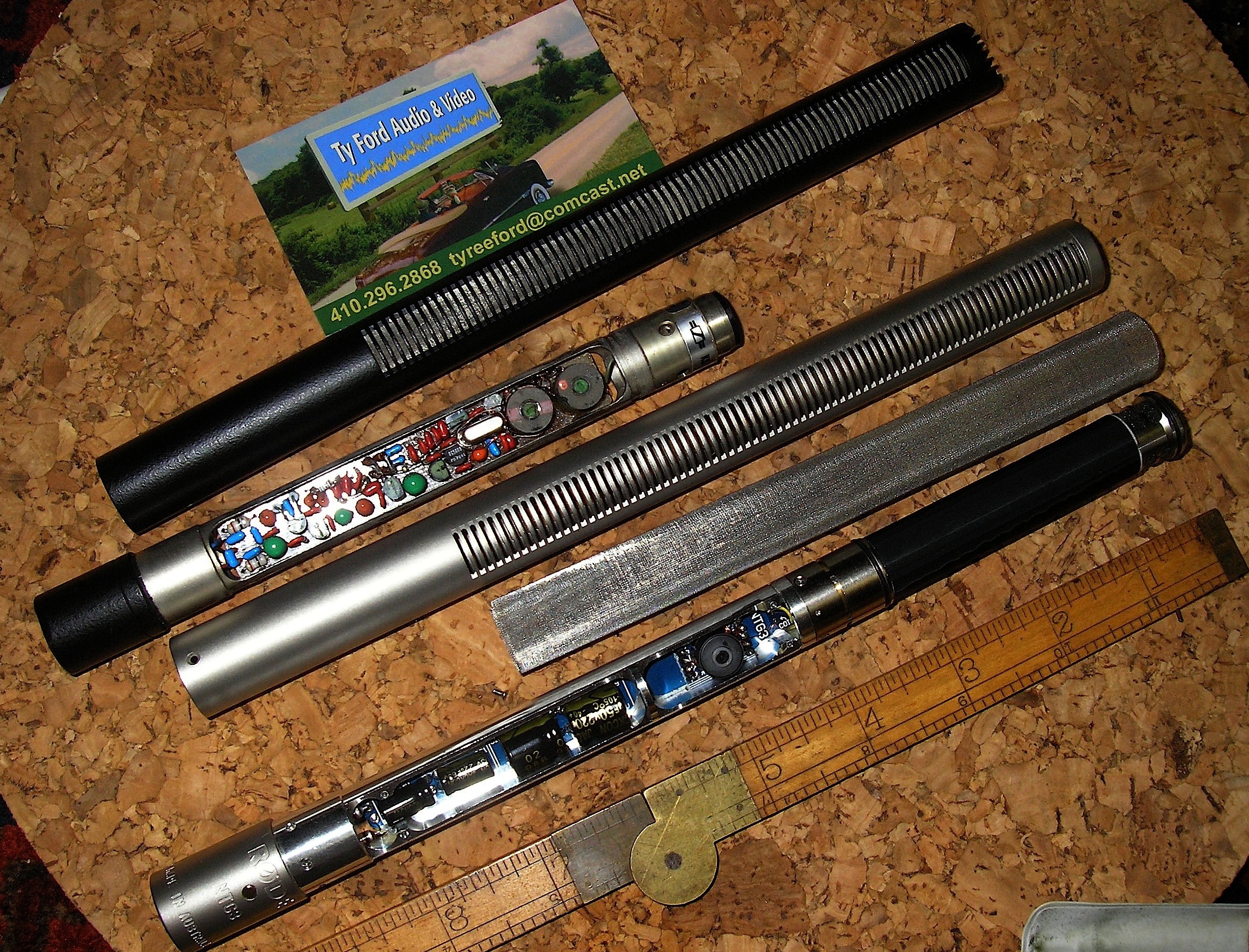
The Rode NTG-3... the poor man's 416?

So far I agree with pretty much everything on this page... including Dan's post above (which is what I've been saying all along as well... NTG3 works for interiors if the interior is "dead".)

Also... yeah... a cardioid/hyper to go against the mk41? You're making me want to search my own name connected to that idea... I'm pretty sure I came to that same conclusion after playing with an NTG3 for the first time... My thought was... "for as easy as they created a '416' they could certainly create an 'mk41'..."

Now... on that subject... before somebody jumps in on the "they COPIED the 416" bandwagon... did you see the pics of both the 416 and NTG3 OPENED UP?

The actual circuitry is very UNLIKE one another... they look nothing alike inside.


To the NTG2 owners who posted recently in this thread...

NTG2 vs. NTG3 comparison review and video/audio coming. It's overdue... my apologies. I intend to show what you get in real-world results for the price difference... and why both mics are a good value at their respective prices. (I wish I had an me66 to put head to head with the NTG2... so if anybody in STL reads this and wants to hang out for a couple hours, PM me.)


About the ck93... I don't remember mentioning any humidity issues with this mic... but I did say that my affection for AKG mics has been fading since my ULS mic has had occasional issues (not ck93... those have a different connection system... that's the "blue-line" mics).
 
Last edited:
I told RØDE that since the NTG-3 goes head to head with the 416 and comes out pretty well, they should pursue a cardioid that will go head to head with the Schoeps CMC641 that would sell for probably $1,000.00 to $1,200.00. It would be a big hit!

Dan

As much as I would love to see what Rode would do for a MK41 in that price range, isn't the standard in that price range the MKH 50?

I think they might have a better market getting a MKH 40 & 50 -esqe mics priced below them. (Granted, it'd be a little unfair for Rode to make ALL of Sennheiser's mics obsolete :nads:)
 
Hi Matt:

Interesting about the interior of the mics. I too agree that with the NTG-3, RØDE did not copy the MKH 416, the made a better sounding, more modern design. How old is the design on the 416, a quarter century old? It totally makes sense that they should be able to make a better sounding mic for less money. The NTG-3 has a fuller sound to my ear and I was never a fan of the 416, even though a lot of other people seem to be. I always preferred the MKH 60 over the 416.

As far as your Schoeps/RØDE comment, great minds must think alike because this came up spontaneously as I was having a conversation with the good people at RØDE, although I definitely said it in a "tongue-in-cheek" way just off the cuff. But after thinking about it, they should do it, there is too much status quo in the audio business, it is good for there to be an upstart. The Schoeps is a great tool but for those who use them professionally, I think the majority are using them because of the sound, not the name and image. That is the beauty about audio, I could care less what is reproducing the sound if it is accurate and pleasing. I think an A/B blind test between the NTG-3 and the MKH 416 would shake up a lot of people's perceptions.

Gohanto, I think that the MKH 50 is sort of a standard but in LA, go on the set of TV shows and features and you will see more CMC 641s. That may be different in other parts of the country/world, talk to the guys at Coffey and Location, then call the guys at Trew and they can verify this. The MKH 50 is a really great mic as well, but I can't think of two mics that sound more different. To my ear, the CMC641 is far more accurate. The MKH 50 is a "bigger" sounding, it colors the sound in a really pleasing way but for accuracy, in my ear, the CMC 641 wins out.

Dan
 
Now... on that subject... before somebody jumps in on the "they COPIED the 416" bandwagon... did you see the pics of both the 416 and NTG3 OPENED UP?

The actual circuitry is very UNLIKE one another... they look nothing alike inside.


This doesn't actually tell you anything, because the only pictures I have seen were of a very old version of the 416 compared to the NTG-3. The MKH 416 has changed a lot internally over the years and the latest version uses PLL lock instead of a crystal and SMD instead of discreet components.

And I have seen the report from a consultant that examined them both.....


How old is the design on the 416, a quarter century old?

No - the MKH 416 was released in about 1975 (it was in the catalogue that I picked up from the APRS exhibition in 1976). The MKH 60 is a lot more modern (and better) and came out in about 1986.
 
This doesn't actually tell you anything, because the only pictures I have seen were of a very old version of the 416 compared to the NTG-3. The MKH 416 has changed a lot internally over the years and the latest version uses PLL lock instead of a crystal and SMD instead of discreet components.

And I have seen the report from a consultant that examined them both.....


No - the MKH 416 was released in about 1975 (it was in the catalogue that I picked up from the APRS exhibition in 1976). The MKH 60 is a lot more modern (and better) and came out in about 1986.


For the record... and I realize you didn't contradict this statement, but I just want to say I think the 416 is a great mic. Given a choice... at the same cost, I'd rather have an mkh60 then a 416, but I'd rather have a CS3e then either (for my typical environment, run 'n gun)... but I can get by almost as well with a 416 for that... and I find the NTG-3 virtually indistinguishable from the 416 in performance... which is why I titled the thread as I did.

The NTG-3 is also physically similar to the 416 in appearance (Mr. Obvious here)... and I personally don't have a problem with that. I'm pleased that higher-end sound is (in some respects... like here) becoming more accessible. A mic must have the mettle to make our ears happy... or it won't matter if the metal makes our eyes happy... the appearance gets our attention while the sound gets our money. (If the NTG-3 didn't PERFORM like a 416... nobody would care.) We've had that moral/philosophical discussion, and I respect everyone's (including your own) opinion on the matter... so no need to open that debate again (I hope). My reason for isolating those issues is because it muddies up a discussion centered around design and performance... i.e. "results"... how they GET to those results is another topic (but if that's the angle you were heading for... to the "copied" debate... it's your right to state your case...)

Everyone is free to decide the validity of this (which I think is 100% valid):

There's an image that can be seen on ty ford's site... in extreme detail... and it's a new (or newer, at the very least... 416)... posted by a very reputable source/consultant... and you can clearly see the difference in circuit design.

Go to:

http://public.me.com/tyreeford

Then scroll down 3/4 of the way to see:

RodeNTG-3MKH416 Open.JPG

Download/Open that and check it out at "actual size" for plenty of detail, on both the circuitry and flawless condition of the 416. (I'm willing to bet that this 416 is either an actual NEW 416... or indistinguishable from a 416 of the past 2-3 years.)

If anybody wants to dispute that... please back up the statement with something... as I'm doing here. What we have is what appears to be a brand-new 416, opened up... for comparison by a reputable professional.
 
Last edited:
Looking at the photos on Ty's page: The Rode just looks clean and modern. The 416 looks like a radio from the 1970s.

Has anyone compaired the 416 & NTG-3 for VO work? I hear a lot of guys use the 416 for broadcast, or at least radio ads. How does the NTG-3 stand up?
 
You know... I'm actually very neutral on the subject of the NTG-3 and 416. I wouldn't say that there's anything wrong with the circuitry of the 416... because of the RESULTS.

See? I make the same argument either way.

As I said... the 416 is a great mic... but the NTG-3 is also a great mic... with a more modern (cleaner signal path... fewer components) schematic... BUT... I don't even care about that. I only care about what I hear.

To answer your second question... the 416 definitely has more proximity effect. If you want to thicken up a male voice by pushing in... the 416 up close will sound "fatter".
 
There's an image that can be seen on ty ford's site... in extreme detail... and it's a new (or newer, at the very least... 416)... posted by a very reputable source/consultant... and you can clearly see the difference in circuit design.

Go to:

http://public.me.com/tyreeford

Then scroll down 3/4 of the way to see:

RodeNTG-3MKH416 Open.JPG

Download/Open that and check it out at "actual size" for plenty of detail, on both the circuitry and flawless condition of the 416. (I'm willing to bet that this 416 is either an actual NEW 416... or indistinguishable from a 416 of the past 2-3 years.)

That link will not download - but if it is the image that Ty originally posted, the 416 is an old version and looks nothing like the latest version.

I seem to remember that Ty's 416 even had the old crystal in, and that went years ago.

I did convey all this to Ty at the time - but I can't remember where he posted it to check again now.

15159d1259242555-ntg-3-rode-blimp-your-take-ntg-3-mkh416.jpg


Here you go :)

This could be taken the wrong way if it's not there... but do you mind pointing out the crystal? What is it between or what color is it?

Is this the old one?
 
Based on the difference in the number and size of the capacitors, looks like a world of difference between the two circuits. Makes me wonder what the circuit diagrams look like.
 
Based on the difference in the number and size of the capacitors, looks like a world of difference between the two circuits. Makes me wonder what the circuit diagrams look like.

I don't think that photo is a fair comparison. There are at least two generations of component technology between them. The much newer Rode likely has most of its components on the board UNDER the large electrolytics. Surface-mount technology. The only other visible component is the ferrite cup-core inductor.

In the photo, the 416 capacitors are the much smaller round orange and green shiny components. Likely tantalum capacitors (vs the more common large tubular black electrolytic capacitors in the Rode).
 
15159d1259242555-ntg-3-rode-blimp-your-take-ntg-3-mkh416.jpg


Here you go :)

This could be taken the wrong way if it's not there... but do you mind pointing out the crystal? What is it between or what color is it?

Is this the old one?

Thanks for the pic.

Yes, this is an old crystal-controlled MKH 416 - the crystal is the cigar shaped silver can next to the two large coils at the capsule end.

Looks a bit like this:-

2m560000-crystals.jpg


The NTG-3 looks as if it has SMD components on the other side of the PCB photographed.
 
Pure drifting , is there a way you can post the article you wrote regarding the NTG3 ??

I am very interested in the NTG3 - however I have an NTG1 and would love to hear some NTG1/2 vs NTG3 comparisons.... the 416 test was fantastic - actually would like to see the same test being done in a studio or completely deadened environment.
 
I'll put up a comparison of the NTG-2 vs. NTG-3... really soon. I have some problems with my DVX (which is what I use to do these comparisons)... but Panasonic hasn't returned any of my emails over the past 2 weeks asking for help on the issue.

Check back for a video comparison... not sure if it will be later today, but maybe.

EDIT: Test 1 is done... but all I had available for "decent acoustics" really isn't that decent... I'm slowly finishing my basement, heading towards the studio area and learning along the way... I expected a closet lined with fiberglass insulation to sound like a recording booth... but there are still too many standing waves in there (in the bass register). I will do another test tomorrow... even though the rest of the house has too much echo... and also an outdoors test... and I'll post them all at once.

Outdoor comparisons aren't done yet... but here's a couple indoor comparisons of the NTG2 and NTG3.

http://www.youtube.com/watch?v=gZc2HzKMSsw
 
Last edited:
Matt I listened to your test, the NTG-3 seemed smoother with a better low end, I was surprised however at how well the NTG-2 did in that kind of room. I used to have an NTG-2 and was very pleased with it so I ordered another one recently. For the money its hard to touch Rode IMHO.
 
I gotta' say that's the first time I put the two up against each other and the NTG-2 is no slouch. That's probably the best mic value out there in fact... however... if you have some good cans or monitors... you can definitely, easily hear the difference in definition and effective reach in the NTG-3.

I drove to what I thought was a good outdoor location today to illustrate this... and unfortunately had a few problems... but I'll have an outdoor test up soon... which will probably widen the apparent quality margin between these two mics.
 
Matt's comparison and all of his others are very good. They will definitely help a lot of people out. I think that and the other Youtube demos are worthy of a Sticky at the top of the forum.
For the benefit of any Audio Technica owners, I recently compared the NTG-3 to the AT4073A outdoors. The two seem very close---both are bright and clean but I think that the NTG-3 is just slightly warmer sounding. It definitely has less air tone than the 4073 and noticeably better off-axis rejection, especially at the tail end. Not a pro here. This is coming from a noob so take that for what it's worth.
 
Last edited:
Hey Matt

Have you done an outside shootout between the NTG-2 & NTG-3 yet?

I just did an INDOOR comparison in a reflective room, and I have to say that they don't sound too bad indoors. My shootout started as a comparison between the AT4053b and the Rode NT3, but I did a 4-way comparison between those and the two Rode shotguns all in the same reflective room. I'll be posting the results shortly after they are done uploading.
 
Back
Top