The importance of grading to bring out a more pleasing image

Doug Jensen

Carbonite Member
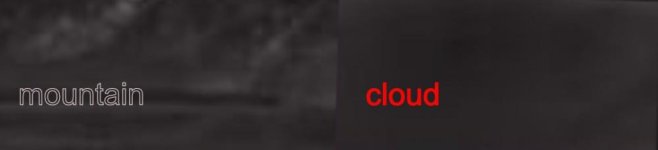
Now that I'm back in Florida for the season, I shot a couple of rocket launches at KSC in the last week or so. Naturally, there is a lot of time to kill as you wait for the countdown, and its a good chance to shoot the bull with other media people who are also waiting. I'm always surprised by how many of them do zero grading for video. Nothing. What they shoot is what they settle for. My contention is that EVERYTHING you shoot can benefit from grading when you have the time for it. So, just for fun, I put together this split screen video that shows what a difference grading in Resolve can make. And whether someone likes my creative choices or not doesn't matter -- because there a hundred different ways the footage could have been manipulated to get a different look.

Shot with four Sony cameras:
FX6: S-Cinetone
Z750: S-LOG3
Z280: Custom REC709 scene file
Alpha 1: No picture profile selected on camera

 
Great video Doug as always. I totally agree. It takes more time but if you are around cameras for a minute one learns that they are limited. The two part workflow of acquisition then post processing is crucial to delivering the best images. With the introduction of RAW, the still photography world adapted their workflow very quickly where the video world seems to be in the gray area. It is more work and resource intensive with computers, but the output can be night and day at times.

I have been doing more live streaming with sports productions recently and it has been pulling me in the opposite direction. It has been a bit frustrating as the streaming programs are limited in terms of color correction so I have put more emphasis on in-camera profiles. This is more of a challenge which does not sit well with my "sickness" of wanting to deliver refined products!
 
Thanks for sharing and posting the example.

I find that I don't feel the need to post process most photos, as I use polarizers and grad NDs to get the shot as good as I can in camera.

Video is a different story, particularly if the footage was shot with a flat or log profile. Even if I used polarizers and grad NDs, I find that I often apply highlight recovery, saturation boost, selective contrast boost, and maybe an unsharp mask.
 
GWith the introduction of RAW, the still photography world adapted their workflow very quickly where the video world seems to be in the gray area. It is more work and resource intensive with computers, but the output can be night and day at times.!

Yes, it is strange that a lot of video shooters still don't bother to do anything in post -- especially now that we have very powerful computers and Resolve is totally free. Although it is still nice to have a scene file or picture profile that can get you 80% of the way to a finished image when you are in a jam, we have definitely passed the point where grading everything 100% in-camera is sufficient. I'd no sooner show ungraded video than I'd post unprocessed RAW photos.
 
Nice examples and great reminder.

no one wants to learn or do the work. They’d rather spend 10 mins on a shot trying LUTS than make it look better with 10 mins of grading.
 
Having started in the dark room working black and white prints Ive always had control over the contrast and exposure of the final image.

To my that is PART of the process.

Doug I think your tune has changed over the decade :)

Getting in camera will rarely work

1) it is hard to monitor on set
2) scenes vary in contrast and unless you want to load a different profile for every shot it is hard to match scene to profile
2a) it is rare to have enough fill light to fit a scene into a narrow contrast box
3) a secondary drawn with a lasso will always have a better shape than a flat grad ND filter
4) a secondary can be tracked, to move a grad ND while rolling is most unusal
5) the client might desire a look or decide to go for a different look

these and other factors basically lead one to shoot with some wiggle room and grade in post

Sure going live, means thi is not always possible.

Sure quick delivery may be to add a look or lut to the whole project.

This doesnt equate to 'being slack' and fixing it in post its about understanding the whole pipeline.

To me the pipeline starts at the lights or hour of day, moves through the camera, its settings and ends in the NLE.
 
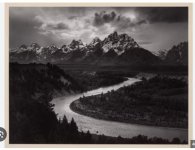
So I 'grew up' with Ansel Adams.

Fifteen year old SMM: 'I like photography'
Some Adult.. ' I have an Ansel Adams book'

For some reason to me he is the base line*. I mean you could not call his work new fangled being over a hundred years old.

But if we look at the darkest clouds and the mountain grassland.. well the clouds are darker. Now this could not have been aquired 'in camera'

If one had spot metered the clouds, and the grass or filmed them with false colour the dark clouds would have had a higher IRE than the grassland.

So how did the clouds get darker than the grassland.. ? He fixed it in post! Well he did it in post.

So to me post has always been part of delivering an image.


*of course any baseline is entirely personal. Who is your baseline? Ansel Adams, Laurence of Arabia? Star Wars? Penthouse?
 

Attachments

  • ansel.JPG
    ansel.JPG
    45.8 KB · Views: 1
  • ansel2.jpg
    ansel2.jpg
    10 KB · Views: 1
Last edited:
I'm a huge fan of Adams. I don't know if he actually said any of these quotes, but they are good anyway.

“The negative is the score, and the print the performance.” – Ansel Adams

“Dodging and burning are steps to take care of mistakes God made in establishing tonal relationships.” – Ansel Adams

“I am sure the next step will be the electronic image, and I hope I shall live to see it. I trust that the creative eye will continue to function, whatever technological innovations may develop.” – Ansel Adams
 
Ansel Adams did dodge and burn when needed, but he devised a system called the zone system, where he strived to achieve the best possible negative by determining the tonal range needed, is it a flat scene or is it a high contrast scene and exposed accordingly. He then either under or over developed each sheet of film to expand or compact contrast producing a better negative or "score". This technique was ideal for sheet film, not when shooting rolls of film with various lighting conditions. Years ago I took a course with John Dowdell who worked with Group f64 that included Ansel Adams, John wrote a book that included a zone systemizer which helped determine the proper exposure and how much to under or over develop the film. If you're really interested you can still buy one, I lost mine years ago.
https://www.amazon.com/Zone-Systemizer-Creative-Photographic-Control/dp/0871000407
 
I decided to upload another "before and after" grading video of yesterday's Falcon 9 launch. It still amazes me the power Resolve puts in the hands of mere mortals, such as myself. It's fun to see what can be brought out of the raw footage.


Doug, would it not perhaps be more useful to split screen your grade against a simple de-logged/709 "out of box" look, instead of the log/raw footage? As I feel like the point you are making is that whenever possible it is better to grade instead of just setting a look or selecting a picture profile in camera.
 
Doug, would it not perhaps be more useful to split screen your grade against a simple de-logged/709 "out of box" look, instead of the log/raw footage? As I feel like the point you are making is that whenever possible it is better to grade instead of just setting a look or selecting a picture profile in camera.

Charles, you make a good point and I don't necessarily disagree with it. The problem is I don't know what point it is that I'm making -- beyond just having some fun showing before and after.

However, now that you made me stop and think about it, I guess my point is that it doesn't matter what settings someone chooses onboard the camera -- they need to spend some time in post grading if they want to create a better image than whatever the camera can do all on it's own. It could be the camera's default look, a REC709 scene file, LOG, RAW, S-cinetone, or whatever. They all have their pros and cons and I'm not advocating for any particular shooting mode -- but whatever someone chooses -- they really need to do some grading in post to bring it to a higher level. I am not a professional colorist, nor do I claim to be, but I feel confident in saying that even I have the ability to take any footage from any camera and make it look better (at least to my eyes) in Resolve or some other dedicated color grading software.

And just dropping a LUT on footage might be a good start, but that still isn't real grading. In the SpaceX video above, there is a lot more going on than just a LUT or an s-curve.

So, I guess this is my point: Grading is not an option, it should be considered a routine part of the workflow. I think a lot of people aren't ready to accept that reality.
Plus I'm just having some fun.
 
Last edited:
Ansel Adams did dodge and burn when needed, but he devised a system called the zone system, where he strived to achieve the best possible negative by determining the tonal range needed, is it a flat scene or is it a high contrast scene and exposed accordingly. He then either under or over developed each sheet of film to expand or compact contrast producing a better negative or "score". This technique was ideal for sheet film, not when shooting rolls of film with various lighting conditions. Years ago I took a course with John Dowdell who worked with Group f64 that included Ansel Adams, John wrote a book that included a zone systemizer which helped determine the proper exposure and how much to under or over develop the film. If you're really interested you can still buy one, I lost mine years ago.
https://www.amazon.com/Zone-Systemiz.../dp/0871000407

To me the Zone System always sounded like something semi-magical on paper, but at the end of the day, no matter who explained it, it was all sorta bullsh!t. The aperture can only be in one position at the moment of exposure. Basically pick an exposure that allows the most "data" capture for what image you're trying to create and then enter post processing...
 
Doug, do you make your stock footage available in log/RAW/ungraded, graded or both?

That's an easy one to answer, always graded to look the best I can make it. No exceptions. In some circumstances I'll even submit alternative grades when I can get away with it.
 
The aperture can only be in one position at the moment of exposure.

EXACTLY!!!! I've been trying to get people to understand that point for years. You have to capture the entire scene with a single exposure, so using a zone system outdoors, or in any uncontrolled lighting situation is impossible. On a similar note, false color is also totally meaningless in outdoors or uncontrolled lighting. Personally, I use zebras to expose for bright reflected whites and everything else can fall where it may. Which is all the more reason to get fluent with grading, because in post you can definitely use a "zone" type of system to bring out different tones in the final image. But it can't be done in camera unless you have control over all the lighting.
 
Sorry for the misunderstanding Run & Gun, Ansel Adam’s zone system has NO application when shooting video, we were talking about how Ansel Adams’ prints were beautiful and I wanted to point out some of that was due to how he exposed & developed the FILM.

I totally agree with Doug about grading, these days especially filming outdoors, I always film in RAW/Log, not with a baked in look like rec 709. You need to capture the most information possible giving you more options to grade a nice image.

When shooting film Ansel Adam’s Zone System used film processing to help obtain a better negative, basically speaking when you push film you increase the contrast and when you pull film you decrease the contrast. He had to decide on one aperture and expose & develop accordingly which gave him a better starting point for making the perfect print.

Doug, I haven’t shot stock in years, are you mainly shooting RF or RM video stock these days?
 
Doug, I haven’t shot stock in years, are you mainly shooting RF or RM video stock these days?

99.9% Royalty Free. The whole industry is moving that way and I prefer it. I may have a few old RM clips at Getty but I don't think they earn anything at all. I don't even submit to Getty anymore. The goal these days is to have clips sell as frequently as possible, rather than trying to make a big score from a handful of sales.
 
That's an easy one to answer, always graded to look the best I can make it. No exceptions. In some circumstances I'll even submit alternative grades when I can get away with it.

I always want my footage/images to be seen in their best light (no pun intended. Or was it...). But I was just curious if anyone ever wanted the log/RAW version of any clips, so that they could grade them to integrate better with the overall program they may be used in.
 
Back
Top