FS7: The Great S-Log-2 vs S-Log 3 Debate

Well I dont think 'the top DPs' are always getting the best from thier camera systems.. they tend to have access to enough light quantity and control that they could just shoot with a striaght 709 camera and get it right.

Most top DP dont come from a background of working with flexible digital files.. you would need to look to the top stills people for that.

I also think that top DPs do sit in on camera tests in pre-production and have a large input on developing a look.. even if a A/C and colourist are twiddling the knobs (iris, gain and post curves) for them.

Once a set lut is created and a grey point agreed, then they are basically good to go having nailed their look which can then smoothly transition through post without thier input.

As for specalised pros being better.. well of course they are quicker, and may know how to acheive things, but ultimately the DP is the one who is navigating what to acheive. That is what directing photography is.

I consider directing the photography to be a two part process, lighting and exposure, followed by 'developing' the 'negative'.

Did you ever hear a (chemical) film DP not go bananas if the post house decided to pull or push thier film stock without consulting them?


Sorry but you really dont have much idea of high end production.. their skill is not down to just having big lights.. so much wrong here.. do you really think that labs would arbitrarily push or pull rushes without it being on the report sheets.. you have never worked on these productions.. clearly ..
 
.. do you really think that labs would arbitrarily push or pull rushes

My point exactly.. not in a million years would that happen.. they would be instantly fired and probably never work again for anyone.

But a digital DP just hands off to post and the colourist is free to arbitarily pull or push the digital rushes because they are an 'expert'? - its equally nuts*,

The digital DP has to provide some form or report sheet, giving a grey card point or reference LUT or whatever. And they are not going to be able to generate those intstructions unless they 'do' know something about post.


( *well not quite so nuts as the digital negative is not ruined, unlike a pulled film ne)
 
Last edited:
To come back to Slog2 vs Slog3.

Well I would suggest anyone DP should make up thier own mind be performing a few controlled tests.

The test would involve a fixed wide DR scene, Tstop brackets, and application of various post curves/luts,

The DP can then draw the conclusion of what works for them and thier post team.

Slog 2 and 3 are both of value.
 
My point exactly.. not in a million years would that happen.. they would be instantly fired and probably never work again for anyone.

But a digital DP just hands off to post and the colourist is free to arbitarily pull or push the digital rushes because they are an 'expert'? - its equally nuts,

( well not quite so nuts as the digital negative is not ruined.)

Well not quite the same.. rushes were printed from the negative.. so that would stay intact ..they won't be shooting on reversal ! and dailies were nearly always a one light color work print anyway.. the grading was done as with digital at the end of the production.. on any professional production the colorist is never just going to be arbitrarily be doing their own thing on a whim.. exactly what your talking about pertains to the director.. he or she will be the enemy here.. they are the only one with that power .. then its better the DP is also the director .. not that they know about post production.. my point is only that your unilateral bold and somewhat bombastic ,if I might say, statement that you cannot be a good camera person.. end of discussion .. if you do not actively do post production work .. is well simply wrong .. and in fact the high end people never do their own post work.. the truth is actually the opposite .. many in the lower levels of production who do their own post very often dont actually know what they are doing and are not getting the best results at all.. and that a professional colorist could get a much better result and probably teach them how to shoot/ expose better to boot !
 
Sir we clearly agree.

My 'rant' was triggered by Nolas slightly 'flip' comment about not doing post.

Clearly there a load of shooter editor colourists who are clueless
Clearly there are top end colourists who are not clueless
Cearly the clueless shooter editor colourists would be improved by hiring a non clueless colourist
Clearly a camera operator (not DP) steadicam operator or suchlike can be top end without knowing jack about colour.. they would not 'paint' the camera or choose the Tstop

:)
 
..they won't be shooting on reversal !

Fair point.. back in the days of wet media I was doing stills and absolutely was shooting on reversal for people like Sunday Times Style. or B+W and hand processing where both the negative and the print could be push/pulled by me - a most satisfying and educational process.
 
Sir we clearly agree.

My 'rant' was triggered by Nolas slightly 'flip' comment about not doing post.

Clearly there a load of shooter editor colourists who are clueless
Clearly there are top end colourists who are not clueless
Cearly the clueless shooter editor colourists would be improved by hiring a non clueless colourist
Clearly a camera operator (not DP) steadicam operator or suchlike can be top end without knowing jack about colour.. they would not 'paint' the camera or choose the Tstop

:)

I didn't take his comment as flippant to be honest .. and I would actually agree with him.. :) .. across the board every DP has the problem of post ruining their great footage.. mostly in the edit than color in my experience .. but thats the life of a freelancer .. and it that regard its the director who is always the culprit .. editor s are made to make cuts they wouldn't do and colorists are made to change the look.. so you work with people you trust.. the dp,s post knowledge isn't rocket science really ..
 
the dp,s post knowledge isn't rocket science really ..

Indeed not, you can learn all on a one year college course*.. but then check out dumbass posts like these made in the last hour or two..

'My F35 is gritty' http://www.dvxuser.com/V6/showthrea...om-F35&p=1986771237&viewfull=1#post1986771237

(under exposed more like)

Or this .. 'explaination of different responses of a coupld of high end camera' (very Contra Yeldin linked above)

http://www.dvxuser.com/V6/showthrea...paldi)&p=1986780883&viewfull=1#post1986780883

(nothing a bit of colour curves in post would not sort)


*but it can take decades to gat a 'feel'
 
Last edited:
I'm surprised by the extent to which the responses seem to be indicating a "hand off the files and forget about it" approach.
As a DP I may not 'do post' in terms of being the person sitting at the Davinci or Assimilate controller, but I make a point of trying to be in the color correction suite for the beginning and end of the grading process. A good colorist will probably be at least 5x faster than I would be at the console, and have better command over complex techniques such as individually tweaking skin tones when one performer is getting too ruddy or pale in a shot with several actors -- but the first thing we do is talk about the overall looks we're trying to achieve, then create representative corrections for a shot from each scene. No, I may not get paid for my time in the color suite -- but it's more than worth it. If I end up being thousands of miles away during those days it's still possible to converse and exchange reference frames to stay involved. Part of owning the look is to stay with the project through completion.
Of course decisions such as s-log 2 or 3, or how to expose to optimize the look, should really be made through testing -- including the colorist in the process. Because while dynamic range and middle gray point are both important while shooting, having the post pipeline in sync with your decisions is at least as important in achieving the look you want!

You said everything I have been trying to say :)
 
... every DP has the problem of post ruining their great footage... but thats the life of a freelancer .. and in that regard its the director who is always the culprit... editor's are made to make cuts they wouldn't do and colorists are made to change the look...

Ain't that the sad and bitter truth!
 
I wonder who communicates thier set up to post and how it is done. (and if you dont communicate.. expect mayhem.. and blame yourself)

As I mentioned above I will often give a quick grade, and send a couple of stills marked with the LUT used.

Id also consider boarding the first shot with a link to a LUT that should work.

Obviously high end productions have established procedures. Im talking basic level.
 
I wonder who communicates thier set up to post and how it is done. (and if you dont communicate.. expect mayhem.. and blame yourself)

As I mentioned above I will often give a quick grade, and send a couple of stills marked with the LUT used.

Id also consider boarding the first shot with a link to a LUT that should work.

The best form of communication is to burn in the LUT :)... I dont think many freelancers have the time, can take the unpaid time.. to be physically there during post.. often your not even in the same country.. sad truth is there is nothing you can do if the director decides to change the look you had agree at the start.. and sometimes they are right.. and end of the day they are the director and have the right to do so.. you can have your name taken off the credits.. not work with them again.. storm out of the building.. etc.. but thats the way it is.. its still better than working ..
 
Is this thread about live TV or two picture profiles entirely designed for post processing?

Sorry, the statement about live tv was off topic, I realized that right after hitting "post". But again, most work is not that precious. If I'm hired to shoot interviews on the red carpet or sit-down interviews for ESPN's Sportscenter, the client isn't going to fly me to L.A. to sit in on the grading of the footage. And I honestly have no desire to sit in on it. If they butcher it in post, so be it. It would be unfortunate if they butcher it, but I wouldn't be devastated and I probably wouldn't even know that they did because I don't always, or even often, see the final product. Many times my client dictates the gamma settings because they have a set of camera specs that they follow or because they want to match other material shot elsewhere.
 
Sure.

I just asked if people give thier footage a fighting chance..?

This might be as simple as a ten word email to someone saying 'this was shot slog2 a lut link is here'

Or more complex with a couple of graded grabs right up to a full sit in.
 
Does slog-2 have more dynamic range than slog-3 or RAW. No. On FS7/F5/F55 it's limited to 14 stops by the sensor and internal processing.

slog-3 as a "container" can technically hold 1.5 more stops, such as would be utilized with the Sony Venice which goes 6 stops over to 9 stops under 18% Middle Gray.

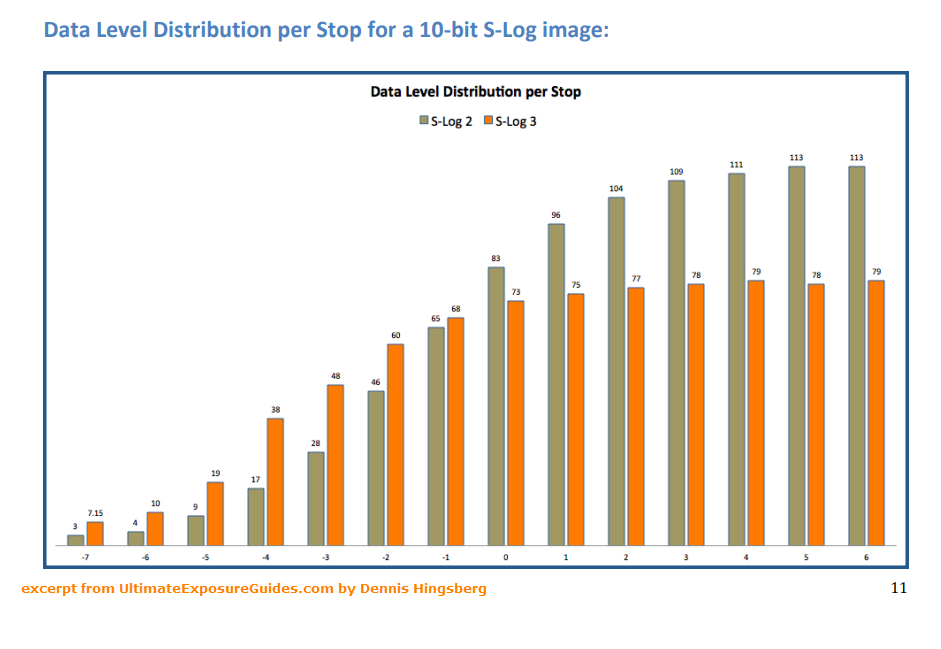
Does slog-2 handle the data better than slog-3. Yes, it does. Look at the data per stop distribution chart I created which is an excerpt from my Ultimate Exposure Guide:


Why did I switch to slog-3 once it was available on my F55, the main reason is because unfortunately the only way to access Sony's new color science "s-gamut3.cine" on the FS7/F5/F55 is to shoot in CineEI mode, and in CineEI mode you can only have s-gamut3.cine with slog3, not slog2. The exception to this rule is if you shoot in RAW, where in post you can actually select whichever gamma and color science combination you like. ie. slog2 and s-gamut3.cine.

As for slog3 being "easier to grade" etc.. it is not purely a matter about throwing on compatible LUTs as much as it is about accessing the newer Sony color science which Sony says, "Sony recommends S-Gamut3.Cine color space for more natural color reproduction with minimal grading required compared to S-Gamut3.". If you like the older color science, that is wonderful, use whatever you like but I suggest you test both color sciences out with skin and try grading both - see which you prefer, or even if you can make them look the same.
 
Does slog-2 have more dynamic range than slog-3 or RAW. No. .

Den.

Nice to see your numbers. Very similar to what I linked pages ago.

You talk about DR being limited by the sensor.. I dont beleive this to be the case - I beleive DR to be limited by data levels.

So an individiual decides the data levels pers stop that they feel is acceptable/gradable.. to0 few data levels and your grade gains a level of artifacts when pushed to be unacceptable to your project.

So let us pluck some stuff out of the air..

Super glossy project..? I require 100 data levels per stop..
Lets now look at the levels that provide 100+ data levels per stop.
Slog2 6 stops.
Slog 3 NO stops - total fail.

Gritty RnG shoot? I require 35 data levels per stop.
Slog3 11 stops
Slog2 10 stops

Somewhere in the middle? 60 data levels
Slog3 9 stops
Slog 2 8 stops

I think the ability of 3 to dig into the weeds better than 2 is not worth it personally vs the crispy 100+ stops that 2 hands out in the top 6 (who says dont ETTR?). But if you are a true snake happy to accept 7 data levels in your shadow.. 3 three all the way :)

You will see none of my DR calculations come anywhere near 14 stops!

------------------
waffle
Who wants 100 levels per stop? well its not much is it? 12bit has 4000 levels which spread ofver 10 stops would be 400 levels.
Shows basically how thin 10bit is.
Of course an 8bit delivery screen only needs 25 levels for 10 stops, but 709 is what? 6 stops so ball park need is 40 odd lvels per stop. so shooting 100 doent give a lot of latitude even to deliver 8bit 709.
 
Last edited:
Back
Top