The FX6 and log exposure for commandos

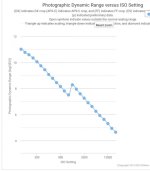
I'm on a phone and can't download Doug's footage. Here's a chart from dxomark indicating that the A1 has more DR (ie less noise) 3 stops above base than 2 stops, albeit still well less than at base. Their tests are somewhat problematic because they only test in full stop increments. (The base photo ISO also differs from what we use for video.) It's not a dual base jso camera, but the implication is that you're better off raising the gain by 3 stops than by 2.
 

Attachments

  • photo130530.jpg
    photo130530.jpg
    43.9 KB · Views: 0
Hey Doug , Are you saying only that the A1 doesn't have dual base or that none of the A7 cameras have dual base? I'm not sure that Sony acknowledges that any of them do ( though I'm not sure about that. ) I know the A7siii does because I have it . Don't know anything about the A1 and haven't looked at your tests because I don't use it . it would be odd for Sony not to put it in that camera when its in the A7siii but I don't doubt your tests.
 
Abe, if you look at DXO color sensitivity tests that is also a good indication, as that might be as telling as the DR tests. Should see a bigger improvement in chroma noise over just noise in general, when engaging a base-boost(BB)
 
You’ll also notice that on the Sony website, they have the “DPReview.com Gold Award” listed on their Alpha cameras, so when DP Review says they see something like dual iso on the A1, i kind of just believe it.
 
Does any of that make me doubt Doug? Actually still no. There is no benefit to him lying about something like that. Just that I can’t really know why his experience differs from other people’s experience. And all of that is a big rabbit hole of variables i can’t control.
 
You’ll also notice that on the Sony website, they have the “DPReview.com Gold Award” listed on their Alpha cameras, so when DP Review says they see something like dual iso on the A1, i kind of just believe it.

That's the most circular reasoning I've heard all year.

BTW dxomark shows no improvement in color sensitivity from 2 to 3 stops gain increase, merely a flatline rather than a decline. But it shows the same for the a7siii, which also shows a much larger benefit in DR when reaching its high base iso. (Basically increasing the gain 4 stops is on par with increasing it 1 stop, implying that if you need to go above iso 1250 or so, you might as well go to 12800.)

And generally speaking, I think you should stop accepting argument by authority and just look at the data and the tests and draw your own conclusions. Trust has nothing to do with it
 
BTW dxomark shows no improvement in color sensitivity from 2 to 3 stops gain increase, merely a flatline rather than a decline. But it shows the same for the a7siii, which also shows a much larger benefit in DR when reaching its high base iso. (Basically increasing the gain 4 stops is on par with increasing it 1 stop, implying that if you need to go above iso 1250 or so, you might as well go to 12800.)

oh? i’d assume if there was no additional base boost then chroma would continue to detoriorate, not flatline or improve at the same place the DR does. it is just another data point hinting towards some form of dual base iso. If they happened at different stops, then you might also be able to guess maybe there was something else going on, but the way they line up is certainly just bolstering the idea, rather than detracting from it. if DR improved, but chroma noise got worse, then you’d potentially lost more than you gained.

https://www.dxomark.com/Cameras/Sony/A1---Measurements
 
Curious Jim , by now you've invested so much time in these discussions, why don't you just look at Doug's tests?
I think because i’ve seen some clips of it cleaning up at iso4000, and that is not accepted as a proof in this thread. So watching some other clips doesn’t really change anything. I’m on the road and primarily on a phone with limited high speed data, and i’d rather save that for when i need it.
 
Which of these would best describe your approach as light fades?

1. As soon as I am underexposing low base, I would switch to high so that all of my footage is ‘correctly’ exposed and there is no way they can mess it up in post.

2. I stay on low base for a stop or two (underexposing) before I switch to high as this will produce a cleaner image if it’s properly handled in post. But it’s approximate and I don’t think about it that much.

3. I stay on low base for exactly __________ stops and I keep track of this by switching to a higher-than-base exposure index. When I’ve exceeded my EI limit of __________ I switch to high base.

4. I ask the client if I think this will be an issue and do what they say.

5. I don’t shoot log in scenarios where this could be an issue in the first place. This has been a hate read for me and I’m not sure why I got this far.

Have you settled into one of these categories?

edit, if i can add a follow up to that, how did or didn’t you come to that decision(or lack thereof)
 
Last edited:
FYI, for the measurements made at sensor level, Bill Claff is a reference
​​​​​​https://www.photonstophotos.net/Charts/PDR.htm
For the A1, there is a switch between 400 and 500 iso. Interestingly, there is not a crazy difference compared to the A7R4 (which switches at around 300 ISO)

Again, this is RAW measurements at sensor output in photographic one shot mode.
Can be completely different in video at the end of the processing pipe. At least, it shows what the engine can do :)
 
FYI, for the measurements made at sensor level, Bill Claff is a reference
​​​​​​For the A1, there is a switch between 400 and 500 iso. Interestingly, there is not a crazy difference compared to the A7R4 (which switches at around 300 ISO)
Again, this is RAW measurements at sensor output

I think this thread is more about noise levels than DR, but since the two are very related this chart is useful. Mr. Claff seems to have done some serious testing, and I respect that. Unless someone shows otherwise I will accept his analysis that there is an almost imperceptible change around 400-500 ISO. I have not done any tests of my own in the range, but the difference is so slight it would be hard to notice a less than 1EV difference in regular shooting if you weren't looking for it. As we can see from the chart, there is no changes in the 3200 - 4000 range. My testing showed the same thing --- which is contrary to what JimGao's Youtube heroes claim in their half-assed review videos.

Three things are clear:
The A1 is not a dual-ISO camera, despite JimGao's claims.
There is no advantage to cranking up the ISO beyond what is minimally needed to get the necessary exposure at anywhere along the ISO scale, despite JimGao's claims.
People shouldn't make claims about stuff they have no clue about.
 
Last edited:
I'm pretty sure that his ISO ratings in photo mode would equate to much higher ratings in video mode. On the a7siii/fx3, the base ISO in s-log3 is 640 but in many contrasty gammas it is 100

With the a7siii, photons to photos shows the DR boost happening at iso 1250 rather than 12800. Curiously, they only indicate a 1EV benefit there
 

Attachments

  • photo130542.jpg
    photo130542.jpg
    37.5 KB · Views: 0
But here's their read noise chart, showing a much more marked improvement for the a7siii. But the a1 shows nearly the same level of improvement and level of noise at ISO 500 rather than (on this chart) 1600 for the a7siii, which suggests to me that it has a similar high-gain circuit to the a7siii. And that it would kick in at iso 4000 in s-log3

Click image for larger version  Name:	Screenshot_20220831-103147_Chrome.jpg Views:	0 Size:	45.5 KB ID:	5694053
 
Sure, but again these measurements are made at sensor output in photo mode and it's difficult to predict what they become in video mode at the end of the chain.
It's used mainly by the astronomers who are looking for the best compromise between exposure time and sensitivity.
In video I think it's more complex, there are other parameters and for my practical use I would more follow Doug's tests than the RAW measurements in photo :)
 
Sure, but again these measurements are made at sensor output in photo mode and it's difficult to predict what they become in video mode at the end of the chain.
It's used mainly by the astronomers who are looking for the best compromise between exposure time and sensitivity.
In video I think it's more complex, there are other parameters and for my practical use I would more follow Doug's tests than the RAW measurements in photo :)

Log native iso is occasionally higher than the raw or other picture profiles.

That is the reason S-cinetone has a lower native iso value than Slog3. something like iso160 in a few of the Alpha’s. I’ve only used the A7S3 and FX6 of the new crop.

iso100 to iso500 doesn’t sound as big as the iso800 to iso4000 jump, but they’re both about a 2+ stop jump up.


Earlier in this thread there was talk of how much cleaner S-cinetone was. s-cinetone will be cleaner than Slog3 for more than one reason.

I’ve seen other cameras map middle grey differently for various profiles, so native iso isn’t always the same across all picture profiles.
 
Last edited:
But here's their read noise chart, showing a much more marked improvement for the a7siii. But the a1 shows nearly the same level of improvement and level of noise at ISO 500 rather than (on this chart) 1600 for the a7siii, which suggests to me that it has a similar high-gain circuit to the a7siii. And that it would kick in at iso 4000 in s-log3


Most sensors can push 2stops these days with minimal noise, but not 3 or 4, so while it doesn’t seem like much, getting that hi boost at 2+ stops is extremely strategic. Well done Sony
 
Last edited:
And about NEVER underexposing log - In a quick pre-shoot test I did recently, underexposing LOW by a stop and raising levels in post was cleaner than jumping straight up to HIGH (exposed as Sony recommends, I didn’t test with an offset). It was a rough test that I didn't double check as I wasn't particularly surprised. My experience is similar to Dr Boffa’s in that log from the FX6 seems way more tolerant of underexposure than with previous Sony cameras like the FS5.
I think some of this ties back to your comment here, where you might choosing between s-log3 vs s-cinetone. considering they have different native iso’s underexposing isn’t entirely apples to apples.

That’s part of the reason i also tend to view exposure as a middle thing. As you might clip a little earlier, but get cleaner shadows with cinetone, indicating that for whatever the true base iso of the camera sensor is, the midtone placement is more a deciding factor of the iso rating.

Obviously the subject you are filming is not a standard, so your subject cannot be the middle, but your proper exposure is middle, and you are choosing where the subject sits along that middle space. However, finding a white object and telling your camera what white is, is also an amazing way to do things, as it is sort of how we do it in our eys and minds. But cameras don’t peg white to exposure settings the same way that the middle is. Either mode of exposure works, and has been used professionally for decades, they’re just two sides to the same coin.

But anyways, if S-log has the midtones pushed up to maximize DR, then it may very well be more noisey than S-cinetone in more ways than one.

Let’s say Slog3 is the standard, and S-cinetone has a slight pull, and is slightly over and midtones pulled down to get cleaner shadows. that offsets where the hi boost is rated as well, so when you are at S-cinetones iso3200 and slog3’s iso 3200, cinetone is pulled back and already engaging the hi boost, and slog3 is pushed 2-3stops by comparison. This is all theory, as i am not a cinetone user, but is worth checking out in testing.
 
Last edited:
Back
Top