FS7: The futility of not grading?

Well, for starters, at least one of my regular clients still edits in FCP7.
People still using FCP 7 may want to try my S-Log plugin. Currently only S-Log 1 and 2, as there hasn't been much demand for it recently. But if enough people request it I could do an S-Log3 version with an LC709A option.

If your NLE supports LUTs, and you have a post LUT which exactly matches your in-camera LUT, then shooting log and applying the LUT in post (yes it would be nice if it happened automatically) seems to me the ideal situation. You have the simplicity of a baked look, with the flexibility of log+LUT.

That's great, for sure. But it really side steps my point of Videographer owner/ops who hand off footage to other organizations. They're not really looking for the Videographer to tell them how to do their post workflow.
 
A lot of people - me included are still on FCP 7 .- particularly in the lower budget world the FS7 appeals to . That would be great to include slog3 Nick . Please do .
 
Morgan , I'm sure you're right and I can use Resolve myself fine. However I have clients and they are often far less sophisticated about color. In fact having seen many of the projects they complete I am aghast at how they miss the simplest issues of matching color , or even just brightness and saturation. They simply don't see these things. They can see the difference if I grade something for them, but it goes right past them otherwise. They are not interested in learning a new program and don't have the time anyway.

That's why I dread giving them anything that needs a lot of correction and why i totally disagree with your messianic crusade to convince everyone they need to shoot in Log all the time - especially as I am quite comfortable with the arcane controls inside a Sony camera and they like what I hand them.

However if I can create a dirt simple path for them to handle log in FCP7 that would be a great thing as long as its very simple like a plug in.

Lenny levy
 
I'm not that bothered that everything should be log - I had an fs100 for years and well I only got rid of it to make nicer pictures - if where shooting baked I could basically buy and fs100 for £1000 and spend the rest on a holiday

why drive to the shops in a Ferrari?

Nothing wrong with going to the shops!
 
..I'm in pre for a job right now and wonder if my ex1 or maybe the x70 .. Or whatever it is called us a better tool than the fs7
 
why drive to the shops in a Ferrari?

Nothing wrong with going to the shops!

Yes, but I think the point was you could have driven to the shops in a Skoda and still achieved your aim to go to the shops.

Form over function comes to mind surely?

Claire
 
why drive to the shops in a Ferrari?

This metaphor... well, I'd say calling the FS7 a Ferrari is a stretch, but regardless, the answer in my case is the FS7 gives me the capability to do high end workflows for clients who want them, and do fast edit baked workflows for client who prefer those, and to have done both while only owning and deeply learning one camera body.

So... why bother owning two cars when one is suited to get you everywhere?
 
I'm losing this argument :)

My interest in the x70 is easy zoom tiny form.

Overall I think that grading is seen with a 1995 headset when a suite was $800 an hour - now it is simple cheap and fast and imo generally will lift most projects

in stills shooting baked just does not happen.. Even on a phone we add looks before posting an image of our cat to Facebook .

our clients add looks before posting a picture of their cat!

to me colouring my work is a large percentage of the joy of working.

it would at least be nice to see a few other ops enjoying the tool they have..
 
it would at least be nice to see a few other ops enjoying the tool they have..

I really enjoy grading in Resolve and it is not the chore that I expected it to be a couple of years ago before I got my feet wet with it. Just the opposite. 99% of everything I shoot, that I also get to edit, is graded in Resolve. In fact I now shoot almost all of my stock footage in RAW and look forward to grading it to "see what I got" -- as much as I enjoyed working in my darkrooms back in the days of film. What I'd l really ike to have is an air freshener hanging in my grading suite that smells like Kodak D-76 or stop bath to set the proper mood.
 
Still photography back in the 70's was all film. And you basically had ektachrome and kodacolor or agfa with fuji just starting for color. I shot everything in ektachrome, very bluish. B&W was mostly panatomicX, tri-x or plus-X every once in a while something like kodak xxx-recording film for high iso surveillance work.

Every roll that really mattered was developed separately pushed or pulled. I used to use polaroid backs on Hasselblads or other medium/large formats to nail lighting and exposure as well as focus. Shooting stills I often used a separate camera and I shot 1 frame for each scene/roll of film. I then developed that first and made any decisions as to how to push or pull each roll of the actual photos.

That is a bit like shooting RAW today.

I also worked for newspapers and there we still developed each roll pushing almost never pulling the development. We just made notes like, TX shot at 1200. But we made individual prints making decisions about contrast by using different papers or polycontrast filters and polycontrast paper in the enlarger before the plates were made.

I still think our quality back then is superior to what we do with stills today.

Video was always a big compromise and it still is, but not anywhere as much as it use dot be. For news you have to nail the exposure and WP because it is not going to be graded, and it is not that hard really.

As stated earlier film and video are now merging, but the markets are not. You still have to be able to deliver pro passable footage right out of the camera, and it is really so easy now with modern cameras and tools. Can it look better, of course, but if the story is compelling nobody cares. Now if a client wants an art piece then you can go crazy in CC...
 
What I'd l really ike to have is an air freshener hanging in my grading suite that smells like Kodak D-76 or stop bath to set the proper mood.

:zombie_smiley::zombie_smiley:Stinky darkroom chemicals is one of the reasons I love digital.
 
So I say Ive lost and then everyone comes out of the woodwork and says 'yes - finishing an image properly is part of the joy of the job'

Those of us who started in a dark room know that machine printing works, may hit deadlines and may be cheap.. but ultimately has a huge cost in terms of the final image compared to hand working up a file/print.

I would also argue that is not that cheap, because if you tailor your shoot on set to shoot to a tight DR you need more lights, time and resources and keep the talent and team hanging around longer.. a huge expense where time on set is the most expensive time in the process!

S
 
I think there are two principles colliding here. Baking vs getting it in camera. They are not the very same, not for everything. The getting it right on set thing is a pet peeve of mine and a can of worms I probably shouldn't open.

The other somehow related topic is the "giving the camera its looks in post" phenomenon. This myth that it doesn't matter what you shoot on, as long as you shoot raw or log you can make any camera look like any camera or anything. If this was true ARRI would never sell a single Alexa. Definitely not as many.

This is something that I have decided long ago is just futile. Today I'm of the mindset that if I don't like what a camera gives me out of the box I will just not use it. If I want an Alexa look I will either shoot Alexa or accept I can't have that look and find another camera I like the looks of. If you like the looks of a camera out of the box you can always improve it further. If you don't and still use it under the illusion grading will change that you are just setting yourself up. I'm done with the days of slaving away in a grading suite. It's a waste of time and pretty pointless. Today I look for the easiest to use camera, the one which will give me what I want the quickest.
 
I think there are two principles colliding here. Baking vs getting it in camera. They are not the very same, not for everything. The getting it right on set thing is a pet peeve of mine and a can of worms I probably shouldn't open.

Open it :)

The other somehow related topic is the "giving the camera its looks in post" phenomenon. This myth that it doesn't matter what you shoot on, as long as you shoot raw or log you can make any camera look like any camera or anything. If this was true ARRI would never sell a single Alexa. Definitely not as many.

I think there are two reason that the A is popular.

-The sensor is good. So you could shoot raw on a BMC (with 10stops of lat) and wherever you go you still only have 10 stops.. and that is beaten by the Alexa.

-Arri quickly made the workflow easy with LUT management both on the camera and in the edit. Sony have hugely let themselves down with Slog1 that didnt have an 'official' way of 'unwrapping' it.. meaning that post was a free for all.

Arri now has that position but only the first point is now true. Imo the popularity now to some extent relies on rep or rather the poor rep of the other cameras and that view is somewhat outdated IMO


Today I'm of the mindset that if I don't like what a camera gives me out of the box I will just not use it. If I want an Alexa look I will either shoot Alexa or accept I can't have that look and find another camera I like the looks of. If you like the looks of a camera out of the box you can always improve it further. If you don't and still use it under the illusion grading will change that you are just setting yourself up. I'm done with the days of slaving away in a grading suite. It's a waste of time and pretty pointless. Today I look for the easiest to use camera, the one which will give me what I want the quickest.

Here I am losing you. 'Slaving away' is a thing of poor lut management and with Slog3 that is really gone. The advantage of shooting log on set is that you are giving yourself flex in post should you not get quite what you want, or should the brief change (aka a different look than what asked for end up being required)

In stills no one ever sees the flat version, as the camera monitors and the post suites all synch properly.. I hope this comes to motion in time (it will)

S
 
Still photography back in the 70's was all film. And you basically had ektachrome and kodacolor or agfa with fuji just starting for color. I shot everything in ektachrome, very bluish. B&W was mostly panatomicX, tri-x or plus-X every once in a while something like kodak xxx-recording film for high iso surveillance work.

(snip)
That is a bit like shooting RAW today.

I also worked for newspapers and there we still developed each roll pushing almost never pulling the development. We just made notes like, TX shot at 1200. But we made individual prints making decisions about contrast by using different papers or polycontrast filters and polycontrast paper in the enlarger before the plates were made.

I still think our quality back then is superior to what we do with stills today.

.

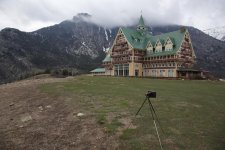
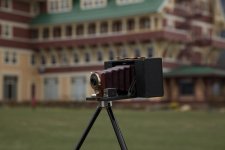
A bit off topic! But Doug and Olof mentioned working with film.


Every few weeks when I get tired of using digital still and video cameras and I’ll take out one or two film cameras just for old times sake.
Like this 110 year old Kodak camera and tripod. Great fun to shoot with. Finder is full color, although it’s getting a bit hazy and only 1/2 inch. Shutter speeds; B, T and Instantaneous, Aperture settings; 1, 2, and 3, No batteries, no menus, no light meter, NO LUT’s, Film is still available. Easy to set up, light weight, folds up and fits in pocket. Tripod collapses and fits in leather case. I have the accessory flash tray but prefer to work with available light for fire safety reasons.


Ah the good old days!


No I’m not as old as the camera.


Wonder if there will still be SD or XDQ cards 110 years from now.


cheers
Morton
1905 Kodak No 2 359.jpg1905 Kodak No 2 360.jpgWaterton Town.jpg
 
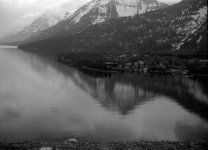
That final still.. IMO you could go up a paper grade and also burn down the sky.. exactly the same as making a nice digital image.
 
Back
Top