The Full Frame Look is a Myth. Here's how to Prove it to Yourself

Maybe, but it's my myth

wtCRHEx.jpg
 
While I've used still and video cameras since I was a kid, I didn't really get into photography and filmmaking until the Canon 5D Mark II was released (2008). Many of you have a lot more experience. My work background is computer graphics, video games, simulations, and in the last few years, image processing of real-time video. Lots of math & pixels (mostly linear algebra for graphics (not super complicated), and basic differential equations for simulations (a bit trickier, but fundamentally simple math, integrated over time)). As noted in my article, I didn't examine the mathematics of full frame, and figured since the 5D looks so much better than other cameras, that the full frame look was real. I had asked people what the full frame look really meant, but after many words and hand waving, never got a really good answer. So, I must admit I was biased towards full frame, and always compared other cameras to the look I could get with the 5D (2 & 3).

The FS700 + SB allowed shooting Super 35 or full frame (-ish: 1.07 crop). I found myself shooting Super 35 mostly as the SEL18200 lens was more versatile and had autofocus (for run & gun). Manually focus tracking live (not rehearsed) moving objects with the FS700's stock viewfinder is challenging.

When the GH4 was released, I read somewhere about the equivalence equations to match FOV and DOF, and once I understood the math, was comfortable purchasing a GH4. The lens used the most has been the Panasonic 12-35 F2.8, which is a (12-35 F2.8)*2 = 24-70 F5.6 (1080p), and (12-35 F2.8)*2.3 = 28-81 F6.4 (4K) relative to full frame. Nice for live shoots, green screen, steadicam, but not shallow DOF. The Voigtlander 25mm F.95, while not used as much, provides 25mm*2.3 = 58mm F2.2 in 4K, which provides decent shallow DOF.

Recently in another forum, the Super 35 vs. full frame debate was back. I tried to find example images showing the concepts of Equivalence (from the Joseph James Photography link). Joseph's page goes into so much detail, perhaps most people won't read any of it: classic TL;DR (too long, didn't read). For those with a math/physics background, it's clear that when we set cameras up to be Equivalent per the math, the resulting images will be equivalent. Arthur C. Clarke's statement, "Any sufficiently advanced technology is indistinguishable from magic" translates to internet forums as, "anything people don't understand is magic", especially when it comes to cameras. While I didn't understand why the 5D looked better, I never thought it was magic, just used it because it looked better and didn't do any further analysis. When looking for answers from working pros why full frame was better, I never got a straight answer. When I'd show talent shots from two different cameras (5D vs. anything else), the 5D was always preferred. So, I figured there must be something about the 5D that's better, I just didn't know why, and left it at that.

Enter the Sony A7S. We can easily shoot full frame or crop to Super 35. For our first narrative short, I shot almost entirely with the FS700's kit lens: the SEL18200. I'd never shot a narrative before, talent was always short on available time, many shots involved motion, so autofocus, IS, and mostly handheld provided the most efficient solution to get the job done. Most people loved the final look (story, not so much), and one experienced DP I met in Atlanta (who provides ARRI rentals from a very cool warehouse/studio: http://www.sharaf.net/ ) noted I should have shot shallower DOF for one of the opening shots. I explained why I used that lens and he suggested masking and blurring in post- to hide the low budget background. A good point, and something I did in another part of the short to hide people's faces when guerrilla shooting in public. I did one handheld shot with the Speedbooster (to reduce RS) and Canon 50mm 1.4 (IIRC at F2) under a parking lot light. The background was nicely blurred and it turned out great. With recent technology (e.g. PPro CC, Resolve, etc.), we can track/keyframe, mask & blur to achieve looks only previously possible with shallow DOF (won't look the same (bokeh, etc.), but does the job. Many people won't know the difference). So there's another tool in the toolbox: shoot deep DOF to get the shot, then blur in post to simulate shallow DOF (perhaps soon we'll have bokeh simulators which do some 'magic' on highlights/edges, etc.). Lightfield cameras of course can control DOF at will in post (but quality isn't there yet).

Back to the S35 vs. FF debate: after spending many hours trying to match the color of the A7S to the 5D3 (RAW), and recounting how talent & clients always love the look of the 5D, and understanding the Equivalence equations, it was clear that the main draw of the 5D was Canon's color science. Shooting stills under the same conditions and lenses with both cameras, the 5D looks better. Since they're both full frame, using the same lenses, it comes down to color. And while it's possible to match the A7S to 5D RAW, it's extra work. So for stills, the 5D3 is still king (better autofocus too).

I looked for example images showing the equivalence math- the closest I could find was this: http://neilvn.com/tangents/full-frame-vs-crop-sensor-cameras-comparison-depth-of-field/ . He used a D810 which also provides a crop mode, but didn't set the aperture to match DOF (left at F2.8 for both). Folks were still not convinced, and Joseph James' page is too long for most to read. So, I used the math and tested the theory myself, and it worked. One never really knows for sure unless we do the test ourselves. That is, exactly matching FOV and DOF with as many variables removed as possible. I used the same camera and lens, and realized that anyone can do this test with a zoom lens, whether or not the camera supports a crop mode (crop in post: an example I also showed).

Samuel Hurtado did in fact do a similar test in 2011: http://www.similaar.com/foto/doftest/doftest.html , using different cameras and lenses. Samuel used his DOF/FOV calculator to learn how this works, but I didn't see the equivalence equations- did I miss them?

In summary, my point is focused on one concept: the full frame look is a myth. Given my experience, and also once a believer that there was something special about full frame, but not knowing why and just using it, I see now I was biased because of Canon's superior color science, compared to other similarly priced brands (ARRI clearly leads at the high end for video). This became clear after shooting full frame with the A7S vs. the Canon 5D Mark III. Since the full frame variable had been removed, all that's left is color science. As the equivalence math and example photos show, we can match Super 35 to full frame, and any other format to full frame given the right lenses and settings.

One element not discussed in the equivalence math is than when stopped down to match Super 35, I notice a starburst pattern on point lights. This is a cool effect, and sometimes desired, but makes a clear difference to light/bokeh when doing a comparison. So while it's possible to match DOF and FOV, starbusts, flares, and other optical behavior may be different (perhaps only really an issue with a multi-camera shoot when trying to match cameras of different formats).

The full frame look is a myth, however full frame provides the most affordable options for shallow DOF. In 2015, if one needs or prefers shallow DOF, full frame is the best option right now. Super 35 and m43 can also provide shallow DOF, with less options and higher cost. Medium and large format can also provide shallow DOF, for much higher cost. Will there be a medium or large format look debate?

Do this.

Take a 50mm and a 100mm on a 35FF camera. Shoot from the same spot with both lenses. First shoot the 100mm FF of a person. Now double the distance of the person and shoot with the 50mm. Then take the 100mm and crop the 50mm shot to look like the 100mm FF shot. Tell me if the shots are the same?

Now, if you take a 50mm F4 on a FF and a 25mm 1.8 on a MFT and shoot the same subject, yes, you can "simulate" each others look. But you have to use a faster Fstop on the MFT right? Yep. What kind of lens are you going to use to make the MFT look like a FF shot using an 85mm F1.2? How about a 300mm FF F2.8? How about FF 35mm F1.4?

Thank you Dusty- right on que! You clearly have more experience here, as I've never shot with medium or large format. However, for your first case (50mm & 100mm), we have to use the equivalence math, moving back and shooting 100mm clearly will compress the perspective of the shot*, and the equivalence math isn't about that case. It's about keeping the camera in the same position and matching DOF and FOV for different sized sensors. Your second point about finding fast enough lenses for m43 is right on- hence the popularity of focal reducers. We're now on a different subject- cost and availability of lenses, vs. inherent properties of sensors, physics, and looks. The point of this thread is that full frame isn't a special look in and of itself, as the same DOF and FOV can be achieved with smaller sensors (S35, m43, S16) as well as larger sensors (medium and large format).

Now, like I said, shooting an interior on an 8x10in view camera at 180mm vrs a FF35mm with a 28mm is a COMPLETELY different look.
This is elementary stuff guys.

Let's compute the crop factor for an 8x10 sensor:

Dropping this into google: sqrt(8^2 + 10^2) inches to millimeters
returns: 325.279, that's our diagonal or image circle diameter in mm.

Doing the same for full frame (already in mm): sqrt(36^2 + 24^2)
returns: 43.267

Our crop factor is: 43.267/325.279 = .133

You didn't specify aperture, so let's use something commonly available: F1.4 for shallow DOF, and let's use ISO 800 as that's pretty common for video work on higher end cameras with controlled lighting (e.g. it's the base ISO for the ARRI Alexa).

FF35 camera settings: 28mm, F1.4, ISO 800, shutter 1/50
8x10 camera settings: 28mm/.133 = 211mm, F1.4/.133 = F11, ISO 800/(.133^2) = 45226, shutter 1/50

I'm only aware of this 8x10 digital camera (back): http://www.wired.com/2011/08/photographer-makes-huge-8-x-10-inch-digital-camera-back/ , so you'd need to make the appropriate changes for shutter if shooting film (much slower shutter). Shutter and ISO shouldn't matter for stills when nothing is moving (except noise); included for completeness.

Since both cameras have been set up to shoot equivalent DOF and FOV, both cameras will produce the same FOV and the same DOF! Any differences in looks will be due to lenses and film vs. digital. The medium and large format look is a myth too! (these formats do provide much higher resolution and low light potential (and really shallow DOF options). That's it). Want crazy shallow DOF at 180mm on 35mm? Right now if you've got the tools, you can DIY: http://www.4photos.de/camera-diy/Super-Fast-Tele-Lens.html . Nothing special about medium and large format sensors other than more options for shallow DOF without using a focal reducer. Just like FF vs S35, and S35 vs. m43, and m43 vs. cellphones.


*projection equation: xScreen2D = Zoom*xIn3D/zIn3D, as Zoom increases , the relative difference between two projected x (and y) points is reduced. When Zoom = zIn3D we have no perspective at all, an orthographic projection. This is how we do the math in CG and the same thing happens when increasing the focal length of a lens.
 
Last edited:
well first, you got my 100mm and 50mm scenario backwards. I said to take the same camera and first shoot the 100mm and then take the 50mm both at same aperture and crop the image 2x's and tell me if there is a difference. There will be due to MAGNIFICATION of the optic.

Anyhow, I don't need to "compute" any crop factors of an 8x10in camera. Knowing that I would shoot interiors at a 180mm focal length to achieve a wide field of view of around 90 degrees vrs a 24 or so mm on the ff35.

I don't mean to confuse you. You do what works for you. It's not a myth. It's fact backed by science.

Man, you have to do all that math just to set up a shot?

Christopher- the issue is commutative, meaning the order doesn't matter since we're not doing equivalence matching (the images won't match in either case). Here's what happens with your exact scenario- 100mm at 3m, then 50mm at 6m:
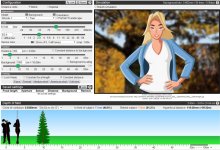
DOF_100.jpg
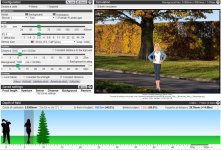
DOF_50.jpg
http://dofsimulator.net/en/

DOF is shallow with 100mm at 3m and deep at 50mm and 6m- perspective projection equations at work here as well. Increasing distance increases zIn3D and reducing the focal length (reducing Zoom/magnification) increases DOF. Scaling after projection (after photo is taken), blows up the image- no change in DOF or perspective.

Math is the best language man has developed to describe the universe. Math clearly shows the full frame look, the medium format look, or any other sensor size look, are all myths. 'Fact based on science' implies math! That's how we make progress in science. We see math makes predictions, then we go into the real world and test the predictions. If the predictions don't work, we try to understand why, and if necessary, try other forms of math to better describe reality. Sometimes the math is wrong, or wrong-ish: Newton's laws of motion are just approximations, and don't fully describe motion (and most certainly not at relativistic velocities- must use Einstein's equations). Nowadays we use simulations to better describe reality, as simple equations aren't sufficient to provide accurate answers. Rigid, soft, fluid dynamics, and optics are some areas where simulation is helpful before building vehicles or lenses, etc.

I've never use the equivalence math before a shoot. Except for this test to fully prove to myself that there's absolutely nothing special about any particular sensor size. If you want to make a point that 8x10 looks somehow distinct from full frame, you must match the cameras using the equivalence equations. If you don't, you're not comparing the sensors anymore, you are comparing unmatched lens-sensor systems and that's where the optical differences will appear in the captured 2D image. If you want to compare 180mm on 8x10 to full frame:

8x10: 180mm, F11, ISO ~45000, shutter 1/50 (film- long exposure: no ISO except film rating)
FF: 180mm*.133 = 24mm, F11*.133 = F1.5, ISO 800, shutter 1/50

Set both cameras up as above and shoot from the same location. The results will be equivalent. Any differences will be due to specific lenses and their behavior at specific settings. You could also mount the FF lens to the 8x10 camera and crop in post. If there's a general behavior of lenses at a particular scale due to physics of light that doesn't happen with lenses at another scale, then we can make a general statement about 'lenses at scale'. I haven't seen any evidence of such a generalized effect, but if such an effect exists, post the links/pics!
 
Last edited:
I'm not even concerned or talking about DOF dude. I'm talking about MAGNIFICATION. Which is WHAT LENSES DO, MAGNIFY. A 50mm is a 50mm as a 100mm is a 100mm.

"Magnifying" an interior shot on a 180mm is far different than magnifying the same shot on a 24mm, REGARDLESS of format. I'm not even caring about DOF. That is what separates the look of 2/3rds format, MFT, s35, 35mm, 65mm, 4x5 or 8x10. It just so happens that as you use a lens that MAGNIFIES more and shoot closer to a subject, the DOF decreases.

Can one achieve a FF look with a MFT? Yes. By using f1.0 speed lenses. But like I said, what lens are you going to use on your MFT or S35 to get a FF 35mm F1.2 look?

See, you are hung up on the DOF factor. I'm talking about magnification.

If we stood side by side and I with a 35FF with a 50mm F/2 and you with a MFT with a 25mm F/2 and se shot exact ISO and F stop, are we going to have the same look? How about when we start going wide? I'll mount a 16mm F2.8. What are you going to mount on the MFT?

Again, a 50mm is a 50mm regardless of format. Using a 180mm for a wide shot interior is a vastly different look on an 8x10 camera. Same applies to a 2/3rd sensor or a FF camera. The background compresses to the foreground.
It's about magnification. You're hung up on DOF. You can get shallow DOF on a 1/3rd inch camera. How? By zooming in or in other words, MAGNIFYING THE IMAGE.
I'm now done here.
 
I don't get the magnification point, would you care to explain a bit easier for noobs?

I don't think there's a difference in FOV or how the background-forground perspective looks, these can be matched between the two formats, and you stay in the same potition.

For example shooting a medium closeup of an actor at 50mm at f 2.8 on FF, if you stand exactly at the same position with a 25mm 1.4 on m43s you get the exact same background/foreground perspective and same DOF too. It's the same image just with differences in optical qua
ity of lenses and sensors of course (sharpness bokeh etc). If you use a 50mm on the m43s and stand back to gret the same med. close up, this is where perspective starts to change.
 
Christopher- magnification, DOF, z-space compression, bokeh, circles of confusion, it's all about the effective math of the camera+lens system. All you have to do is post images/links where cameras and lenses are set up with mathematical equivalence, to make any point regarding sensor size.

"If we stood side by side and I with a 35FF with a 50mm F/2 and you with a MFT with a 25mm F/2 and se shot exact ISO and F stop, are we going to have the same look?" - no, but these solutions will work:

35FF: 50mm F4, 4x ISO
MFT: 25mm F2, 1x ISO

or

35FF: 50mm F2, 4x ISO
MFT: 25mm F1, 1x ISO (e.g. Voigtlander 25mm F.95)

"
How about when we start going wide? I'll mount a 16mm F2.8. What are you going to mount on the MFT?"

35FF: 16mm F2.8, 4x ISO
MFT: Speedbooster EF to MFT, crop factor was 2, now *.71 = 1.42, 16mm/1.42 = 11mm, F2.8/1.42 = F2. Tokina makes an affordable 11-16 F2.8 ($479). To match brightness and DOF, we need F2. The SB gains a stop of light, so we're good with light, DOF will be deeper. This doesn't mean the FF sensor provides a unique look, only that in this corner case we can't quite match shallow DOF due to lens availability, which could change in the future. Let's go up a size in sensor: a 645D camera with a .79 crop:

35FF: 16mm F2.8
645D: 16mm/.79 = 20mm, F2.8/.79 = F3.5

Again, nothing unique or exclusive about a 35mm sensor in terms of looks. In researching this, I found that folks state that larger format cameras do better in wide shots due to less distortion. This sounds like a limitation of lenses for smaller formats. Would be cool to see a side-by-side comparison between 35mm and medium or large formats where the cameras are set up as close as possible using the equivalence math. Clearly some wide angle lenses do a better job eliminating distortion than others.

In the case we needed max sharpness and detail for deep DOF in bright light, smaller sensors won't have to stop down as much and can have less of an issue with diffraction causing resolution loss (if one doesn't have access to ND filters).

There are advantages and disadvantages for different sensor sizes, however the math shows no sensor creates a unique look that can't be replicated in another sensor size, up or down. If in practice that's not true, we need to see actual images demonstrating how this is possible (with both cameras set up with equivalence).
 
Again, a 50mm is a 50mm regardless of format. Using a 180mm for a wide shot interior is a vastly different look on an 8x10 camera. Same applies to a 2/3rd sensor or a FF camera. The background compresses to the foreground.
It's about magnification. You're hung up on DOF. You can get shallow DOF on a 1/3rd inch camera. How? By zooming in or in other words, MAGNIFYING THE IMAGE.
I'm now done here.

Dusty this is not correct. Background compression is lead by camera to subject(s) distance and Fstop.

So go 10ft from your subject and 15ft from the B/G and shoot with a 24 and a 100 at maybe F4, make a couple of prints, chop the middle out of the 24mm print, enlarge it to the size of the 100mm print and the perspective DOF will be identical (ignoring increased grain, lack of res. and other enlargement artifacts)

IMO sensor size means little in the theoretical space - I went from 645 to FF35 in stills after a load of testing - typically my F2 nikkors were giving a similar look to my 2.8 or 3.5 H1 lenses.

Of course when one leaves the theoretical space and enters the real worls there are a bunch of reasons why large chips 'win' - mainly due to the complexity of making small stuff - like jamming millions of pixels onto a sensor ect.

Even a blob of dust on a large sensor is less bad news than a blob of dust on a small sensor.

If my FS7 was available in S35 and FF35 I would have picked the latter.

But mainly because FF matches the lenses I own and can buy cheaply.

S
 
This statement in the title is wrong.
Because you can stand closer at you subject to get a wide shot you get more DOF. And different field of view because of the foreground background comression. Wide lenses make the background look futher away and tele lenses make the background closer by. Also your choice of lens and/or your distance will be different, making a different look. Period.
These are two point you forget in this statement.
 
Christopher- magnification, DOF, z-space compression, bokeh, circles of confusion, it's all about the effective math of the camera+lens system. All you have to do is post images/links where cameras and lenses are set up with mathematical equivalence, to make any point regarding sensor size.

"If we stood side by side and I with a 35FF with a 50mm F/2 and you with a MFT with a 25mm F/2 and se shot exact ISO and F stop, are we going to have the same look?" - no, but these solutions will work:

35FF: 50mm F4, 4x ISO
MFT: 25mm F2, 1x ISO

or

35FF: 50mm F2, 4x ISO
MFT: 25mm F1, 1x ISO (e.g. Voigtlander 25mm F.95)

"
How about when we start going wide? I'll mount a 16mm F2.8. What are you going to mount on the MFT?"

35FF: 16mm F2.8, 4x ISO
MFT: Speedbooster EF to MFT, crop factor was 2, now *.71 = 1.42, 16mm/1.42 = 11mm, F2.8/1.42 = F2. Tokina makes an affordable 11-16 F2.8 ($479). To match brightness and DOF, we need F2. The SB gains a stop of light, so we're good with light, DOF will be deeper. This doesn't mean the FF sensor provides a unique look, only that in this corner case we can't quite match shallow DOF due to lens availability, which could change in the future. Let's go up a size in sensor: a 645D camera with a .79 crop:

35FF: 16mm F2.8
645D: 16mm/.79 = 20mm, F2.8/.79 = F3.5

Again, nothing unique or exclusive about a 35mm sensor in terms of looks. In researching this, I found that folks state that larger format cameras do better in wide shots due to less distortion. This sounds like a limitation of lenses for smaller formats. Would be cool to see a side-by-side comparison between 35mm and medium or large formats where the cameras are set up as close as possible using the equivalence math. Clearly some wide angle lenses do a better job eliminating distortion than others.

In the case we needed max sharpness and detail for deep DOF in bright light, smaller sensors won't have to stop down as much and can have less of an issue with diffraction causing resolution loss (if one doesn't have access to ND filters).

There are advantages and disadvantages for different sensor sizes, however the math shows no sensor creates a unique look that can't be replicated in another sensor size, up or down. If in practice that's not true, we need to see actual images demonstrating how this is possible (with both cameras set up with equivalence).

See, you keep taking your small sensor and opening up the iris. I keep telling you we stand side by side exact same settings.
I already agreed with you that if you open up the iris you can get a similar look.
What you are failing to see is that if we use the same settings, you won't get the same look.

Again, what lens are you going to use against say the Canon 85mm 1.2 on your S35 frame?

I will say it ONE LAST TIME. A 50mm is a 50mm as a 100mm is a 100mm regardless of what camera format it is mounted too. Period. The image circle it produces might be different, but the magnification is EXACTLY THE SAME. This is what you are failing to recognize.
Now the format in which your shooting changes the FOV. The FOV on an 8x10 camera at 300mm is roughly the same as the FOV of a 50mm on FF35. Now slap a 300mm on the FF35 and what happens? You magnified EVERYTHING in the frame. The background is now COMPRESSED into the foreground. Now take that COMPRESSION onto the 8x10 and realized that is your medium focal length lens (like the 50mm FOV on the FF35). COMPLETELY different look! So if you shoot on the 8x10 at F/8 with the 300mm and shoot 50mm F/8 on the FF35, you will NOT achieve the same look.

So it's not a myth. So side by side with the 50mm on the 35FF and 25mm on the MTF SAME EXACT SETTINGS of F/2 will NOT achieve the same look. Especially in terms of MAGNIFICATION OF THE IMAGE! But sure, if you open the 25mm on the MFT to F1.4 or so you will get a similar DOF, BUT NOT MAGNIFICATION. PERIOD!

All lenses do is MAGINFY THE IMAGE. Like a telescope.

I'll put it like this.
You have an 10mm penis. I have a 400mm penis. Who is going to stretch the female out more? I'll even let you use a teleconverter for an extra 5mm's.
 
yikes, what a mess. all things considered, if it works for you, it works for you. There is no oscar for "best DOF", or "Best FOV"

I for one am shying away from full frame just because it's too narrow in DOF, and i favor s35 amd M43 because i can get shallow if i want, but can get the depth if i need it.

Awhile ago i made this, focusing on crop factor showing an image circle of a 50mm ove swatches of different sensor sizes, but around 2:50 i go into the whole 50mm vs 100mm examples of magnificant/FOV/DOF,


But you moved.
See, with the larger format you're not going to move backwards. In fact, your going to move towards. Stay in the same spot and forget the FOV in your test, does your background not compress into the foreground?
 
But you moved.
See, with the larger format you're not going to move backwards. In fact, your going to move towards. Stay in the same spot and forget the FOV in your test, does your background not compress into the foreground?

I wasn't disagreeing with you, nor was I saying that that video fits exactly to the argument at hand, just a demonstration of fov magnification of the background at different focal lengths maintaining the same fov of the in focus subject
 
See, you keep taking your small sensor and opening up the iris. I keep telling you we stand side by side exact same settings.
I already agreed with you that if you open up the iris you can get a similar look.
What you are failing to see is that if we use the same settings, you won't get the same look.

Again, what lens are you going to use against say the Canon 85mm 1.2 on your S35 frame?

I will say it ONE LAST TIME. A 50mm is a 50mm as a 100mm is a 100mm regardless of what camera format it is mounted too. Period. The image circle it produces might be different, but the magnification is EXACTLY THE SAME. This is what you are failing to recognize.
Now the format in which your shooting changes the FOV. The FOV on an 8x10 camera at 300mm is roughly the same as the FOV of a 50mm on FF35. Now slap a 300mm on the FF35 and what happens? You magnified EVERYTHING in the frame. The background is now COMPRESSED into the foreground. Now take that COMPRESSION onto the 8x10 and realized that is your medium focal length lens (like the 50mm FOV on the FF35). COMPLETELY different look! So if you shoot on the 8x10 at F/8 with the 300mm and shoot 50mm F/8 on the FF35, you will NOT achieve the same look.

So it's not a myth. So side by side with the 50mm on the 35FF and 25mm on the MTF SAME EXACT SETTINGS of F/2 will NOT achieve the same look. Especially in terms of MAGNIFICATION OF THE IMAGE! But sure, if you open the 25mm on the MFT to F1.4 or so you will get a similar DOF, BUT NOT MAGNIFICATION. PERIOD!

All lenses do is MAGINFY THE IMAGE. Like a telescope.

I'll put it like this.
You have an 10mm penis. I have a 400mm penis. Who is going to stretch the female out more? I'll even let you use a teleconverter for an extra 5mm's.

I have been working in computer graphics for almost 15 years and have had the luxury to be able to work in a world where I can have any sensor size camera with any fov that I want and I can tell you without question that your concept of compression is totally wrong. Any normal lens no matter what focal length will the same perspective as any other if they are at the same location in the scene, you just get to see more off your scene with a shorter focal length but common parts of the image are identical.
 
Last edited:
Any normal lens no matter what focal length will the same perspective as any other if they are at the same location in the scene, you just get to see more off your scene with a shorter focal length but common parts of the image are identical.

+1

...I've shot with everything from the Minox 8mm x 11mm format all the way up to portraits and macro shots with the Polaroid 20 inch x 24 inch "instant print" camera ( and 30,000 watts of Speedotron Black-line flash ), and what dhessel says is 100 percent true.

Lens to subject distance controls perspective.

Lens to subject distance and F-stop control DOF.

Media format size is completely irrelevant. ( assuming that equivalent F-stops are possible )
 
Here are 3 images, CG since I don't actually have the equipment to do this in real life. These are rendered with Vray which as a physical camera model that has all the normal camera controls. It is designed to be phyically accurate. Sorry about the noisy images but I am short on time for this.


Settings used are as follows

Format: FF
Focal Length: 38
FOV: 50
Fstop: 1.11
ISO: 2.25

Format: 24inch/610mm(width)
Focal Length: 538.5
FOV: 50
Fstop: 18.8
ISO: 646.2

Format: s35
Focal Length: 25.5
FOV: 50
Fstop: 0.74
ISO: 1

Which one is which?
 
Last edited:
  • Like
Reactions: jcs
Back
Top