The Crown BTS

Thanks, great referral. I do like the look of the Crown with the Tiffen Glimmer Glass. Glimmer Glass is one of my go-to filtrations.

Chris Young

From interlaced grabs (yes interlaced! Some still demand it.)

Camera
Camera.jpg

Camera + Bronze Glimmer 10
Camera + Bronze Glimmer 10.jpg

Camera + Smoque 1
Camera + Smoque 1.jpg
 
LOL! I knew that would be one of the questions asked. Very good for the first question. I cheated :)

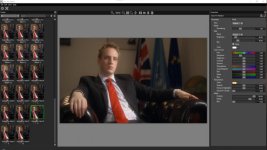
I used Tiffen's DFX 4.0. This allows me to use almost any of Tiffen's optical filter looks in post. Bringing me the option to offer lens filter effects into much lower end productions. On the practical side, I have literally dozens of 4 x 5.6 and circular filters and a couple of matte boxes now gathering dust because they are too large and involve too much rigging for mirrorless and many of the smaller video cameras. Everything from NDs to ND grads to the old school colored grads, Promists white, black, warm, enhancing, etc that were popular in their day. These physical filters also complicate travel today in these compromised travel days when flying interstate with just an interviewer and shooter who has to cart all of his own "small" camera kit, lights, and sound. The rumor is that Tiffen sold out their DFX software to Digital Film Tools as it was seriously affecting their "real glass" sales. It's now been bought out by Boris FX. Love the software. Nearly everything is done in software grading these days and seeing the flexibility and availability of these "optical filters" with the ability to rehearse many film looks, lighting gobos FX, and just pure grading power all available in one package DFX was a definite starter for me when Tiffen first released the package.

EDIT: I've added a video down below that I believe is no longer available that better explained Tiffen DFX.

Chris Young


Virtually any optical filter effect you can see in the following clip is available in DFX 4.0 and is highly customizable and can be saved as one of your presets.


DFX streaming demo from around 2016.

 
Last edited:
Haven't seen The Crown but I really enjoyed the BTS. Thanks for posting. There really is a unique energy on a bigger production like this that came through well here. It's humbling to see how the big productions do it. All of the things that I wish I had the time/money/manpower to pull off on my small sets, they execute on the big ones (and then some). Sometimes that's just having an uninterrupted moment to think -- I liked Adriano's comment about having the freedom to exercise his creativity.
 
Yes, it really shows how different larger scale productions are from OMBs. Not even close to being related. As a OMB, it is amazing to me to see a large group of people working together with one single purpose. Seemingly plodding along but leaving no stone unturned for quality.
 
Chris, are you sure the Tiiffen software is really necessary? I graded this version of your original in about a minute using Resolve. It would have been even faster if just chose whatever I liked and wasn't trying to come close to the look of your Bronze Glimmer. I think I've reduced the hot spot on his forehead even better than the Tiffin filter.

DJ1_1.2.1.jpg
 
I think it helps to have watched some of the The Crown before watching this fascinating BTS. It’s spectacularly beautiful. Hard to believe how the sausage is made.

One thing that struck me in the BTS was how unflappable Adriano Goldman was in all situations. There are scenes where crew are practically standing on his toes while he’s waxing lyrical about his work, apparently having no difficulty concentrating. I wouldn’t be able to string a coherent sentence together in such circumstances (and in my native language, to boot).

Good stuff.
 
Chris, are you sure the Tiiffen software is really necessary? I graded this version of your original in about a minute using Resolve. It would have been even faster if just chose whatever I liked and wasn't trying to come close to the look of your Bronze Glimmer. I think I've reduced the hot spot on his forehead even better than the Tiffin filter.

Agreed Doug. Anything you can do can in DFX be achieved in many decent NLEs but it takes longer. I like it when I have a new dithering producer sitting next to me who's not at all sure of what he wants his production to finally look like that in a very short amount of time I can assault his senses with a variety of 'looks'. You can get them to something they like very quickly, bang, bang bang. I cannot offer a host of manual grades with glows, diffusion looks, color grades, etc in a few minutes. I have to take time to create them. Not much time for the simpler ones but still time. DFX is like going to a tailor who can show you the color, feel, and look of a range of materials quickly. Off the peg grading, I call it. Where I found it useful is grading archive material in history docos to try and get a particular feel, tint or look quickly by just flicking through ten, twenty "camera" filters, and film looks to fit the mood the producer wants.

Chris Young
 
Chris, you speak words of wisdom. Time is money and anything that speeds up the process for you in post or makes dealing with clients easier is probably worth the expense.
 
Surely there's a difference in the effect achieved by glass in the optical path vs a digital after-effect...? Although perhaps not enough for those of us who need to work quickly and cover our asses to care
 
Surely there's a difference in the effect achieved by glass in the optical path vs a digital after-effect...? Although perhaps not enough for those of us who need to work quickly and cover our asses to care

And another thing, “digitally” it’s non-destructive, so you haven’t made an irreversible choice and baked it into the camera original footage, which with today’s indecisive producers and directors, is probably a good thing(for them). Personally, I like doing a lot of things in-camera, you know, like properly exposing the shot and choosing the correct white balance, which many think is the domain of post, now too. Also, personally, I’ve never been a huge fan of “soft fx” filters, because too many people go overboard with them when using them(too strong).
 
Also, personally, I’ve never been a huge fan of “soft fx” filters, because too many people go overboard with them when using them(too strong).

I agree with that attitude for today's cameras. But back in the day of my Ikegami HL59 Betacam I kept a Tiffen Soft/FX 2 discreetly screwed onto the front of my lens 100% of the time. I never took it off and clients and other crews (on multi-cam shoots) could never figure out why my camera always looked so much nicer than all the others, especially the Sony D600. The filter, combined with some tweaks to the circuit boards took that "video-edge" off the picture just enough, while still keeping eyes and details sharp. It was a time when the "Macie look" was all the rage in New England and I thought it looked awful (too muddy) so I took the side panel off and painted the camera myself. Back in those days you couldn't just export a scene file so it made it easy not to share the secret sauce. I used Macie for my repairs, but I'd never let an engineer touch my picture settings. Of course all that changed around 2005 when I got my cheap little Z1U and it clearly blew the doors off the $60K Betacam. What we all thought had been good enough turned out to look like s*%t. Never looked back.
 
Surely there's a difference in the effect achieved by glass in the optical path vs a digital after-effect...? Although perhaps not enough for those of us who need to work quickly and cover our asses to care

When first tried DFX I didn't try glimmer Glass but I did with Promists, both black and white. The same shots with the glass and with its digital equivalent are virtually indistinguishable. You know how good a look you can get with a good grade of RAW or LOG with or without a LUT. The grade hasn't 'damaged' your picture in any way. You've just rearranged pixels and luminance and color values. Same with DFX. DFX's filters are just 'looks' in the true sense of the word. Created by very experienced graders when Tiffen had the package developed. As I said they were so good that the rumor was that they were losing sales on the optical filters once the word got out that these DFX filters were that good. The other thing with the glass is if you commit to a 1/8, 1/4 or 1/2 filter that is exactly what you get. A certain fixed amount of diffusion, glow or whatever that filter is imparting to the look and feel of the shot. It is then 'baked in' in a similar way Rec709 colors are. With a filter's digital equivalent all its parameters can be modified very subtly if required. Once modified save it as a new preset should you wish to come back to it.

Look below and see your Promist selections alone. There are 18 rows of Promist equivalents. All of which can be manipulated in a wide range of parameters with the very intuitive sliders on the right. Fully tuneable as compared to a 'baked in' look which if a client doesn't like at a later stage leaves you pretty well screwd. Look from an artistic POV I like working with glass but that's my desire my wish. From a practical and pragmatic and financial point of view, this commercially kills the glass. Added benefit? Never had to deal with flare on the filter with the digital ones :)

Chris Young

DFX Interface Warm Pro 8.jpg
Camera sample.jpg
Camera sample + Promist.jpg
 
I agree with that attitude for today's cameras. But back in the day of my Ikegami HL59 Betacam I kept a Tiffen Soft/FX 2 discreetly screwed onto the front of my lens 100% of the time. I never took it off and clients and other crews (on multi-cam shoots) could never figure out why my camera always looked so much nicer than all the others, especially the Sony D600. The filter, combined with some tweaks to the circuit boards took that "video-edge" off the picture just enough, while still keeping eyes and details sharp. It was a time when the "Macie look" was all the rage in New England and I thought it looked awful (too muddy) so I took the side panel off and painted the camera myself. Back in those days you couldn't just export a scene file so it made it easy not to share the secret sauce. I used Macie for my repairs, but I'd never let an engineer touch my picture settings. Of course all that changed around 2005 when I got my cheap little Z1U and it clearly blew the doors off the $60K Betacam. What we all thought had been good enough turned out to look like s*%t. Never looked back.

Why would you purposefully set-up your camera to have a different look on multi-camera shoots and then not share that info so the producer could get a consistent look? Good grief, I'd have had you fired:-D
 
Why would you purposefully set-up your camera to have a different look on multi-camera shoots and then not share that info so the producer could get a consistent look? Good grief, I'd have had you fired:-D

It ensured my camera would always be the A camera. The other cameras were never going to match no matter what was done on location because in those days painting the cameras had to be done by taking the side panel off and using a screw driver to turn pots on the board. If other people had foolishly paid an engineer to tweak their camera to have a muddy look, that was their business and they weren't about to undo it. It was a far different era than today where scene files can be shared. And in the end, yes we were all friends, but also competing for the same work, and the "look" of my camera was proprietary and gave me a competitive advantage. Plus I was an outlier shooting on Ikegami instead of Sony, which almost everyone else was using in my area, so there's really no way in hell their cameras could ever match anyway. I was doing about 225 shoots per year in those days and less than 10-20 involved multiple cameras, so I'm hardly going to give away information that makes it easier for competitors to compete the rest of the year. In the end, this is a business and you have to treat it that way sometimes.
 
Last edited:
Back
Top