The Clamp light vs. Worklight vs. PAR38 Cans

holymexicobatman

Well-known member
So what's your preferred DIY/cheap light? And what if you were setting up for a permanent low-budget studio set? Which has better control, mounting options, light quality, etc?
 
Clamp lights (the narrow "spot" ones) are my most frequently used cheapo lights. I keep a crate of them in my truck at all times, just in case. 60-70% of the time my standard fixtures are fine and the clamp lights never leave the truck, but for those other times, they've been invaluable.
 
If you're setting up for permanent, you should be looking at actual pro lights. More initial outlay, but the cost in time, frustration, and effort will be much, much less. It's worth it.

I'd start looking for used pro gear. Tungstens. Diffusion. You WILL be much happier in the long run. Get the tools which are actually designed to do what you want to do.
 
If you really want to get a par can, don't waste your time with those smaller units. Look into Par64's, they pack the punch that you really need...

But yeah, the pro gear is cheaper than you think, what's your budget for this?
 
Among the choices, for a studio, rock and roll pars: PAR64s, hands down. Not so long ago they were just about the only thing in studio grids.
 
Lots of great input guys, thanks. I really doubt I'll need much more light than par38 since the grid is only 7.5ft off the ground! =/ This would be a very, very small space and lighting only one person(headshots and medium shots only) with a simple cyc backdrop.

While I'm mentioning cyc's. What's the cheapest material to make a cyc for throwing some light gradient colors on it? Id like to make some nice soft color combos on the backdrop without doing greenscreen and we're only talking 10x10ft.
 
Either way, I would still go for the Par 64's with 500 watt globes. Even if this is "too much light" it gives you a jumping off point that is safe, and from there you can leave it bare for a good stop, or diffuse it quite a bit and still have enough light to shoot.
 
Cheapest cyc? A roll of seamless paper is fifty bucks or so if you can find it locally (9' box shipping is kind of harsh!).

For something more permanent, most studios use linoleum, I believe they paint the "back" side and don't worry about texture - so you may be able to score a closeout, remnant or scratched piece. It can be painted hundreds of times, too.

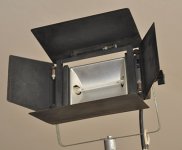
Cheap lights - just constantly check eBay's continuous lighting listings. Look for theatrical fresnels and open faced lights with barn doors.

I have three or four of these, sometimes you'll find them as low as $40 or so...
DSC_0018.jpg

Dual biax flo's are getting down under $200. they're awesome lights, lightweight, daylight, and cool.

Pyramid is selling 1k fresnels for about $150 this week. But you can get a brand new altman (made by L&E) theatrical fresnel for about $100 new if you look around - up to 750k, also takes 300 & 500 globes, nice lens.
 
The kind of cyc i'm referring to is the the theatrical kind--not the seamless full studio kind. Basically it's just a straight white-ish clean surface(usually some sort of nylon) for projecting color onto.

Why not just get a white seamless like mentioned earlier? It's like 50 bucks, and if it gets a little dirty you can always roll out another 10 feet.
 
You might want to consider something closer to 50% grey for a background if you intend to paint it with a color gelled Fresnel.

Good Luck!
 
Why not just get a white seamless like mentioned earlier? It's like 50 bucks, and if it gets a little dirty you can always roll out another 10 feet.

That actually sounds like a good idea. I've just never seen it done before. Do you think a plain white would paint well with gelled lights? Like David mentions, would it need to be slight more gray or off-white?
 
Remember white will reflect more light, and if you're projecting color onto the backdrop especially in a small space, the reflected light will color your subjects as well. Grey rather than white will reduce this effect.
 
To save on initial startup cost, we've decided to use modified clamp lights/scoops with diy barndoors and diffusion, using dimmable fluorescent bulbs.

Questions: What dimmable fluorescents do you recommend? And how would you permanently mount a clamp light?

I'm thinking we'll setup three hanging pipes as a semi-grid. One in front, one directly overhead, and one behind. Each would be about 10' feet long. What pipe do you recommend for only hanging a maximum of three modified clamp lights on each section? We may eventually upgrade to LED's next year. Would PVC be too weak or would aluminum be a better option? The pipe would also need to somehow be secured to the existing wooden cross beams overhead as well...
 
The gray sounds like a great idea, haven't done it before, but it sounds good.

Dimmable flourescent bulbs? Except for the Diva, I've never seen a fluorescent globe that dims. You're not going to get one either unless you have a ballast that supports dimming, which would probably end up being quite pricey and would probably end up flickering.

I don't know if this is quite the application for CFL's. You don't need the light to be daylight, heat isn't really that big of an issue with the low wattage bulbs you'll have to use, and you'll just introduce a whole host of color issues. Why not just go for some 200 or 250 watt incandescent globes?

As far as the grid goes, I'd probably go for a few junior nail on plates and junior cheesebouroughs. Screw the junior nail on plates into your wooden beams over head, and then you can stick the junior cheesebouroughs into that and use it to clamp onto your pipe. If you really want you can use PVC, but you need to support it more. I would just use aluminum pipe since you're going to have this thing up there for so long and if you get bigger lights in the future, you don't have to worry about changing it all around.

What are you going to use for diffusion?
 
The gray sounds like a great idea, haven't done it before, but it sounds good.

Dimmable flourescent bulbs? Except for the Diva, I've never seen a fluorescent globe that dims. You're not going to get one either unless you have a ballast that supports dimming, which would probably end up being quite pricey and would probably end up flickering.

I don't know if this is quite the application for CFL's. You don't need the light to be daylight, heat isn't really that big of an issue with the low wattage bulbs you'll have to use, and you'll just introduce a whole host of color issues. Why not just go for some 200 or 250 watt incandescent globes?

As far as the grid goes, I'd probably go for a few junior nail on plates and junior cheesebouroughs. Screw the junior nail on plates into your wooden beams over head, and then you can stick the junior cheesebouroughs into that and use it to clamp onto your pipe. If you really want you can use PVC, but you need to support it more. I would just use aluminum pipe since you're going to have this thing up there for so long and if you get bigger lights in the future, you don't have to worry about changing it all around.

What are you going to use for diffusion?

Ok, maybe I'm a little misinformed about the dimmable fluorescents. I'll have do some digging...And yea, I was thinking aluminum would be a smarter way to go long-term. Diffusion material will probably depend on what kind of bulbs we use. Obviously if we go for incandescent, there will be a bit more heat. Originally I was thinking of cutting up frosted shower curtains to the right size, but I don't know how flammable that may be.
 
Interesting, the problem with the dimmable fluorescent bulbs is you have no idea what the color temperature of them are, or if they have any strange spikes in their color spectrum. Their CRI could be something abysmal, but it's difficult to tell without either them telling you, or you getting a color meter and trying it yourself. The other thing too is whenever you dim anything, the color of that light will change, which isn't something that you'd want in this setup.

As for the LED bulb...what do you gain? LED is still very new technology and people are still having a tough time making one that reproduces colors very well. Whenever I end up using them on set we always end up adding the strangest gel pack to get it back to white. People have been using incandescent globes without fail for way too long. I really suggest sticking to the tried and true method, as everything else in this situation is just a little silly.

The last thing about these two globes is the price! 6 globes would be over 120 dollars, as opposed to the incandescents which would probably be around 5 bucks a piece, if not less.
 
Interesting, the problem with the dimmable fluorescent bulbs is you have no idea what the color temperature of them are, or if they have any strange spikes in their color spectrum. Their CRI could be something abysmal, but it's difficult to tell without either them telling you, or you getting a color meter and trying it yourself. The other thing too is whenever you dim anything, the color of that light will change, which isn't something that you'd want in this setup.

Good points on the Fluoro's. As for dimming, some fluoro's and LED's are dimmed with PWM (Pulse Width Modulation) circuits. This could have undesirable effects when shooting on video because the frequency of the PWM might allow for flicker to show on video at certain shutter speeds. This is especially prevalent with inexpensive LED lighting.
 
Back
Top