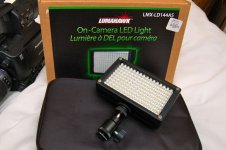
The Best On-Camera LED Light

I cannot find their lux rating of that light anywhere on their site, but they say that the light is BY FAR the brightest COMPACT led light for film and video production.Now that if true that it is the brightest , I am wondering when the photometrics were done to determine that. I see there are many led on camera lights that in the order of 1200 to 1800 lux out there, and I imagine that the Zilite should be at least 1800 lux. Spmewhere I saw the specs as being not a very bright light at all. And some say that it is a damn bright light probably haven't seen a damn bright light to compare it to_Or is it manufacturer's inflated spec on that. Hmmm.
 
Let me see now..., according to the physics of light that you need 4X as much when you double the distance ( for the same brightness level), then you would get 4X more light when you halve the distance. So... 143 lux at the 2 meter distance would equate to 143 X 4 = 572 lux.
Is that really bright light ?? around a 30W bulb. I didn't think so...
But it is " by far the brightest compact led light for film and video production "
How do they measure those things anyway ?
 
What would you guys recommend for shooting in a dark night club? Keep in mind, I'm not shooting for a film - more like promotional videos with a lot of quick cuts and "action" shots. After the last party I filmed, I found that about 80% of my footage was unusable due to graininess caused by cranking up my ISO. I can't say I was surprised as I knew going into it that I'd only get clear shots when I was in better lit areas, but I did it anyway and hoped for the best. Now I realize I need something so I can stop wasting time and bytes.

I was thinking of picking up a glidecam and one of the 352-LED ring lights from Ebay and running with my T2i and Tokina 11-16mm. I was thinking a LED ring light would be perfect for my needs since with that sort of close quarters shooting I would want to keep my light as close to the camera as possible. The problem with that light is there is no battery pack. I figure I could rig something up but want to make sure I'm on the right track before investing more time and money.

Feedback? Is there a better way to do this?
 
Them led ringlights as well as most led lights ( on camera) that have a lot of teeney weeney leds in them are really for close quarters usage. I hear it over and over again that a led light that is powered with internal AA batteries and is equivalent to a 75 to a 150 watt halogen is really bull s**t even the specs say it so. They can say whatever they want about the inflated specs but it is impossible that a led light that consumes LESS than 10 watts can be equal to a 100 watt or more halogen/incandescent/ filament bulb. As much as the hype is about the leds, allow me to clarify. Even the most efficient led in the world right now is the Cree XM-L that theoretically can output 1000 lumens when consuming 10 watts. Now that is the theoretical value but in actuality is even less than that, So let us assume that it does indeed shell out 1000 lumens at 10 watt consumption or 100 lumens per watt at that power level, for the sake of argument. That is only one (1) lighting class led, and also puts out a lot of heat behind it Now, 1000 lumens is roughly the equivalent to a 60 watt incandescent kitchen unfrosted bulb. Them teeny weeny leds that are often used are really low efficacy ones that are mass produced for other applications other than for video use. They exhibit a bluish tint because they are (the phosphor in them) the brightest BIN ( binning is led jargon that places leds in different tint classification as well as efficasy) available for the most light output. Leds are encapsulated so that the capsule serves 2 purposes. 1- it protects the phosphor and 2- it acts as a magnifying lens to narrow down the beam and make it brighter up front.Now the more you narrow, the brighter it gets, but narrowing it down too much and it would not be very useful for video use, unless your lens is zoomed in. Widening it too much will be more of use BUT the light will not be powerful enough.So the led manufacturers in their quest to deliver a "powerful" light will find the sweet spot angle like 40 degrees to make everyone happy and voila the spotty 40 degree native angle of most teeny weenie leds. Now here comes the interesting part. You see that the are almost always blue in tint AND that they are never wide enough to cover the shot. So, you put in a yelluw CC (color correcting) filter in front AND a wide diffuser to spread the beam out a bit. Problem solved. Solved somewhat but adding them 2 things in front of the led and you now have decreased the light output by almost half. Remember the Cree led I mentioned that consumes 10 watts for a 60 watt equivalent ? that one makes the led 6 times more efficient ( 10 watts to make it look like 60). That seems about right on target as far as leds go. So if a led consumes 5 watts, then it is fair to assume that it is equivalent to about a 30 watt bulb ( 5 X 6 = 30 ) if a led consumes 20 watts, the it is around a 120 watt bulb. These are really the best figures without factoring in led driver electronics, heat coefficient losses, etc. which in reality makes the led 5X more efficient rather than 6. Now, to answer you question as a suitable on-camera led light for dark interiors WITHOUT having to use the gain up too much, it all depends also on your average working distance. A rule of thumb I use, and a rough one at that , is simply for every 5 feet from the camera to subject 500 lumens is sufficient, So at 20 feet it would be around 1800 to 2000 lumens. Light is not linear so that at 20 feet it would be more loke 2400 to 3000 lumens. Also the fact that some cameras are more sensitive than others and thereby need less lumens. This is assuming 0 gain. A led light that uses 4 or 6 AA would NEVER shell out light sufficient for 12 feet without camera gain. If it did, the batteries would have to have over 1.5 amps of current going through them, they get hot and will pan out in less than 15 minutes of usage. I laugh every time I see a lite panel type on-camera unit that says over an hour with AA's, and equivalent to a 150 watt bulb. Yeah right. You would do well by checking out lights such as the Comer 1800 that uses neutral lighting class leds that are way more efficient than them teeny weeney ones. You can always dim it down when needed. Always remember, good video requires good lighting and it is always best to have more than not having enough.
 
Can you put the Z96 light about 5 feet from a white wall WITHOUT the diffuser or yellow filter just to see if it has a spotty bright center section or a nice wide even illumination. I am just curious to see what the beam looks like from the little leds in the unit. I would appreciate that very much if you can post the result as a photo or vid clip. So much is mentioned about this light that I just gotta see it. Million thanks.
 
I took a pic using T2i + Sigma 17-50mm with the Z96 mounting on top without the white or warming filter. About 5-6 feet from the wall

z96-wall.jpg
 
Last edited:
Video lights/led video lights/ any light for that matter, why are they all projecting a circular beam ? If you take the rectangular format of HD 16:9 and fit it within the light circle, you would see that the "half moons" of unused light at each side really don't do much other than being spill. We do not shoot round videos, perhaps that was the norm of the first TV B&W tubes that were really circular as a viewing experience. The beam shot above is a perfect example of a "regular" projection pattern of most sources. Light edge falloff as well as the center hot spot. Physics of light really are at play here, as the light is at a farther distance at the edges than the center, hence the falloff. How about a led video light that projects a rectangular beam pattern and the lens/reflector on it computer designed as to attenuate the center area to produce a even wide field with sharp edge cut-off and no intensity variation ( or as little as possible to not be noticeable) across the entire area. It's like we have been so accustomed to see lights as circular only beams and have never thought about an out of the box idea. Same goes for flashlights, why always a round beam and not a wide field rectangular one ? Just a thought.
 
My apologies if this on-camera light has been mentioned before - I'm thinking of getting the Lumahawk LMX-LD144AS LED Light. Here's the website - http://www.lumahawk.com/ What intrigues me is the fact that you can dial in the colour temperature from 3200 to 5600 K. Has anyone tried this light?
 
The lux at 50 cm looks mighty impressive at 6,580. Wow, six thousand five hundred and eighty. Why didn't the say 26,320 luxes at 25 cm ? Really it is like a 1650 lux at the proverbial 100 cm, the distance most are measured and spec'd out. Equivalent to a
312 watt tungsten ? must be UFO technology if they can get a 312 W equivalent and consuming under 19 watts. Probably a spotty beam as usual to arrive at those lux figures. Try a diffuser on for size, then measure.
 
hehe.. I looked at the spec and felt it's kind of deceptive to post lux per 50cm. Most company measured at 1 meter or 3.3 feet. Light drop off quickly across distance. =)
 
Back
Top