Technical Steps to Make Digital Video Seem like Film to Audience - A Short Guide

Ebrahim Saadawi

Carbonite Member


Warning:
It's not as long as my first article on the technical aspect of image quality, but it's not small either. So it may be boring for people who already know this information. Beginners and learners will enjoy and benefit hugely though, at least I hope-
_________


I decided to gather all the technical elements that differentiate between footage shot on film, vs digital video. Just from the image quality perspective.

http://pastelcinema.com/guidedigitaltofilm/

It's published on PastelCinema so it's better to read it there to avoid copyright issues.

I hope it helps shooters, and gathers feedback from professionals on anything I missed or should change.​
 
You certainly went over many of the things. These tips would go a long way. There is something more, though. I feel that the main difference is film's tones --- its curves or gamma. You touch on this when you talk about latitude and highlight roll-off.

Here is something shot on Super 8. Its frame is somewhere between a 1/3" and 1/2" video chip. It's handheld in natural light. It has some film grain that you speak of, but since it is ISO 50 of Kodak's newest Vision 3 film stock, it's not a lot, and even if all of the grain were removed, the difference between this and most videocameras would still be striking.


I think a lot of this look can be reached in post, in the hands of an expert colorist, but few videos do that I have seen.
 
Thank you for sharing this very informative article, and the illustrations helped me to understand a lot of things. One thing I might add is that the "rolling shutter" issues were only introduced to digital cameras in more recent years, with the switch from CCD to CMOS image sensor chips. So the issue is not inherent in the digital format itself, but rather is determined by the sensor used in the particular camera. The "image" seen by a CCD sensor was dumped into memory all at once, basically freezing a moment in time, while a CMOS chip reads the data line by line, so when the camera is panning for instance, the position of objects in the frame is changing for the duration the shutter is open/frame is being read. Leaning telephone poles are the least of the issues - airplane propellers get curled up into some pretty weird shapes with CMOS. With either sensor, shutter speed will of course also have some bearing on the captured results as you pointed out with motion blur.

Thanks again!

Jeff Pulera
Digital Vision
 
I hope it helps shooters, and gathers feedback from professionals on anything I missed or should change.​

A couple of things to fix:
1) Film grain is totally random. Video noise - less so. In fact, the term "fixed pattern noise" exists in relation with video for a reason. Also, with film the image IS grain.
2) Film has been in the ~4:3 Academy ratio for a looong time. One of the stupid things people do is shoot everything in 2.4:1 and call it "cinematic" then dump it on the web to be watched on 16:9 and taller screens...

1-I switched random with predictable in film noise and digital noise. Will fix that.

2-People do associate wide images with film and square images with TV. And I strongly believe using the 2:35:1 technique is a very valid element in giving modern viewers the perception of filmic/cinema like images. In fact, any letterboxing gives that impression to all the viewers I know around me. So I disagree with this point I think it's one of the elements that help make a filmic image to viewers. Cinema is wide while TV fills the square TV.
 
On 24p:

Everyone talks about 24p as having the look of "film," but no one really grasps exactly why that may be.

A lot of people say it's simply what people are used to, because movies (not necessarily "film," but movies) have been 24 fps for a long, long, time, pretty much as long as anyone alive today can remember. But I don't think that's it at all -- we've all grown up with both 24 fps and HFR all our lives, we know what each is like, and we don't want our movies to be 24 fps simply because it's what they've always been. There's a lot more to it than that.

But I think it's sloppy and actually a little bit contentious to go with the terms "film look" and "video look" when it comes to frame rates. It may have been a workable shorthand 10-15 years ago, when 24p was new, and the vast majority of video cameras only shot 59.94, but it just doesn't work any more, now that video cameras which DON'T shoot multiple frame rates, including 24p, are the exception rather than the norm. "Video" can be a lot of frame rates these days.

Rather than it just being out of some kind of habit, the reason 24 fps is pretty much universally used in film and in dramatic television is because it doesn't look like reality. It looks like fiction.

A high frame rate looks like reality.

So, if you're creating a fictional work, it often works the best to film it a frame rate which looks fictional.

So, instead of thinking "film" vs. "video" when referring to 24p vs. HFR (be it 48 or 60 fps), the more apt way of thinking about it, artistically, is "fiction" vs. "reality."

Which isn't to say all fiction has to be 24 fps; if you're trying to give a fictional piece a "reality" feel, then 60 fps is perfectly valid for that.

It is, however, very difficult, if not impossible, to get a "reality" feel out of 24 fps.

Certain visual things work in certain ways -- they just do. You don't make someone look giant and imposing with a wide shot from an angle high above them. It just doesn't work that way. You do it by shooting up at them from a lower angle and having them fill much of the frame. You may not LIKE that low angle as a matter of taste, but if it's the impression you want to give, it's what you want to use. Similarly, if you want someone to look heroic or even angelic, you don't light them with reddish light coming from below. It just doesn't work.

Frame rate is no different. Frame rates give you particular feels, and different frame rates work better for different purposes.
 
2-People do associate wide images with film and square images with TV. And I strongly believe using the 2:35:1 technique is a very valid element in giving modern viewers the perception of filmic/cinema like images. In fact, any letterboxing gives that impression to all the viewers I know around me. So I disagree with this point I think it's one of the elements that help make a filmic image to viewers. Cinema is wide while TV fills the square TV.

Well, I'm not arguing against what you feel is cinematic. Only pointing out a factual error. You've written "film has always been much wider than 4:3" which plainly isn't true.
Also, while at that, you may want to fix the line saying that super35 is 1.85:1. This isn't true also. Super35 isn't a particular ratio, just useable area on the negative (incidentally, it is a 4:3 area). You can shoot many aspect ratios in super35, depending on how many perfs you use and how you print it. In fact, tons fo films have been shot in 2.39:1 in super35 with spherical lenses.
 
we've all grown up with both 24 fps and HFR all our lives

I think you're onto something. I'm with you, our preference for 24 fps cannot simply be because of familiarity.

the more apt way of thinking about it, artistically, is "fiction" vs. "reality."

That may be closer to the truth. Certainly the two have different feels, as you say. But does this fiction-reality dichotomy capture it? What about these seemingly contradictory data?

1. NFL Films shot their game highlights on 16mm. Do we feel like these are fiction?


2. Ken Burns's documentaries have loads of old film reels. Not only that but he shoots film for his interviews and B roll (like an aerial view of the Grand Canyon). Do we feel these are fiction?


3. Sitcoms had always been a mixed bag of video and film. Do we feel that Everybody Loves Raymond (35mm) was more fictional, and Full House (video) feels more real?


If anything, I've always heard nontechnical audience members describe things shot on video as looking "fake" and "phony" compared to film. Think soap operas or The Hobbit in HFR. Whoever can explain exactly what the difference in psychological effect is and why will have done what no one else has so far, at least that I know of.
 
Last edited:
There are psychological studies which pretty much confirm what I said. I'm on my phone right now, or I'd dig up links.

NFL Films show archive footage at 24 fps, and historical footage can be shown that way. While it isn't necessarily fictional, what it is NOT is "live". I usually say "live" instead of "reality"; not sure why I didn't do it that time.

24p wouldn't be appropriate for live reporting fro a scene; in 24p & Frame Rates I demonstrate what news footage would look like if shot that way. It wouldn't really work.
 
Personally, I've always seen a more noticeable difference between interlaced and progressive than between 24fps and 30. Interlaced looks instantly like video regardless of frame rate.
 
There's only one interlaced frame rate -- 60i. (Well, 50i in PAL). 60 motions per second always has the "live" look whether it's interlaced or progressive.

There's isn't a HUGE difference between 24p and 30p (though there is a difference), but there is a big difference between 24 and 60, or 30 and 60, whether it's 60i or 60p.
 
I believe 30p is the verge of noticeable difference, anything lower is not. For example I left 24p a long time ago and just now been shooting at 25p as it's just the much more global format and doesn't put you at risk of improper viewing as much as 24p and it looks the same. I think if one has a 25p option it's just better on every level to shoot at that in the modern day.
 
It's not better to shoot 25p if you're working in a 60 Hz standard, which is all of North America and Japan (which is 600 million+ people). It would be a big mistake to do so, actually. If you want to be on US/Canadian/Japanese TV, shooting 25p would be a hindrance. If you want to deliver on DVD or Blu-ray in those regions, it will be as well.

It may also be an issue for YouTube -- I'm just going off the top of my head here, but uploading to US or Canadian YouTube is strictly a 24p, 30p, or 60i/p affair.

But even if it's not, even if 25p is available, it's pretty much irrelevant -- you can then choose whatever frame rate you want and you won't run into problems. Frame rate choice between 24p and 25p then becomes 100% an artistic choice, with neither being technically preferable over the other.

24p and 25p are pretty equivalent visually, but there IS a difference. I can see it. It's a tiny, tiny difference, but it's there.
 
James, my point is based on that there is no human-ly perceptible visual difference between 24 & 25 frames being projected a second. I really believe there really is no visual difference. Do you actually see it? In realtime?
 
I really do. It's a 4% difference, and that's actually more than you think.

But even if there's no visual difference, when you're talking about "technical steps," the technical reality is that you don't want to shoot 25p in 60 Hz territory.
 
35mm film cameras are huge. In fact, most 35mm film cameras are impossible to be carried by one person, or even two.

The size and weight of the film cameras forced shooters to keep it steady. In most films there are no vibrations from handheld movement, and when there is movement, it’s done using heavy equipment like cranes and dollys.
Video cameras were first created small and light so many shooters just picked them up and shot handheld, resulting in shaky motion and vibrations. This made our brains associate shaky handheld motion with digital video and smooth steady motion with film/cinema.
To achieve the most film like look one should try to minimize shaky camera movement and keep it steady and smooth. Unless the situation demanded handheld movement it should be used with extreme moderation.

Unfortunately this is not entirely accurate.

The earliest film cameras were incredibly small and light weight. Even those much later, I routinely (used to) carry around studio 35mm film cameras by myself. There have always been manageably weighted options with the following exceptions: the early advent of sound due to blimps/booths being required, and for special processes like 65mm/IMAX/Vistavision/Technicolor film formats. In fact, even these formats don't mean it will be too heavy. Panavision made a MOS 65mm camera that had a 500' magazine and weighed less than 30lbs. That's about the weight (or less) than a rather kitted out Arri or Red digital camera system.

But other than those exceptions... if you wanted light weight cameras, there were lots of options... Arri BL3, Arri 235, Aaton 35-III, Panaflex Lightweight, Moviecam Compact, etc are the ones that come to mind first. Certainly there are heavy film camera configurations, but those typically were allowed to be designed that way to embrace other advantages and otherwise not used in configurations where light cameras were needed. No harm, no foul.

Anyway, just wanted to say that heavy film cameras do exist but certainly they started small and there were smaller options always available. Early digital cinema cameras were not much smaller than film cameras, and in fact were larger than some.

Anyway, if we can learn anything from the 1928 film "The Cameraman" it's that a film camera and tripod is certainly light enough for Buster Keaton to sprint around the city with it, like no sweat.

images-1.jpg


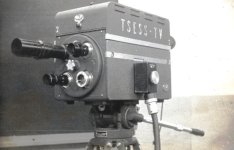
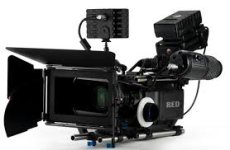
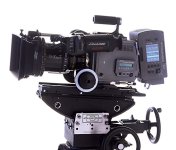
btw here are some typical professional video cameras used instead of film cameras for professional productions through the years. Yes there are smaller ones, but these were pretty common:

img_f23_03-1.jpg
starwars3.jpg

Sony 2/3" HD Cinealta cameras used on one of the first big milestone major motion pictures to go all digital (StarWars Ep1, Ep2) 1999-2002


Welkwithcamera.jpg
1943-DuMont-Camera.JPG
oldcam.jpg
c (46).jpg
Studio Television Video Cameras from old days.


images.jpg
Original Red One Camera Configuration. Not really that small. 2007


IMG_0346AlexaPlusCodex-640x480.jpg
Typical original Arri Alexa setup if shooting RAW to a deck. Arri now offers internal RAW recording on some models. 2010

url.jpg
Original Sony F35 camera configuration with deck.

genesis_with_panavision_ssr-1.jpg
Typical Panavision Genesis camera setup....

gv_viper.jpg
GrassValley Viper circa 2007?


Of course there are numberous professional video cameras that are smaller, but if we are discussing cinematic quality... Video that aims to replace film... these were the usual suspects in the early days of the digital take-over of hollywood (only 8-12 years ago really) this goes to show that top level video cameras have been and continue to be pretty much just as cumbersome as studio film cameras. The difference really is in smaller media storage.

Only in the last couple years has the size really slimmed down.
 
Last edited:
One can certainly emulate many of the visual qualities we like about film with high quality modern digital cameras. But digital is fundamentally a different medium and I don't think we should constrain our aesthetic expression to emulating the past. Film has its own issues. We have the DR to grade value curves in the highlights and shadows any way we want to achieve a particular look. We can texture images from soft and milky to hard and contrasty, smooth or granular and edgy. Color can be very saturated or desaturated. We can even modulate color saturation in relation to value levels so highlights progressively desaturate while midtones remain rich, a film like quality.
To me compression is the enemy. In some recent grading experiments I went from graded 12 bit uncompressed bayer raw to uncompressed 800Mbps broadcast AVI to Sony's latest high end 200Mbps 10 bit 4:2:2 XAVC. The difference between the uncompressed video and even this high quality compressed codec was like going from SACD audio to MP3. The image still looked really good, but it lost subtlety, depth, and life. What looked like skin in the original became "skintone" in the compressed version. It lost that quality of translucency and fine color modulation that skin has. Deep shadows lost color and texture. This was clearly visible even on a good calibrated 8 bit monitor.
Now consider that most of what we view online is compressed to between 5 and 10 Mbps and most low end cameras shoot original footage at less than 25Mbps. I've dealt with compression codecs since the earliest days of video conference applications when broadcast video was still analog. They have certainly considerably improved over the years, but they don't call them "lossy" for nothing.
 
Ryan: that's a very informative and entertaining post. Would you possible have the time to write something about the history of camera manufacturing (cinema) from film to digital. You seem to know a lot and about Panavision and your writing is very poetic. I'd love to read something long.

David: I am surprised you can see the difference between 24p and 25p, it was a test subject of mine for a long time and just could, physically couldn't. When you think of it, the visual difference might vary among people based on their visual system, meaning how their eyes receive the light, how sharp, how that light is ''processed'' through the retina, and most importantly how fast the CNS receptors recieves and interprets that data, people with high quality and ''fast'' visual systems might be able to notice such small differences in frame rate, and there are differences in that speed for a fact. A thought.

Razz: compression is the devil for Image quality but the angel for practicality. The world wouldn't work without compression and everything would be of much, much lower quality. If one wants to emulate rich negative film raw and uncompressed with high bit depth is a very very essential step in my opinion.
 
Back
Top