
Navigation
Install the app
How to install the app on iOS
Follow along with the video below to see how to install our site as a web app on your home screen.
Note: This feature may not be available in some browsers.
More options
You are using an out of date browser. It may not display this or other websites correctly.
You should upgrade or use an alternative browser.
You should upgrade or use an alternative browser.
Talking Heads?
- Thread starter graywolf
- Start date
I think he's talking about interview-style shoots (the OP)?
Directly into camera has gotten more popular. . .you see it in some documentaries with interviews (it's very intense, the eye contact, like they're talking directly to you), any time someone needs to directly tell the audience something (instructing/begging/persuading), and even the occasional regular interview. But it's a bit weird for interviews 'cause, again, so intense. If they're simply relaying information (this happened, then this happened) to a real/imaginary interviewer, off to the side is more typical, if they're talking directly to the audience, to the camera is more typical. But there are always exceptions.
Directly into camera has gotten more popular. . .you see it in some documentaries with interviews (it's very intense, the eye contact, like they're talking directly to you), any time someone needs to directly tell the audience something (instructing/begging/persuading), and even the occasional regular interview. But it's a bit weird for interviews 'cause, again, so intense. If they're simply relaying information (this happened, then this happened) to a real/imaginary interviewer, off to the side is more typical, if they're talking directly to the audience, to the camera is more typical. But there are always exceptions.
deltoidjohn
Veteran
Are you talking about having a presenter, or are you talking about having all your interview subjects deliver their lines directly down the lens?
Having the interview talent talk directly to the lens will be a nightmare. The talent will constantly be looking back and forth from the interviewer to the camera while talking. Their eye-lines will be all over the place. Not only that, but they will not deliver a natural and convincing performance because they are talking to a machine rather than a person (and they are not trained to do that, like a presenter is).
There is a reason interviews are usually delivered off-screen rather than directly down the lens: Think of it as "show & tell". Talking directly to the audience is "telling" them something. Having them talk to an off-screen interviewer put's the audience outside the conversation - instead they are being "shown" the conversation - you are showing them not only the story, but the reactions, emotions and convictions that go along with it. Now, occasionally you might need to "tell" the audience something directly, to establish more context - this is where a presenter can deliver lines directly to the camera.
If you want to deliver that hard-hitting, direct address to the audience from an interview subject, one common technique is to film b-roll of them looking directly down the lens. It gives the audience that sensation of being looked at and being given a call-to-action, without having to break away from conventional (and natural) interview methods.
Having the interview talent talk directly to the lens will be a nightmare. The talent will constantly be looking back and forth from the interviewer to the camera while talking. Their eye-lines will be all over the place. Not only that, but they will not deliver a natural and convincing performance because they are talking to a machine rather than a person (and they are not trained to do that, like a presenter is).
There is a reason interviews are usually delivered off-screen rather than directly down the lens: Think of it as "show & tell". Talking directly to the audience is "telling" them something. Having them talk to an off-screen interviewer put's the audience outside the conversation - instead they are being "shown" the conversation - you are showing them not only the story, but the reactions, emotions and convictions that go along with it. Now, occasionally you might need to "tell" the audience something directly, to establish more context - this is where a presenter can deliver lines directly to the camera.
If you want to deliver that hard-hitting, direct address to the audience from an interview subject, one common technique is to film b-roll of them looking directly down the lens. It gives the audience that sensation of being looked at and being given a call-to-action, without having to break away from conventional (and natural) interview methods.

graywolf
Well-known member
I think he's talking about interview-style shoots (the OP)?.
Yep! But, I guess a real interview without the interview being seen is actually a kind of fiction.
So, I guess, I will go with "intent" as the best answer.

JPNola
Veteran
Interrotron. Errol Morris.
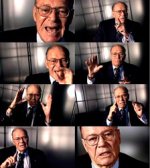
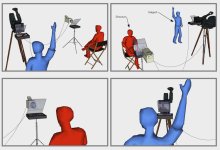
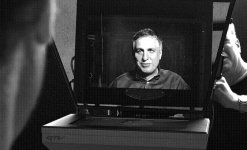
It aids greatly to set things up so that the interview subject cannot see anyone in the room. No ability for eye contact with camera op, Sound op, P.A., etc. Leave the interview subject no face to look at but the face on the screen.
One of those Alaska reality shows, The Last Alaskans, uses interviews with subject looking at lens and to great effect.
With all respect, it isn't as much of a nightmare as John makes it out to be. I've done it dozens of times. You rent a teleprompter, feed a second camera to the prompter, second camera shooting interviewer who is blocked from the interview subject's direct view. It does require a sizable space, lighting the interviewer, and the necessary material to block the interviewee from being able to see the interviewer. A 4 x 4 flag is enough. Or a good sized piece of duvetyne. A sound blanket and a c-stand will also do the trick.
You might be surprised how, when given no one else to look at, even the most nervous and shy interview subjects will lock onto the face on the prompter and thus lock their eyes into the lens. It works especially well for testimonials, personal stories, retelling of an event, emotional content. Best for interviews where the subject speaks at length rather than just provide short responses to questions. It is, after all, the way that we see other people when we have a conversation with them. It is more personal than looking off the lens at someone else. The subject is speaking TO the viewer directly.
I disagree with John as to why interviews are usually shot with the subject looking off the lens. I think the reason was a desire to preserve the 4th wall and have it seem as if the subject wasn't aware that the camera was in the room. The idea being that the content is more natural and authentic if not being delivered to the camera, if not being performed FOR the camera. With subject speaking to camera the subject is acknowledging the viewer / acknowledging that there is an audience behind that 4th wall. The viewer is less observer and more participant. The viewer is being spoken TO. As opposed to the viewer being an eaves-dropper on a conversation that is independent of viewer.
edit: the second prompter in that diagram above is optional. The times I have done it we only used one prompter. The interviewer just look at the camera and could not see the face of the interviewee. The problem with this technique is that clients will almost always balk at paying for a second camera op and expect one camera op to set up both cameras. They wanted it executed using the same 2-man crew. They'll pay for the additional camera and the prompter, but won't want to pay for an additional camera op...instead expecting the one camera op to do double duty. So the camera op ends up doing extra work above usual but with no increase in operator rate. Essentially operating two cameras but only getting paid the same as if operating one camera. Clients reason that the second camera is a "lock down" so it doesn't need an operator and thus they shouldn't have to pay for one. But someone still has to set it up, frame the shot, set the focus and exposure, roll the camera, cut the camera during breaks in the interview and in between interview subjects, and swap out / monitor media cards.
It aids greatly to set things up so that the interview subject cannot see anyone in the room. No ability for eye contact with camera op, Sound op, P.A., etc. Leave the interview subject no face to look at but the face on the screen.
One of those Alaska reality shows, The Last Alaskans, uses interviews with subject looking at lens and to great effect.
With all respect, it isn't as much of a nightmare as John makes it out to be. I've done it dozens of times. You rent a teleprompter, feed a second camera to the prompter, second camera shooting interviewer who is blocked from the interview subject's direct view. It does require a sizable space, lighting the interviewer, and the necessary material to block the interviewee from being able to see the interviewer. A 4 x 4 flag is enough. Or a good sized piece of duvetyne. A sound blanket and a c-stand will also do the trick.
You might be surprised how, when given no one else to look at, even the most nervous and shy interview subjects will lock onto the face on the prompter and thus lock their eyes into the lens. It works especially well for testimonials, personal stories, retelling of an event, emotional content. Best for interviews where the subject speaks at length rather than just provide short responses to questions. It is, after all, the way that we see other people when we have a conversation with them. It is more personal than looking off the lens at someone else. The subject is speaking TO the viewer directly.
I disagree with John as to why interviews are usually shot with the subject looking off the lens. I think the reason was a desire to preserve the 4th wall and have it seem as if the subject wasn't aware that the camera was in the room. The idea being that the content is more natural and authentic if not being delivered to the camera, if not being performed FOR the camera. With subject speaking to camera the subject is acknowledging the viewer / acknowledging that there is an audience behind that 4th wall. The viewer is less observer and more participant. The viewer is being spoken TO. As opposed to the viewer being an eaves-dropper on a conversation that is independent of viewer.
edit: the second prompter in that diagram above is optional. The times I have done it we only used one prompter. The interviewer just look at the camera and could not see the face of the interviewee. The problem with this technique is that clients will almost always balk at paying for a second camera op and expect one camera op to set up both cameras. They wanted it executed using the same 2-man crew. They'll pay for the additional camera and the prompter, but won't want to pay for an additional camera op...instead expecting the one camera op to do double duty. So the camera op ends up doing extra work above usual but with no increase in operator rate. Essentially operating two cameras but only getting paid the same as if operating one camera. Clients reason that the second camera is a "lock down" so it doesn't need an operator and thus they shouldn't have to pay for one. But someone still has to set it up, frame the shot, set the focus and exposure, roll the camera, cut the camera during breaks in the interview and in between interview subjects, and swap out / monitor media cards.
Last edited:
Yeah, I was going to chime in teleprompter is the way to go for interviews with subject looking into lens. As to the two camera operator thing. . .sorry, that's today's reality most of the time. Same way we often have to do our own sound instead of having a location sound mixer. I will have a shoot Tuesday where we are shooting a speaker doing a powerpoint presentation and have a backup cam shooting the powerpoint screen (it's being recorded via Snaggit as well but sometimes Snaggit fails). I will set up the cams and have to cut them etc. It's really not that big a deal. Hell wedding guys do this all the time! With even more cameras!

Run&Gun
Veteran
Run&Gun
Veteran
I don't own one, but I've shot for a few clients who have one and I've used it on a few shoots. Same basic principal as the others, but the person is standing next to the camera. You can hang some black duve or something so the subject can't see the person, just their face in the mirror, but I've never done that.

John Foundas
Well-known member
You can literally take the front glass off a prompter, clip it in a knuckle clamp and postion it at a 45* angle in front of the lens.
Have producer face the glass/camera L/R and voila! You need to hood the camera with a black cloth for reflections.
Works like a charm
Have producer face the glass/camera L/R and voila! You need to hood the camera with a black cloth for reflections.
Works like a charm
graywolf
Well-known member
One thing that most folks seem to be missing is that we almost never just stare into someones eyes when we are talking to them. I notice in a recent mic test that I keep looking here and there when talking to the camera. But that does not look unrealistic, what does look unrealistic in that same video is when I reminded myself to smile. Those were real ugly grimaces.
offbeatbryce
Well-known member
to me it depends what kind of interview you are doing. I just finished a documentary in my local area for a historical piece that was about an older gentleman who talked about his sister. The purpose of the film was to grab the audiences attention to draw them in to learn more about the woman. Since he was talking about his sister I felt it was appropriate to have him make eye contact with the camera so he was talking to the viewers of the film rather than off the side of the camera.
I've done both though.
I've done both though.
I would just know the basic rules, and then decide if you want to break them.
Looking straight at the lens is generally someone speaking directly to the audience: "Hi boys and girls. Today I'm going to tell you about the time I went to the Moon..."
Looking just off the lens is generally the audience listening in to someone speak without them actually talking directly to the audience: "I always think back to the time I went to the moon..."
No break those rules all you want
Looking straight at the lens is generally someone speaking directly to the audience: "Hi boys and girls. Today I'm going to tell you about the time I went to the Moon..."
Looking just off the lens is generally the audience listening in to someone speak without them actually talking directly to the audience: "I always think back to the time I went to the moon..."
No break those rules all you want
Last edited:

Doug Jensen
Carbonite Member
I used an EyeDirect a couple of years ago for a series of interviews with winter Olympic athletes for NBC. Worked very well.
Last edited:

TubEfingers
Well-known member
When we're shooting fund raising films with kids as the talent it seems to have a more positive impact when they're speaking directly to camera,
don't know if this applies to your production though
don't know if this applies to your production though