Study say 4K transition will be faster than HD was.

  • Thread starter Thread starter Guest
  • Start date Start date
I get that the new 4K TVs have that. Just saying we could potentilaly have that at HD too.
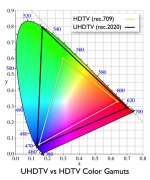
You have 4 times the pixels count which gives you more pixels to represent more colors and more DR. That's why there is a new color space for 4k which is rec2020. Where your limited to rec709 for HD. It's like a box of crayons, you get the kids restaurant 4 pack with SD, a 8 pack for HD and 24 pack with 4k.
 
4K


Things people say 1: "There is no resolution benefit at normal viewing distances."

-Viewing distances are different than they used to be, due to computers and Smart TV, people are occasionally very close to the television. Sometimes they may want to watch a video in a window while they browse the web.

-Text and hair aliases in HD

-If HD upscales well in 4k, and Arri Alexa proves 2K is good enough for drama and cinema, then there is no penalty to dramatic content makers. Meanwhile, home users, and birthday shooters definitely love and appreciate 4k and above resolutions for capturing memories. So, pros can keep shooting with the Alexa, and consumers can enjoy it on their 4K status symbol. Everyone is happy, even the weekend shooter and the web browsing teen.


Things people say 2: "4K is still years away"

-The transition from interlaced to progressive was a pain. The transition from Analog to Digital was a pain. HD to 4K will be seamless for most consumers, by comparison. The technology is already in place. They just need a new TV.


Things people say 3: "No one is going to replace their HDTV"

-Yeah, but they will replace that dumb HDTV they bought before smartTV technology matured.

- 4K prices will drop faster, because in a digital world, 4K is not new technology.


Things people say 4: "I would rather better DR and color from our TV's before we go to 4K"

- 4K is not preventing that. In some ways it is helping it. More pixels to mix colors (someone already mentioned that on this thread). Brightness and Contrast are a separate problem, as far as I know. So I will not speculate any further on that.

-Does it have to be an either or? The only way to get people to use better TV's is to sell them new ones. It is easier to sell them 4k than better dynamic range and color. A bit of a trickle down theory, but newer TV will have more options, meaning video content can start taking advantage of them. Also, broadcast is holding bit rates and color spaces behind, as much as anything.


Things people say 5: "4K is useless"

- Even if that were true, and it isn't, didn't we learn from the camera industry that we didn't really see camera manufacturers concentrate on other things until they exhausted the resolution war? My theory was, the faster we get to 4K, the sooner we can focus on other specs. One battle at a time. 4k is a good platform. 8k is useless. 4K is practical. HD is limited.


I recently was watching TV on a giant old SD CRT television. Didn't bother me one bit. In fact, I actually prefer it over HD TV in some ways. Highlights and detail all bleed into a mess, but helps with making highlights look more organic, masks all the digital compression. On the other hand... I watch the digital compression mess that is SD on Netflix, and 9 times out of 10, I don't notice it unless I am looking for it. So, why do I like 4K? because, it is a better display. gives more options. I can display photos on it, and not worry if they are vertically rotated. holy f'n goodness!!!! imagine using your TV to actually look at those pictures we take with a digital camera for a change.


HD is still arriving, and 4K is already beginning. HD is not even ubiquitous, why would it matter if we switched to 4K? Broadcast is still using 720p for the most part. Why do we have to have Smart TV be stuck in the broadcast standards and mindset? TV's are tool in the house for many other purposes than watching 'Burn Notice' or 'The Andy Griffith Show'.
 
Last edited:
You have 4 times the pixels count which gives you more pixels to represent more colors and more DR. That's why there is a new color space for 4k which is rec2020. Where your limited to rec709 for HD. It's like a box of crayons, you get the kids restaurant 4 pack with SD, a 8 pack for HD and 24 pack with 4k.

If this is the case then how do you explain two hd cameras or two 4k cameras or two tvs whatever or where one has more dynamic range than the other? Or one has better color? An HD sized OLED tv is going to look better than a 4k tv because it has it represents color better, deeper blacks, etc, etc. But higher resolution is something that is easy to point to and sell. Even if it is not an improvement. Televisions have improved considerably since rec709 was approved in 1990. That is why a new standard is being recommended in rec2020. But not everything in that standard will necessarily be adopted. The resolution aspect, 4k or 8k, is not as important as the deeper color. We shall see what happens.
 
If this is the case then how do you explain two hd cameras or two 4k cameras or two tvs whatever or where one has more dynamic range than the other? Or one has better color? An HD sized OLED tv is going to look better than a 4k tv because it has it represents color better, deeper blacks, etc, etc. But higher resolution is something that is easy to point to and sell. Even if it is not an improvement. Televisions have improved considerably since rec709 was approved in 1990. That is why a new standard is being recommended in rec2020. But not everything in that standard will necessarily be adopted. The resolution aspect, 4k or 8k, is not as important as the deeper color. We shall see what happens.
It's pretty simple, HD is rec709 which is 8 bit and about 8 stops of DR. 4k tvs are rec2020 which are 12bit 12 stops of DR. Now, let's say you put a movie that was mastered in 4k let's say wolf of wallstreet. It was mastered in 4k, don't worry 2.8k ARRI raw upscales well, plus it was also shot film which is 3.7k true digital res but was scanned at 4k. And a c500 at 4k for 1 shot (the cool prison shot 99% cgi) now watch the 1080 rec709 version on your OLED HD tv, I'll bring my Sony 65" 4k tv and play the 4k rec2020 version. Watch it side to side and see the differences between the formats. And if you think color, range, clarity (f"ck sharpness, 4k takes away the oversharpen peaking looking HD look) is still better on your OLED HD tv, then there's no hope for you until everything is 4k and nothing is HD anymore. So you would have a while...
image.jpg
 
Last edited:
I (f"ck sharpness, 4k takes away the oversharpen peaking looking HD look)
Love this. This is what people don't get. Even many cinematographers don't get this. 4K is more detail, not more sharp. In HD, a black speck is recorded as a dark gray square 4 times the dot's original size. Then, if sharpening is added, that gray square gets separated from it's neighboring pixels, further distorting the original essence of the original black speck.

In 4K, that black spec, may actually end up being a black speck. And if the black speck is too small for 4K, than it is recorded as a small gray speck. The eye can see the edges of HD pixels, but 4K pixels are small enough to go relatively unseen at most distances.

Until recently, 4K has been limited to the big screen. So, it has never really been able to be appreciated for tonality and smoothness it has over HD. HD can look smooth, but you lose detail. In 4K, this is less of an issue.


There can be visual anomalies with too much detail at certain distances. But 4K is not a resolution monster by most people's standards. 8 megapixels has always been considered somewhat average and practical for image capture, since it can print up to magazine sizes, but doesn't take up a lot of file space.
 
Last edited:
I live on Eastern Long Island, I have a friend who is a major installer to the rich and famous. The $16,000 4k LG 85 is the must have toy of the coming summer season. These are the people who run the major media companies and financial institutions. So if there is truth to the trickle down theory, next Black Friday is 4k all day.

Yes soon.

I'm sure the people in Eastern Long Island were among the first to install 3D TV's, too, but that doesn't mean it's going to catch on. The top 1% will always try to outdo each other with the latest toys.

I've seen 4k on large screens, and it looks good. But not good enough for most people to throw out their relatively new HDTV's and spend a premium on 4k just to have no programs to watch. I think the switch to 4k will require 3 conditions: 1. Availability of programming, 2. Affordable TV sets, and 3. Replacement cycle for current HD sets. So I think the 10-12 year adoption rate in the original article is reasonable. Hopefully by that time we'll also have better compression standards, and some type of 4k bluray disk.
 
I'm sure the people in Eastern Long Island were among the first to install 3D TV's, too, but that doesn't mean it's going to catch on. The top 1% will always try to outdo each other with the latest toys.

I've seen 4k on large screens, and it looks good. But not good enough...
Now we're getting somewhere. After 4K, manufacturers will have to improve other aspects to improve the user experience and entice new buyers. With HD, they still have the 'resolution' card up their sleeve. Sooner we get 4K, the sooner we get better at everything else. Bit rates, color, dynamics, true blacks, etc etc... not to mention new functionality never before thought up for the TV experience. remoteles TV etc... 4K is good, but it is also a maltese falcon of sorts. Unlike the transition from analogue, there is not much of an issue to transition to a 4K tv. Broadcast can stay at 720. Streaming and solid state will take over for 4K content.
 
I'm sure the people in Eastern Long Island were among the first to install 3D TV's, too, but that doesn't mean it's going to catch on. The top 1% will always try to outdo each other with the latest toys.

I've seen 4k on large screens, and it looks good. But not good enough for most people to throw out their relatively new HDTV's and spend a premium on 4k just to have no programs to watch. I think the switch to 4k will require 3 conditions: 1. Availability of programming, 2. Affordable TV sets, and 3. Replacement cycle for current HD sets. So I think the 10-12 year adoption rate in the original article is reasonable. Hopefully by that time we'll also have better compression standards, and some type of 4k bluray disk.

Humans evolved love of beauty, 4k imaging is the biggest communally available leap in the pursuit of beauty since oil painting.

All past bets or industry standard rules of thumb are off. This is a sea change.

3d never happening is not an argument. The rich and their toys is not an argument. The three stated conditions are no longer relevant-

Sony, Samsung, LG and Apple are, or soon will be producing 4k capable smartphones.

Most "people" on this planet get their media on their cellphone. Cellphone replacement cycle will partially dictate 4k acceptance. And, seque to computer screen and monitor screen.

"People" or "the average person" who are often condescended to on these boards as not being capable or caring about quality are going to have 4k in their hands before most "pros" know what hit them.

Why? Because who doesn't want beauty in the palm of their hand?

A fabulous time is upon us artistically. Why all the resistance?

10-12 year adoption rate? I'd say more like 10-12 months.
 
Humans evolved love of beauty, 4k imaging is the biggest communally available leap in the pursuit of beauty since oil painting.

All past bets or industry standard rules of thumb are off. This is a sea change.
My favorite and most beautiful argument to date.

taking this "4k imaging is the biggest communally available leap in the pursuit of beauty since oil painting."
 
Wow, it is getting thick in this thread!

Lightstrum - I think it might be good for you to analyse two key words from your post - Resistance and Adoption. These two concepts obviously have different meanings and interpretations by all of the posters here. This is a video forum and when we see 4k hoopla we think of needing to buy new cameras, computers, delivery schemes etc... Cell phones screens are not a care in the world for us...

Adoption is wide scale, something you can sell to "normal" people. Like a DVD or cable/sat programming. Given this lens, do you still see a 10-12 month adoption? Becuase I don't see "Duck Dynasty" moving to 4k in 10 months nor do I see a huge profit potential in making 4k YouTube videos when people don't have 4k computer monitors nor a 4k Blu-ray option. But that is just me, I'm clueless about the beauty of cell phones directing my business decisions.

You can cheer on 4k all you want, as long as somebody else is paying the infrastructure bills... Screens are only a part of the mix and usually the very first part.
 
4k = to big a file storage for me for right now.

At home we have a beautiful Big Screen tv, and guess what we watch? Leave it to Beaver, Andy Griffin, and old family shows. I have young children and we don't care much for the junk they are making now days.
Anyway, the cameras they used back then to film these shows were great. My kids do not even mind that the films are in Black and White.
The quality of the show out ways the quality of the camera. (I think Spock said that.) :)

For events it would be great to film with a 4k camera, and then go back to edit and crop out what you need.
I will give it a few years after I see for myself how consumers and clients are reacting and buying 4k TV's and cameras. Most of my clients only want content for the web right now. I am so glad I waited with the 3D cameras and TV's phase.
 
Soon is a relative term but I don't think anyone in this thread is saying that it will be wall to wall 4K by 2016.

Well, now they are -- 2015, actually:

10-12 year adoption rate? I'd say more like 10-12 months.

lightstrum, that just isn't going to happen. I do not say that because I am "against" 4K. I say that because it isn't going to happen.

You seem to think people are going to be struck so dumbfounded by a 4K TV that it'll make them open up their wallets in a way no product in history ever has before -- not even DVD, the fasted-adopted standard ever.

Look, 4K will (at least SHOULD) eventually be generally-adopted (unless it's overtaken by something else beforehand, like 8K), but this idea that you'll see it happen THIS YEAR is just pie-in-the-sky, totally unrealistic -- and I would say that under the best, lightning-hot economy, which obviously does not currently exist.

I really don't understand the level of emotional fervor people have over 4K. It is superior to HD, all other things being equal, and following a natural progression, yes, it should be adopted. But I don't understand why someone would be actually offended by the idea that it'll take a while to be in general use, to the point of actually insulting other people who say it's going to take a while. That's just the way things go.
 
You can cheer on 4k all you want, as long as somebody else is paying the infrastructure bills... Screens are only a part of the mix and usually the very first part.

4k is already at a place where i can utilize it. Even if know further progress is made, i have all the bases covered.

Displays:
MBP retina
4K TV
AMC
IMAX

Content:
4K camera
Raid hard drive system
Netflix UHD
Youtube/Vimeo

Ready.
Already affordable and accessible many.


Whether cinema, or broadcast ever go beyond 720p, is irrelevant at this point. I probably never care to watch 'Scrubs', 'Friends', or 'Revenge' in .... ok, i don't care to even watch these shows, but even if I did, I can watch majority of banal fiction in SD any day of the week. SD/720p/ are all incredibly useful. But I am thankful i have access to UHD. Now we can move on to the next steps.
 
I'm not against 4k, it's actually quite nice, but whenever I hear someone getting really excited about it I just can't get the memory of all the 3D hype out of my mind. It was only a couple years ago that there were people here evangelizing 3D and saying that anyone who didn't jump on the bandwagon with them right then and there were going to be left behind. Now it looks like that bandwagon crashed in the ditch. I'm not saying that 4k will suffer the same fate as it clearly has some advantages on the acquisition side, but I just can't get too hyped up on it at the moment. Let's see where we are on 4k delivery next year.
 
If Apple puts 4K in the iPhone 6 and the next iMac that will make the general public take notice and 4K will be in demand big time in 2015. People today are watching House of Cards on Netflix in 4K and youtube is getting thousands of 4K videos uploaded every day . Does anyone really think it's going to take 10-12 years for 4K to catch on ?
 
I'm not against 4k, it's actually quite nice, but whenever I hear someone getting really excited about it I just can't get the memory of all the 3D hype out of my mind. It was only a couple years ago that there were people here evangelizing 3D and saying that anyone who didn't jump on the bandwagon with them right then and there were going to be left behind. Now it looks like that bandwagon crashed in the ditch. I'm not saying that 4k will suffer the same fate as it clearly has some advantages on the acquisition side, but I just can't get too hyped up on it at the moment. Let's see where we are on 4k delivery next year.
You can't compare 4k to 3D, it's 2 completely different things. 4k is just the next standard. 3d will never take off until higher resolution, higher frame rates becomes "viewable", more dedicated content and of course no more glasses. Until then 3d was dead to start and the amount of motion sickness people got didn't help 3D. You don't get motion sickness from watching 4k. Now why 4k? Because 4k is the standard of film developed by Kodak for storage and digital projecting standards for s35mm film. Obviously 1080 wasn't good enough. As film's resolution in a digital equation is between 3.7k to 3.2k depending on the film stock. So it's only natural for 4k which is the standard for film, to be the next standard for home viewing. We're all chasing that "film look" so why are we fighting the standards set forth by the oldest film company in the world when it comes to resolution.
 
Back
Top