Studio layout advice requested

Thanks again
My thoughts. Feel free to correct me:

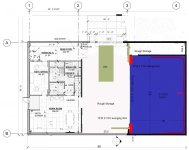
The entire metal building box will be insulated walls and roof with at least 8" (possibly more). That will help keep the rough storage from getting extreme. The 14' OH door will be insulated.

I don't want to be cooling $$ the big studio space while it's not in use. I see the smaller studio space being used a lot more than the big one (at first anyway).
Since the smaller studio space will have cyc walls pieces and drywall I will have to at least keep it climate moderate so it doesn't get too hot or cold and crack.
I could and probably should make the middle rough storage have the ability to be air conditioned somehow when needed.

Other rooms ideas
Gear Storage - moderate climate controlled "tempered"
Work Room - normal air conditioned
Edit/ Office - extra cool for render computers
Dressing/makeup/restrooms/kitchenette - normal air conditioned
Upstairs living space - normal air conditioned
Audio booth - air conditioned

RE: Curtain opening height. I'm looking into various theatrical / misc curtains that might work. Looks like a 12' or 15' height opening could be done. Seems to me like a ~30W X ~15H opening wouldnt be too restrictive when shooting using the open big studio? You could still use a jib and angle shots?

I don't know about being able to store above the studio box bldg because the design has trusses up there spanning it. It's 18' clear studio int height with trusses above the 18' with the metal box building having 22' H eaves. The crude 3d pics make it look like there is a big open space up there but that isn't accurate because I just made an 18' box to represent the studio height not showing the trusses/roof
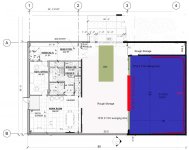
 
Gotcha on the possibility of storage over the studio ceiling.

As for the HVAC - the system for the main soundstage can be oversized by a couple of tons and when the doors are open the entire space will cool - air migrates naturally. In addition, you could provide one large or two smaller ducts that can be controlled for flow that empty from the ceiling into the "rough" storage area of the space (no need for a second unit). Also, since cold air falls cooling is relatively easy. During the winter two well placed ceiling fans in this area can keep the warmed air flowing to the ground. I keep my studio 82F in summer unless production is underway (then 72-75F) and 52F in winter. It takes about 15 minutes to get the space comfortable regardless of season (using the fans in winter for pulling the hot air off the ceiling). NOTE - during summer when it is really hot out, the floor temp may be 82 but the ceiling can get as hot as 92-95 (in just 20 ft). This is not a real problem in the summer because cold air falls, but in winter all the heat stays on the ceiling unless you move it down with fans.

Most of the time, with the opening between the space open, the HVAC ducts to the storage could be closed. When the curtains are closed, then open as needed to the amount of flow you desire.

FYI, air ducts that feed a sound sensitive area can be quire a bit more expensive- dampened - and larger for lower velocity flow (think fan noise on lights and cameras). You want the HVAC folks to know your needs and usage so they can design properly.

The ducts to the storage area need not be dampened as much as they likely will be higher and more dispersive - but, again, review this with your vendor as you decide the full range of usage for the larger space.

One more thig - if you go with an opening (15x30) as opposed to no wall at all) it does change the flexibility of the space when used in full. Think about this and make certain you are not creating a problem. (or - possibly design a wall on a set of large hinges that can be unlocked and swung flat to either side as needed?

YMMV

Bill
 
Thanks again Bill on all the great points and info. Very helpful. Yes architect and I have talked about the A/C noise early on. We will certainly work with A/C folks as you said.

Seems I need to have some type of divider "wall" with opening between the rough storage and small studio for the reasons earlier but I don't want that opening being a big limitation/problem so I am still thinking about curtains vs some sort of swinging/sliding big door(s) or both so as to try to keep as much flexibility as I can while still having a divider.
When shooting as big open studio I will be limited due to weather roof noise, but since the talent will most likely be inside the smaller more isolated studio space maybe that will help noise some?

As far as A/C units, do you see this building as having 1 unit for the left side office/work/living and 1 unit for the studios side......so 2 total units?
 
Perhaps, instead of just building a false ceiling over the smaller studio space alone, do a double insulation approach under the entire metal roof (with a couple of inches of air space so no more than 10-12 inches total)) and then more modest insulation to dampen the soundstage ceiling area. This insulation will make the entire space far more pleasant from a deadening perspective and much easier to heat and cool. You will still need to do the work to isolate the soundstage walls, but the noise intrusion will be lower if the first barrier provides more dampening. Again, sound dampening means better insulation for HVAC.

Also, HVAC folks love to work to their engineering specs. In the last three installs, I have insisted on increased capacity over what the calculator tells them (a ton or more for the AC capacity) and I have been very pleased - much easier and faster to heat and cool, does not run as hard so never a strain on the system. And you can then easily leave the spaces set abnormally low or high (50-52F for winter and 80-84F for summer, respectively) knowing you can get the temp up or down as needed very quickly. (Do you have NG, electric or fuel oil for heat?).

One last thought, is there some limitation on building height? Or is the cost to build higher that much more expensive? If not, I would be inclined to add three + feet to the height of the building to get more height regardless of area or application. You will find it is very helpful in the long run (perhaps even some valuable storage above the living area/post/client spaces).

2 HVAC systems should easily provide enough capacity, but you want a way to direct flow to/from your living space. Otherwise two smaller units for your downstairs client and upstairs living. (Or, one unit for downstairs and a room type AC/Heat unit for upstairs - there are a lot of new approaches to heating and cooling a living space that did not exist even 10 years ago). And you don't want to crank the AC for your comfort while most of that air goes downstairs wasted at night. Heat rising sucks in these circumstances and is hard to work against. Just food for thought.
 
Last edited:
Thanks again. I'll see if I can increase the height and about double layer roof insulation with a 2 inch gap instead of just 8-12" with no gap.
If I am able to increase the overall building height do you think having a 15'H dividing section defeats some of that gain though?

I'm planning to meet with architect next week to go over our ideas.
Here is an idea for the middle dividing wall/curtain utilizing a sliding 10'W X 15'H door, a 10'W X 15'H swinging door, and a ~19' W X 15' H curtain. When open for big studio mode it could provide about a 35'W X 15'H opening. 4-2022 studio 44 wall doors.jpg 4-2022 studio 44 wall doors open.jpg
 
im a fan of symetry.. Id move the blue space up a bit to create a storage run on that lower side too.. being off the ext wall will also help sound. maybe 42 become 36 or 32
 
"If I am able to increase the overall building height do you think having a 15'H dividing section defeats some of that gain though?"

I am not certain I fully understand this question. Do you mean that the studio area insulated "false" ceiling only goes to 15 feet? If so then use all the additional height you can to try and get to 18 ft. I would want more (I have usable 20ft and wish I had 4 more).

While I am also a fan of symmetry, three foot wide storage is almost useless (perhaps to store large flats that you pull in and out. But with 24in shelves you would not be able to even enter the space. I think storage needs to have at least 7 ft of depth so you can put up 24in shelves on one side and 18in ones on the other and still have lots of room to move and maneuver.

Trust me when I tell you that flexibility is essential to fully utilize the space for a long time to come. Also, with 12-14ft high by 24ft long (up to 30ft on one wall) and 24in deep shelving, that is a lot of storage. And almost double that on the other wall at 18in deep - all accessible in that one narrow area. Must be adjustable shelving for maximum usability. Then, if you can actually raise the roof, there will also be a lot of storage over your living space. Perhaps enough to reduce what is needed down below to make more space for actual production.

I do think you are making great progress. Hope you get some good info in your meeting next week.
 
I think i suggested 6-8 ft of storage

ive been thinking about that

my shipping container is 8ft wide and is useful

but with 3 foot dedicate to walkway indeed 3/8 of the space is not used

storage is a trade off of accesibility vs density

8ft - 3ft shelf 3.5 ft walkway 18in to lean polyboard or build a tube/bg roll store
 
Again experience of the size of everything helps. So whilte I have 3 foot (ish) stacking crates down one side I know that full (of grip or stingers) a 36in crate is about or above the max one can carry I also know that it is too short for..
40in cstands
tripod bags
60in cstands
which present seperate storage challenges. This is where intelligent use of the 18in comes into play.
 
morgan_moore - I don't think you actually said how wide, but if you gain symmetry using his studio width as shown, then only three ft on either side would be available - hence my assumption. Your two most recent posts above mirror my experience as well. Agree with all of it. And yes, our gear is as oddly shaped and diverse as can be. Never one size fits all, hence more than 50 different bags, cases, crates, trunks... Not to mention backdrops and flats.... :-( Helpful observations!!
 
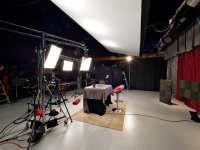
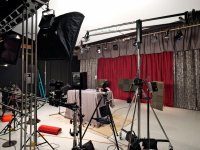
FYI, a couple of shots of the prepping for a shoot this coming Tuesday doing a musician and song writer from Nigeria (an exceptional talent and all around great guy). Three fixed cameras and one looping on a 12 ft Kessler dolly using their Second Shooter. Recording each camera in UHD to Atomos recorders and then doing a live switch from the donwconverted output from the recorders into a Roland V1-HD. Then output that to record on another Atomos recorder.


BDP_StudioScene_View_ONE.jpg BDP_StudioScene_View_TWO.jpg

Bill
 
morgan_moore - I don't think you actually said how wide, but if you gain symmetry using his studio width as shown, then only three ft on either side would be available - hence my assumption. Your two most recent posts above mirror my experience as well. Agree with all of it. And yes, our gear is as oddly shaped and diverse as can be. Never one size fits all, hence more than 50 different bags, cases, crates, trunks... Not to mention backdrops and flats.... :-( Helpful observations!!

I wrote.. maybe 42 become 36 or 32 which gives enough for 8ft on each side (does it?)

I see seperation of the inner room from the ext walls as good for sound and of course think one gathers a lot of stuff.

Id also want a balcony around the cyc to build a grid..so it is hard to see without quite getting all the things we dont know.. support poles cyc 'roof' etc

and of course it is the OP space so they can do what they want. I just have a little experience at my own small place and also shooting at some bigger ones.

also how rough is rough? could three women in bikinis go through it? will our OP ever host three women in bikinis?
 
Last edited:
You are right (I see it now :crybaby:), I am guilty of not reading carefully enough. But continuing discussion only helps to clarify even more experiences. Good stuff. I will say I want the 42 ft width myself. Certainly no less than 40 so maybe I am just blinded by this desire, LOL.
Edit - some kind of ceiling access would be great. I did not do this and I am on ladders a lot. Not certain how I would make that work but if designed properly, it would be a huge timesaver and much safer.
 
to me a balcony works with a cyc.

in my square wall studio you could put a ladder against the wall and rig something

with a cyc you cannot get close to the wall in a safe manner. but if you build a permanant grid maybe that doesnt matter.

also if the cyc is 15ft high.. 15ft shelves are gaff. its not easy to get stuff down from much above 5 foot.
 
Thank you again guys, very much. Thanks for the pics too!
I am looking at ways to try to keep that middle separater as tall and able to open as wide as possible. Haven't figured it out yet.
I'd love to make the bldg 55' or 60' wide and then have symetrical storage on both sides of the studio but.....$$

So if I have to choose between going taller than 18' clear or 42' wide vs 40' wide what would be your opinion? taller or wider priority? both! haha
Are you guys thinking U shape cyc? 40" vertical radius? 30" horizontal?
The building is already 24' tall (at crest) in order to clear 18' inside the studio box. I'm going to see about getting 20' or 22' clear but may have to stick with 18'

Ceiling access sounds interesting. Are you thinking being able to walk on the studio false roof and open sections to reach down inside to adjust things or ?

Right now the design has the inner studio built a few inches off two of the outer metal building walls. If it were several (~4?) feet from the outer metal bldg walls then I could access the cyc edge lights from the back side, but then the studio would have to be considerably smaller since I can't really make the entire bldg bigger to compensate. I'd probably need shrink the studio in ~4 feet in order to have enough room between the studio wall and the metal building outer wall to get a ladder in there? Is it worth losing the studio size to be able to access the light fixtures from behind the cyc?

I can see how trying to manipulate fixtures close to the cyc would be difficult/dangerous since a ladder would have to stay back away the curve. Rear access looks easier since you could get much closer
 
Last edited:
I really like what morgan_moore posted - it is really clever and intriguing. However, even with a 36" radius curve (too small in my opinion, you are losing 6ft of floor space and beginning to severely cramp the usability of your studio. If you had 48x40 (plus 8ft on either side fo access/storage - note this leaves 42ft of usable floor width with a 36in radius) to begin with, then absolutely no problem (that would allow you to bring in a fairly large car or smaller van (just an example) and actually be able to have the space to move and stage around it. Unfortunately, it sounds like that much footprint is simply not possible in reality for land or cost reasons

I had a cyc with 36" radius curves (into a corner with 30ft to the right and 36ft to the left in a 40x 60 space). It was difficult to light the corner (really needed 6ft radius minimum) so I ended up using the 30ft width most of the time (it had the greatest working distance (50ft) and I shot against the 30ft flat wall.

I have been trying to figure out how to use his idea - with enough space it solves all the problems with flexibility, efficiency, storage, safety and with a WOW factor, but it just needs a lot more space to really be done right. Maybe 38 ft across is enough and you put storage on one side only, I don't know.

FYI, I did use ladders to position lights with my cyc (remember 36in radius, not so easy as the radius increases). Never had a problem. But it is not considered safe anymore (I still do it today, but it is my space and my life :shocked: ).

Love to hear feedback!!

Bill
 
my sketch while not completely to scale had 5ft rad which is IMO the minimum 'proper' size - I agree a 36in rad just looks 'cheap'

why? i ddunno maybe it is just hard to light and tend not to produce stellar results..

going back a few of my posts i do allude (probably in a tangential manner) to the 'space wasted' vs 'quality cyc' tradeoff and I did mention having less cyc of a higher quality. - where higher quality is larger rad.

I think one thing between Bills ideas and mine is that I am generally used to a smaller space so yours seems huge :)

Again with a small space ive learned some stuff.
 
There is nothing at all wrong with ladders, properly used and considered - in fact the UK Health and Safety department - a bunch of people constantly blamed for banning things - actually put on their website "Have we banned ladders? NO!" Ladders shouldn't be used if you have access to something more suitable for the job, but a ladder with a pair of hooks at your grid height so the ladder cannot fall, and has the right climbing angle, is safer than many other ways to get up there. It is quick, and practical, and with hooks, can be used without fear of it sliding and falling. Standing on a ladder (especially with my stomach expansion) means two handed activities up there are comfy and have plenty of support. Uninformed H&S zealots, of whom there are still far too many, try to ban them, but normally fail when skilled and intelligent people put them right - but eventually, the idiots will win.
 
Back
Top