
Navigation
Install the app
How to install the app on iOS
Follow along with the video below to see how to install our site as a web app on your home screen.
Note: This feature may not be available in some browsers.
More options
You are using an out of date browser. It may not display this or other websites correctly.
You should upgrade or use an alternative browser.
You should upgrade or use an alternative browser.
Still the Best
- Thread starter Tom Roper
- Start date

But only super big budget films will be shot on 70mm. TV has gone entirely digital and, once the TV talent begins to trickle upwards into the features, those will be done on digital as well. And, even when they are done in film, they are then scanned into 4K and beamed in either 4K or 2K.
And, btw, the hot current trend in digital projection is laser power, with its superior brightness and color rendering that stays true from generation to generation, something an analog film projector simply can not do.
And, btw, the hot current trend in digital projection is laser power, with its superior brightness and color rendering that stays true from generation to generation, something an analog film projector simply can not do.
Ya, I read that a while ago but even IMAX is moving toward (the top of the line) digital, without the wear&tear of film.Actually, Tarantino has made arrangements with theaters for "The Hateful Eight" to be shown natively in 70mm...
http://gizmodo.com/imaxs-new-laser-projectors-make-me-wish-i-lived-in-a-mo-1689480610
http://www.usatoday.com/story/tech/2014/11/17/imax-laser-projection-kodak/19181053/
That said, the image acquisition portion is a different beast entirely. A scene shot in a controlled setting, artistically lit, looks great on film. Digital is probably almost there with Alexa65 and F65. But digital beats film on other aspects of production and this gap can only get bigger going forward.

roxics
Veteran
I do think film looks great, but I honestly have a hard time distinguishing modern film stock from higher end digital productions shot on Alexa, Epic and F65. It just seems like those cameras with some grain added. What I really miss is older film stock that had a certain less accurate to reality profile about them. More dreamy looking. Stuff from the 60's 70's 80's and 90's before film became so technically accurate with modern Vision 2 and 3 stocks. The other day I was watching the Sound of Music and was thinking "how does one achieve that look today using digital or even modern film?"
I don't know about the rest of you, but it seemed like movies could get away with certain things in the past that would just come off kind of cheesy looking today. Part of that I think is because of the older film stocks and the way they rendered that slightly surreal, more dreamy, separated-from-reality look.
I don't know about the rest of you, but it seemed like movies could get away with certain things in the past that would just come off kind of cheesy looking today. Part of that I think is because of the older film stocks and the way they rendered that slightly surreal, more dreamy, separated-from-reality look.
So, a number of the early screenings of "Hateful Eight" had problems with either video or sound. Film must be a beautiful media ... to record on. Projection? Not as nice.
http://variety.com/2015/film/news/hateful-eight-70mm-projection-problems-1201668461/
And here's Chivas Lubetzki on digital.
http://variety.com/2015/film/news/emmanuel-lubezki-revenant-digital-ali-1201667828/
http://variety.com/2015/film/news/hateful-eight-70mm-projection-problems-1201668461/
And here's Chivas Lubetzki on digital.
http://variety.com/2015/film/news/emmanuel-lubezki-revenant-digital-ali-1201667828/

Mike Harvey
Veteran
When I saw the film I didn't know what they shot with but I KNEW that I liked the look. It had a similar aesthetic of the original films. I am happy that, although more expensive, they went with film and that film is not dead yet.
Abrahms wanted to stay so true to the originals that he used the exact same type of stock as the original trilogy (Kodak 5219).

Run&Gun
Veteran
So, a number of the early screenings of "Hateful Eight" had problems with either video or sound. Film must be a beautiful media ... to record on. Projection? Not as nice.
http://variety.com/2015/film/news/hateful-eight-70mm-projection-problems-1201668461/
And here's Chivas Lubetzki on digital.
http://variety.com/2015/film/news/emmanuel-lubezki-revenant-digital-ali-1201667828/
Read an unfavorable review last night. It looks like there is a lot of disparity between theaters showing this in 70mm. Some are getting rave reviews and others are saying they're not set up properly and there are image and sound issues(one said about a 1/2 second off).
One of my friends said there is one theater around us that is showing it in 70mm. I'd like to try to catch it.

Surf it Mike
Well-known member
Who cares the audiences certainly don't, if it was shot digitally would audiences even know the difference ..apart from a knowledgable few ?
Most movie goes don't know the difference between Michael Bay and Wilow Bay ... but QT fans might deem themselves connoisseurs of film making.Who cares the audiences certainly don't, if it was shot digitally would audiences even know the difference ..apart from a knowledgable few ?
My take is that, shooting on film is fine for the big budget projects but then they're better off when shown on a latest 4K laser projector.
PS. It's interesting to see Lubetzki saying that the state-of-the-art digital cameras still don't have the dynamic range of film - presumed 15 stops - but exceed it in everything else. With a dual-readout sensor, the DR difference ought to be so minute as to be imperceptible. And only if you shoot bears in a snow covered forest, to boot.

joe1946
Veteran
Indeed, film is still the best. The present best video cameras are trying to come close to film looks. Trying, though not there yet…
roxics
Veteran
Most movie goes don't know the difference between Michael Bay and Wilow Bay ... but QT fans might deem themselves connoisseurs of film making.
My take is that, shooting on film is fine for the big budget projects but then they're better off when shown on a latest 4K laser projector.
PS. It's interesting to see Lubetzki saying that the state-of-the-art digital cameras still don't have the dynamic range of film - presumed 15 stops - but exceed it in everything else. With a dual-readout sensor, the DR difference ought to be so minute as to be imperceptible. And only if you shoot bears in a snow covered forest, to boot.
I agree completely. I saw the 70mm print of The Hateful Eight yesterday and after that I will not go see another film projected print again unless I can be assured it's being run by a competent industry insider who knows how to properly focus a projector and set up a screening. The film was out of focus the whole time. Major close-ups looked liked blur-o-vision. I went in expecting something amazing looking based on the hype and came out feeling like I was shafted compared to people who will go see the digital run of the film.
At first I was like "is this an artistic choice?" and also "well I know 70mm natively has a shallower DOF but this seems ridiculous."
When I came home I pulled up the trailer on my TV via youtube and everything was tack sharp and looked beautiful.
After this and seeing out of focus 35mm footage in the IMAX film projection of Interstellar last year, I would not at all be unhappy to see projected film die as a medium for screening.
roxics
Veteran
Even 4k digital laser projectors have optics that require proper focus. Bad focus ruins any experience.
Yet for some reason they always manage to get those in focus whenever I see a digital projection, but the last two film projections I have seen failed to do so.


combatentropy
Veteran
I don't think guage affects dynamic range. Witness 8mm, if you buy the latest stock.
As for Emmanuel Lubezki saying that film excels silicon still in dynamic range, he's probably right, technically, for most cameras. The problem with that complaint is: most real-world scenes stay under 12 stops, and Hollywood wrangles lighting so that usually a scene is no more than 7 stops.
It's true, I've measured it myself and read other people come up with the same measurements. The difference between a white shirt and a black one are 5 stops. So, under uniform lighting, you at most need 5 stops. On an overcast day, the difference between sun and shade is just one or two stops. So 5 + 2 = 7. So on an overcast day, the most you would need is 7 stops. On a sunny day, the difference between sun and shade is about 3 stops. The further you step back into the shadows, of course, there is no limit. The difference between the darkest corner of a large, unlit room inside and the bright sky seen through the window could be 5, 7, 9 stops. So if you wanted to shoot someone in a black shirt standing in the shadows of a huge, dark room, and also in the same shot you see a window (whose light of course isn't shining in that dark corner), and out the window is someone in a white shirt standing in the sun, and you want to capture it all, well, you might need 13 or 14 stops. But most of the time you need 7-10 stops.
But wait a minute, you say, it's not until you get to the cameras rated at 12 stops or so that anything looks good. That's not true. The DSLRs look good, especially when hacked with raw. I would say that RAW or at least 10-bit like ProRes has more to do with getting wide dynamic range than the sensor having more than about 11 stops. It just so happens that the camera that let you record the rawest usually also have sensors with good dynamic range.
That's not to say I'm against wide dynamic range. Wide dynamic range is related to low-light sensitivity, and I would love more cameras to reach the ability of the A7S. But even with the A7S, we've reached the limits in light sensitivity that most of us will need. It seems that at ISO 51,200, you can shoot in moonlight, and the A7S goes three stops more, to 409,600.
The thing that film has over silicon is that it naturally grades things beautifully, and it's amazing to me how poorly graded most digital movies still are, even the ones from Oscar-winning professionals. While shooting, they're clipping the highlights --- maybe because with film it's the shadows that clip (because, after all, it is a negative). Then while grading, they're leaving the mid-tones too low-contrast, too milky, which is what makes video look like a fake, plasticky soap opera.
Last edited:
http://www.dpreview.com/interviews/...scar-winning-cinematographer-emmanuel-lubezki
DP Review got Lubezki to talk to them.
DP Review got Lubezki to talk to them.
... have you found that you need to have a different method and philosophy for exposure when shooting with digital as compared to film?
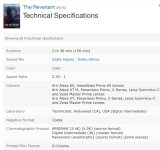
EL: Absolutely. Very different. When I signed on to do The Revenant, I wanted to do all the day scenes on film, just because of the high dynamic range, and I wanted to do all the dusk and night scenes with a digital camera. That's because the digital cameras are more sensitive to light. They can see more in the shadows, and you can push them a bit. For example, let's say that Arri says their camera is ISO 800 native. You can shoot it at IS0 1600 and there's still no noise. You're able to shoot scenes at night with firelight, and you can capture the stars and the Aurora Borealis in the night sky - things that film couldn’t do.
I started doing a lot of tests while we were rehearsing the movie, and every time I went back to the lab to see the results, the images I was capturing with the digital cameras were more interesting to me because they had less noise or no noise at all. It was like opening a window for the audience to get them immersed in this world, whereas film still had that poetic or romantic look, and the grain and texture was making the world of The Revenant look more romanticized. It wasn't really allowing me to get immersed into the world of these trappers the way the digital cameras did.
Little by little I realized that I didn't want to shoot the movie on film. For a middle-aged cinematographer who’s been shooting for so many years - that's a very hard call. It's like suddenly saying to a musician “You know, forget about your incredible piano, you're going to play this concert with a Minimoog.” It's heart-breaking, but the images spoke for themselves. We sent all the film cameras and film back to Los Angeles and started shooting the rest of the tests with the digital cameras. What I learned really fast is that, as opposed to film, you expose differently. You can overexpose film, and for many years I overexposed film because I liked the way you could still see the highlights, and by overexposing I was able to bring up a little bit of information in the shadows.