Split diopter

DavidBeier

Veteran
For years, I've been impressed with deep focus photography in it's various forms (double exposure, high f-stop, and split diopter). I've played a bit with using super high f-stops and trying to do composits of two focuses but now I'm really curious to try some split diopter stuff.

My only question is, how exactly do I do that?

I know what a split diopter is in theory but I don't know physically how it attaches to the lens, where I can get one, or how it works.

I'm currently shooting on a 60D with a bunch of adapted vintage Nikkors on it. Does the split diopter just screw on to the front? How to I control the focus of the other half of it? Where can I get one? Anything else I should know?
 
it is usually in form of a filter. The diopter just changes half of the lens to another focus depth. There are many strengths since all split focus shots are not the same. Do you want some examples of some big film uses?
 
I hate this FX, looks very off and makes cinematic footage into camcorderlike thingy but i never seen 2 focus points with blur behind both subjects, it was always close focus on one and infinity focus on other side.
Would like to see some cool stuff, so far i hate it.
 
I'm willing to bet you've seen it successfully used 500 times and never noticed it. Some are more obvious than others. I was just re-watching pulp fiction as part of AMC's gangster movie marathon and I noticed a split field diopter during the Marcellus Wallace vs. Butch chase scene.


This one is a bit more obvious since we have a major movement through the 'seam', but there are probably scores of diopters uses that I can't tell when watching a film.


Here is a classic example: Used twice... one obvious to the trained eye (not to common viewers) and the other questionably deep dof or a diopter. The obvious is the OTS of Dreyfus, looking at his wife. The not so obvious is the two shot where Dreyfus's son stares at his father and cries.


Here is a small discussion with M. David Mullen, ASC at cinematography.com: http://www.cinematography.com/index.php?showtopic=39257 and http://www.cinematography.com/index.php?showtopic=4698
 
Last edited:
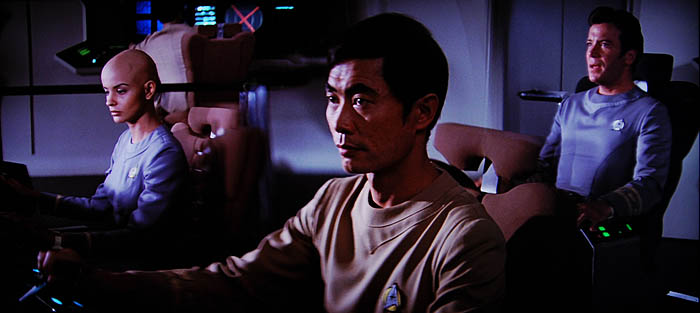
Robert Wise was a fan of deep focus, and here's an example that is described as 'plane glass on either side of a diopter' so that the central character is in focus, as well as two to each side in the background, as described by David Mullen, ASC.

startrekTMP9.jpg


Wise's credits include editing on "Citizen Kane"(1941)... obvioulsy Toland made an impression...
 
I hate this FX, looks very off and makes cinematic footage into camcorderlike thingy but i never seen 2 focus points with blur behind both subjects, it was always close focus on one and infinity focus on other side.
Would like to see some cool stuff, so far i hate it.

I have it on good authority, "Citizen Kane"(1941) was shot on an early prototype of the Sony 1/8 inch sensor Handy Cam...
 
it is usually in form of a filter. The diopter just changes half of the lens to another focus depth. There are many strengths since all split focus shots are not the same. Do you want some examples of some big film uses?

I've seen it a lot in cinematography I love. I'd actually like to know how to practically make use of a split diopter and what kind will attach to the 52mm Nikkors that I have on my 60D. Also, do the different strengths of split diopters change the distance the FG object must be from the camera to stay in focus or the distance the FG and BG objects are from each other?

Basically, I just want to play with one of these and see how it affects my stuff. I've done some split focus stuff in my still photography where take two shots with the and then blend them in Photoshop but this is a lot harder with motion film.
 
On the subject of the split shots, I was amazed how many were in The War of the Roses. Then I looked it up and noticed the DP was Steve Burum who worked a lot with Brian DePalma and it made sense.

Also, on the subject of Pulp Fiction, I think the cooler use of a split diopter is when Butch is sneaking up on rapists with his sword. Of course, I can guess why Youtube wouldn't have that scene online :)
 
Some use tilt shift lenses if it's possible. Different effect, same thought process. Hiding the seam is more of hiding a transition versus a hard line.

Diopter strengths is based on meters, if I remember correctly it's based off one meter.

If you focus on infinity, a .5+ diopter is something like two meters, a +1 diopter is one meter, a +2 diopter focuses to about 1/2 a meter, and a +3 diopter is about a third of a meter.

Since a meter is 3.3ft (rounded), I suppose when focusing to infinity a +.5 diopter would have half of the image focused at around 6'8" feet, a +1 diopter would be 3"4", a +2 diopter would be about 1'8", and a +3 would be 16" or 1'4".

I think if I were to use them, the +.5 and the +1 would be my choice, however you never know when you need the closer... but a +3 diopter at infinity and 16" is going to be a rare shot.
 
Back
Top