robotsound
Well-known member
I recently ordered an ETC Source 4 light to use in independent filmmaking.
For those who don't know, the Source 4 is something of a de facto standard in high end theater lighting, but it has been making inroads into the film industry as people figure out that it's great for movies too. I first read about the Source 4 being used by David Mullen (ASC), when he was shooting season 2 of Big Love for HBO. Apparently he learned about it from the original director of photography on that show.
It's a tungsten light. The one I got is 750 watts, with a 50 degree beam angle.
The Source 4 has a couple of neat features that make it a little different than a more traditional fresnel light. It has a fairly sharp optical style lens on the front, so the light is harder and more directional than a fresnel, even when set to flood.
It also has four shutters inside the light instead of barn doors. Since the shutters are right at the focal point before the lens, they result in a pretty sharp cut of the light, more so than barn doors can provide.
Given these characteristics, it's a pretty great light for filmmaking. The light is really hard, but can easily be bounced to be as soft as you want. A bed sheet on the wall or ceiling is bigger (and thus softer) than any soft light fixture could ever be. Also, the fairly precise cuts made by the shutters can in some cases remove the need for extra grip equipment. Do away with the need for extra flags and your setup times decrease.
I haven't done a shoot with it yet, but here is a quick picture I took while setting it up for the first time. The only light in the picture is coming from the Source 4, which was quickly and imprecisely bounced off the white ceiling.
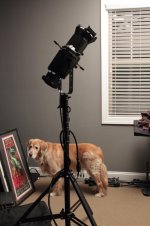
There is a bit of a learning curve getting these lights adapted to film use.
For one thing, you need to get a TVMP adapter (Matthews makes a good one) to adapt the yoke that supports the light onto a baby pin or junior receiver.
They're a little heavier than your average 2K, so you really want a combo stand to go with it, not a C stand.
Finally, it comes with bare wires, so you have to buy a plug and wire it up yourself. It only takes a screwdriver though, and is very easy.
I've been very happy with this light so far, and I'm looking forward to using it on future shoots. If anyone has any questions about it, I'll do my best to answer them.
For those who don't know, the Source 4 is something of a de facto standard in high end theater lighting, but it has been making inroads into the film industry as people figure out that it's great for movies too. I first read about the Source 4 being used by David Mullen (ASC), when he was shooting season 2 of Big Love for HBO. Apparently he learned about it from the original director of photography on that show.
It's a tungsten light. The one I got is 750 watts, with a 50 degree beam angle.
The Source 4 has a couple of neat features that make it a little different than a more traditional fresnel light. It has a fairly sharp optical style lens on the front, so the light is harder and more directional than a fresnel, even when set to flood.
It also has four shutters inside the light instead of barn doors. Since the shutters are right at the focal point before the lens, they result in a pretty sharp cut of the light, more so than barn doors can provide.
Given these characteristics, it's a pretty great light for filmmaking. The light is really hard, but can easily be bounced to be as soft as you want. A bed sheet on the wall or ceiling is bigger (and thus softer) than any soft light fixture could ever be. Also, the fairly precise cuts made by the shutters can in some cases remove the need for extra grip equipment. Do away with the need for extra flags and your setup times decrease.
I haven't done a shoot with it yet, but here is a quick picture I took while setting it up for the first time. The only light in the picture is coming from the Source 4, which was quickly and imprecisely bounced off the white ceiling.
There is a bit of a learning curve getting these lights adapted to film use.
For one thing, you need to get a TVMP adapter (Matthews makes a good one) to adapt the yoke that supports the light onto a baby pin or junior receiver.
They're a little heavier than your average 2K, so you really want a combo stand to go with it, not a C stand.
Finally, it comes with bare wires, so you have to buy a plug and wire it up yourself. It only takes a screwdriver though, and is very easy.
I've been very happy with this light so far, and I'm looking forward to using it on future shoots. If anyone has any questions about it, I'll do my best to answer them.
Last edited: