Sony RX1R II

Lots of info about it

Including:
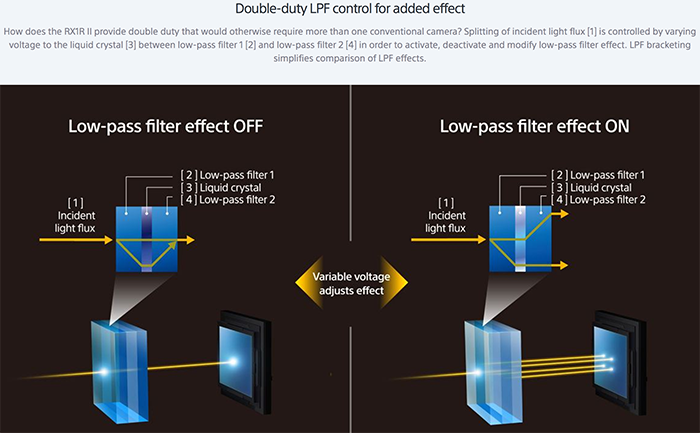
The three settings for the low-pass filter3 include “off”, which provides comparable effects to having no low-pass filter and is suitable when prioritizing resolution, “standard”, which strikes a balance between resolution and removal of moiré and color artifacts, and “high”, which places more emphasis on reducing moiré and artifacting. This unique feature allows photographers to achieve the desired image quality and resolution based on the presence of moiré-inducing high spatial frequency objects in the scene, essentially combining two cameras – one with and without a low-pass filter – into one body. Low-pass filter bracketing is also available and can be used to compare the effects of different settings.

Which I'll file under "stuff I didn't even know I could wish for"
 
First, an electronic ND filter. Then, an electronic LPF. Soon - and it's already released by another company - an electronic lens.

Personally, I want a 200-400 mm telephoto zoom the size of a quarter.
 
Personally, I want a 200-400 mm telephoto zoom the size of a quarter.
Well you can do with the Canon's yet to be launched 250 Mega Pixel DSLR where you can read lettering on the sides of an airplane from a distance of 18kms using your wide angle lens.
 
I like the small form factor and full frame sensor. B&H says Nov 5th is the date of availability and it will cost 3299 usd. Looks nice and easy to carry around.
 
Which I'll file under "stuff I didn't even know I could wish for"
To which I at first would have added "and is it really useful anyway....." :)

But thinking about it....... Spatial aliasing is a FAR bigger problem for video than still images. The reason is that if an object or pattern moves (say) left to right across frame, the alias pattern moves the opposite way. (It's how you can tell true resolution from aliases on a resolution chart - just gently pan side-side.)

That may not sound a big deal - but it is. Video encoders rely on motion prediction for efficient encoding, and the above seriously affects their performance. A level of aliasing may be hardly noticeable on the original signal, but may need a significantly higher bitrate for a decent encode than if the aliasing wasn't present.

On a still image that is not an issue - the same amount of aliasing may simply make edges look a little "busier", may be hardly noticeable except on a chart. Hence it is desirable to have a more aggressive OLPF on a sensor for video work, than the same sensor for stills. It's one of the main reasons why it's appropriate to talk of sensors optimised for still or video use.

This development changes all that. In video mode alias suppression is most important, but it can be switched out for optimum still quality. That's why it really is a big deal. Add to that the 42Mp sensor, and as well as very high resolution stills (obviously! :) ) it's of the exactly the right dimensions (2x3840)x(2x2160) to make for simple yet high quality 4K readout.

In other words, a sensor fully optimised for both stills and video.
 
Watching how the thing works (there's a layer of liquid cristal sandwiched inside the OLPF, three different voltages applied to it generate the three levels of OLPF available), I thought exactly the same: you can have no-OLPF, OLPF for stills, and super-strong OLPF for 4K video in FF mode, in case anybody is ever going to complain about aliasing/moire in FF mode.

Bildschirmfoto-2015-10-14-um-17.11.15-700x433.png
 
Why a fixed prime though? You'd think even at a small size and a full frame sensor, they could do a 24-50 or something like that.
 
Zoom would kill it's compact size. Don't forget it's full frame. Actually I quite like a concept of prime - it force you to be more creative. Also with 42MP you can easily crop 2 to 4 times.
 
It's a camera for people who already have a great camera (and have the $$$$ to spare on this expensive "toy").

@DLD: that zoom is for APS-C, and yes, it's awful
 
It's for people who went out and ordered the new high priced Windows Surface Book. :happy:
 
It's a street/portrait camera. Not sure why they added the LPF tech though.
because they sold the first version of this same camera in 2 different versions, with and without OLPF....
this is for still purists, really the answer to leica M shooters more then anything....
the fixed lens lets them optimize the glass with the sensor....the last version (s) provided insane IQ, better then the same sensor in other bodies combined with any other 35mm....but we are splitting hairs at that level of IQ....
a very, very, very nice toy....
 
... this is for still purists, really the answer to leica M shooters more then anything....
the fixed lens lets them optimize the glass with the sensor....the last version (s) provided insane IQ, better then the same sensor in other bodies combined with any other 35mm....but we are splitting hairs at that level of IQ....
But it's easier to do the in-camera corrections for all sorts of stuff when it's a single fixed lens. You're right about it being Leica Light (or is it Leica Cheap?) but, IMO, a pancake ~ 2x zoom would have made it more versatile.

And those zoom pancakes are in the $350 retail range, with the cost of manufacturing around $50. For a $3,200 model, they could have done more.
well i guess that is what the RX100IV is...the crazy part is that you pretty much need a 42mpix FF with a fixed 35 zeiss prime these day to see a difference in a 11x14? 16x20? print (when you compare it to the RX100IV)
the RX100 is half the size, 20mpix, 1.8-2.8 24-70 zoom 4Kvideo (with options up to 960fps!?) and 1/3 of the price.....
but the RX1R IQ is probably comparable to any medium format digital back....
it really is crazy what we are getting this days....and all this tech (variable OLPF, variable ND in the FS5, better and faster AF) along with crazy resolution and DR will end up in the next round of cinema cameras...although some people will probably complain if the F75 has AF....
 
but the RX1R IQ is probably comparable to any medium format digital back........
Right. The image quality with a prime on a 42 PX sensor must be a total kick-ass. The latest generation Medium Format cameras have higher pixel count but, to get a full benefit of that, you have to either crop the final print like crazy or blow it up a building high - hey, look, it's Beckham in his undies over the entire Empire State Building - which is why I think they could have traded some quality for more versatility. As it is, it's a super-duper selfie machine - look into the lens, snap, delete 35 MPX of the frame in Lightroom and you still get a perfect Facebook photo.
 
It looks like it can be a great camera for fashion shoots (indoors at least). giving you medium format qaulity for this price is exceptional.
 
Back
Top