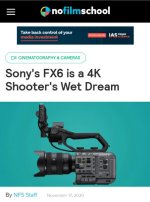
FS5: Sony PXW-FX6

Continuing on a theme - Advantages (that actually matter) that the FX6 definitely has over the FS5:

- They moved the headphone jack so it won't dig into your stomach while holding the camera in the perfect low handheld position.
- They added a couple of assignable buttons (always felt like the FS5 was at least a couple short).
- There is a flag clip button - yes! I hope NLEs can read it though, I'm not going to be using Catalyst very often.

The big questions still needing answers:

- Does the hand grip still wobble? The FS5 hand grip is excellent but it has a bit too much play.
- Can I reassign or disable the ISO/GAIN, WHT BAL, SHUTTER auto buttons so that I don't accidentally knock one of them and then realise 10 minutes later that I have auto f*****g white balance engaged?
- Can I name clips like I would be able to if the universe was essentially benevolent?
 
That's fair, within the world of cameras, this is a video camera first, and only a "cine" camera by branding and a few patch on colour profiles. It should have IBIS.

This is a camera that looks like it is meant to be either handheld or on affordable sticks with a long lens, and IBIS will be crucial for both. Not like people buying this camera are going to invest $10K in sticks and head.

Leave the hard mounting to cars to some other camera.


EDIT: just read the specs, looks like there is no IBIS. Will have to buy the A7s3 for all those shaky handheld overhead angles.

FWIW I dont think the A7SIII IBIS is especially useful. Better than a poke in the eye, but a far cry from the smooth cam feel of GH5 and S1 IBIS I used.

But once you kick in "active steadyshot," I think the A7SIII ibis comes up to par. Active steadyshot uses a 1.1x crop to (as I understand it) digitally shift the image around similarly to how it would be done in post. Which sounds kind of crappy in theory but seems to work well in combination with sensor shift.

So you might not be missing THAT much by not having the IBIS of the A7SIII (although I suppose every little bit counts). There's no reason why the FX6 can't have the digital IBIS part but I haven't seen that it does

I'm sure few would trade Variable ND for IBIS at this point.
 
Enough of these trivialities - Does the FX6 have clip naming or am I going to have 47 clip001s on my editing drive?

Kinda strange how it is ONLY the sound department which puts in the effort to get sensibly and logically named files for Post.

Why doesn't Camera Dept do this too? After all, they're a much bigger and better resourced department!

The camera brands are dropping the ball here, in not making it as easy as possible for Cam Dept to embrace an improved workflow.
 
To be honest, I may skip the 2020 cameras. Though amazing they are, gonna wait till next round. Crazy, these are the cameras I have been waiting for since 2012, at least, but it is all a bit too late, and during a pandemic. Also, nothing really cracked that DR ceiling. So, Really only Gemini, Monstro, Venice, and Arri are living in that cinema DR world of their own.

But what an exciting year for video cameras!
 
IDK, Gerald Undone is slacking. I don't think he answered that. ;)

Variable ND filters have their drawbacks, which can be serious (including softening, color shift, and the X if you go too far)

But if you have a good vari ND filter, I feel pretty set for exposure adjustments. eND is unquestionably better (seems like no color shift or softening, always at the ready, can be set to auto), but I'm not dying without it.

I think the FX6 looks like a great camera. I still kind of feel like it makes more sense to have something like an fs7/fx9 for shoulder mounting and then something even smaller and with more AF power like the A7SIII for gimbal. It seems like Sony is pitching the FX6 as the gimbal camera to accompany an FX9 or just go on its own.

If I need auto exposure adjustments, I can use auto-ISO because it's usually a low-standard situation for me (like livestreaming a gallery walk-through). But I think for high-standard shooting (like narrative), it'll be interesting to see people make use of the eND for exposure ramping...which would be great if you can manually control it remotely
 
Anyone else wish the two FX6 threads were merged? lol

Nah, I feel like I need to start a 3rd thread, or even a 4th?

The question I ask myself is if I should buy one or two?

Or three?

Yup, exactly. The AF and internal variable ND, are what push me to the Sony cameras. Waiting for tests, but I'm assuming the better cooling system in the FX6 should make the 12,800 ISO look somewhat better than it does in the A7S3. I guess it's time for me to continuously bombard Sony with requests for X-OCN to make it's way to all the cameras in Sony's Cinema Line.

Did read an early user report that the minimum noise reduction turned on with high ISO from the FX6 looked even cleaner/better than the max noise reduction from the a7Smk3

X-OCN in their entire cine line up would be mean.
 
Maybe FX6 once it gets the WDR update? Their slide claimed a 4-stop boost thanks to the wide gap between native ISOs...

Will definitely come in handy. If done the way Red does, there are limits. Awesome feature.
 
What's the difference between that and dgo?

DGO is a simultaneous read out and combined exposure.

The way Red does it, is shoot double the frame rate, and every other frame is one of two predefined exposures. A and B frames. Then in post it can be combined. Red cameras aren't dual iso, other than the Gemini, so it is done by shutter speed. So, you can imagine the motion artifacts that causes.... however, you don't always have to combine them, so much as use one track for holding the sky or windows, etc. The one advantage is that it is selective in post... which is also kind of a disadvantage.


The Sony Fx6 with Dual iso may still have some motion artifacts, but could be combined in camera, similar to how an iPhone might do it. Will be interesting to see it in action.

how do they do simultaneous readout? some sort of parallel circuitry? given that fx6 is dual iso, is it possible here? also, i wonder if the high readout speed would help minimize motion artifacts
 
how do they do simultaneous readout? some sort of parallel circuitry? given that fx6 is dual iso, is it possible here? also, i wonder if the high readout speed would help minimize motion artifacts

For Arri and Canon, it is the way they build the sensor, it is hardware. I've held the parts in my hand, but couldn't tell you exactly, but essentially, the Arri and Canon are sending two exposures (high gain and low gain) at the same time (or visually the same time) and combining the them in camera.

I don't know how Sony will do it. And I haven't kept up with how the iPhone is doing it these days. But at least with the iPhone XS, they don't seem to be doing HDR composites in video, just in stills, and that is likely because they are not doing DGO, but shooting two exposures one right after the other, and then combining them, which also has weird artifacts if something in the shot is moving quickly.

It is unlikely that the Fx6 has simultaneous dual gain readout.
 
Last edited:
Ah, then much less exciting... I've seen the issues with the RED and Z-Cam implementations, even though the DR is great
 
I'm sure few would trade Variable ND for IBIS at this point.

speaking of IBIS performance, I just saw this video comparing S1H to R5 to A7SIII IBIS - long story short: the Panasonic smokes the other 2. the R5 is marginally better than the a7siii. the a7siii is a shakey cam, although it doesn't seem like the operator was trying to make it smooth, so obviously better results are possible.

 
Back
Top