Sony Introduces 61 Megapixel α7R IV

ARRI's cameras are the only ones producing a real-time HDR signal from two signal gain stages at the sensor level. It's been 9 years since the ALEXA came out and nothing can really touch it when it comes dynamic range.

Yeah, I have always wondered if that was because of a patent or because of cost and tech that other companies don't have similar solutions to the current inability of digital sensors in terms of aesthetic latitude towards the extremes.
 
Last edited:
lol...I've already started to prepare a post listing their achievements and contributions.

please don't.

As much as they have or haven't done, I haven't ever needed one. That says enough to me right there. You could explain to me what Gregg Toland has done or hasn't done for cinematography. I would love to read more about that.
 
FWIW, Sigma pf will have a dual exposure in order to achieve high dynamic range. Red experimented with it as well but had some problems with frame blending, IIRC. I remember NorBro explaining to me how it worked. Not ARRI but doable for the no-motion sequences. How pf will fare with this technology is currently known only to Sigma's executives.
 
...Red experimented with it...
Red implemented it as an option in their production models. I believe it is still an option, but yeah, it is generally avoided, but is a nice option for more static or slower moving subjects.

That is cool to hear about Sigma diving in.
 
Red experimented with it as well but had some problems with frame blending, IIRC.

RED HDRx exposes two frames, a normal frame and a 2nd frame with a shorter exposure ( you can adjust how much shorter the 2nd exposure is ) and then combines these two images to create a single HDR frame in post. The main problem with this technique is that both exposures have very different motion blur, because the 2nd frame with the shorter exposure may have little or no motion blur at all. Some editors even resorted to blurring the 2nd exposure before the two frames were combined into one HDR frame.
 
ARRI's cameras are the only ones producing a real-time HDR signal from two signal gain stages at the sensor level. It's been 9 years since the ALEXA came out and nothing can really touch it when it comes dynamic range.

No.

BMB 4.6K uses a custom Fairchild sensor with dual 11bit ADC for HDR readout. Quite similar to ARRI but obviously not as high precision (ARRI uses dual 14bit ADC).
 
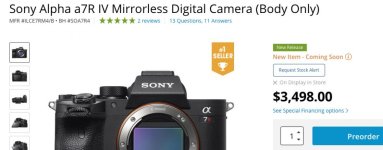
Definitely possible. FWIW, I follow all cameras and most of the Sonys and Canons are '#1 Sellers' or 'Top Sellers' at some point within a few days of their announcements. Then they sometimes disappear and later could reappear again. I like seeing that because it shows me the system appears to be more legit (who knows though). And I only follow them @B&H.
 
I saw that too (but I saw it here). The one that caught my eye is the IMX554DQC: 31 Mpix, full-width capture with 14-bit ADCs at 30fps, and with 1.1x crop at 50fps (but it has to go down to 12-bit ADCs for 60fps). Weirdly enough, the "video" modes are cropped at 19:10 instead of the usual 16:9 (1.9 instead of 1.77)
 
Well some time ago there was a spec sheet for 61 and 36mp sensors. One got released in form of A7RIV so we could expect a second one in form of A9II or A7SIII/IV
 
I saw that too (but I saw it here)...
I saw it there too but there was no link to Sony's own site, as there is usually, so I went looking for links at all the wrong places and realized that SAR just copied the leak from ERumors without attribution. No bueno. Image Sensor World properly linked and gave credit to the site that published it first.

I found the quadruple pixel arrangement to be an interesting idea, whose purpose escapes my non-engineering brain. What I did notice was that there were no MFT or APS-C sensors there. It seems full speed ahead for full frame, with the 55 MPX version likely going to Nikon and Panasonic at some point. The A7 RIV sensor was announced in September, 2018 with the camera itself expected to be shipped about a year later. So, instead of purely speculating what camera may come out, knowing Sony's sensor lineup surely can help narrow the options down. After all, these pieces will find their way into some camera or they wouldn't be made at all. Which they are. In huge numbers.
 
Oh, so SER got the scoop first this time and SAR reposted without attibution. BAD.

The quad-bayer thing is interesting because they can do different integration times in different sub-pixel sites (increasing DR dramatically at the cost of motion artifacts that almost nobody is going to notice), and even better, they can do different gain at different sub-pixel sites (again, increasing DR, this time not so dramatically but still noticeably; it's similar to the dual-gain ADC that Arri uses, but without having to take the same electrical charge through two ADC paths, which I'm sure poses some challenges; Sony separates the charge at source, which seems like a simpler design). The downside is that now you have to read four times as many photosites, which makes it too slow for video even at this 4x15Mpix resolution... unless you move to 12-bit ADCs and skip rows, which probably kills all those other advantages.
 
I think, but nowhere near certain, that 30 MPX IMX554 DQC will go to the next generation entry level full frame a la Canon RP or A7IV. The 410 will remain the video friendly 6K choice. The high MPX 409 - giddy up - will go to competitors with the primary stills units. 313 will be inside an 8K high end hybrid model, with 311 going to competitors. The quad-array 521 is probably going to end up in some video primary offering, which is why they mention camcorders ... but it's full frame, so a fixed lens seems out of the question.

Oh, well. That's a rough road map for the next year.
 
I think, but nowhere near certain, that 30 MPX IMX554 DQC will go to the next generation entry level full frame a la Canon RP or A7IV. The 410 will remain the video friendly 6K choice. The high MPX 409 - giddy up - will go to competitors with the primary stills units. 313 will be inside an 8K high end hybrid model, with 311 going to competitors. The quad-array 521 is probably going to end up in some video primary offering, which is why they mention camcorders ... but it's full frame, so a fixed lens seems out of the question.

Oh, well. That's a rough road map for the next year.

IMX554 is a stacked FF sensor that does 36fps at full-res and full-bit-depth. I'd love to see that in a cheap body but I was guessing a9II. IMX410 was my guess for the next round of cheap-ish cameras. For the rest, I agree.
 
Back
Top