Sony FS5 RAW Option Coming: Texas Media Systems

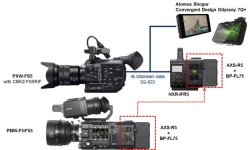
I've seen this diagram:
5714ebc241792_fs5-raw(1).jpg
But I just need help clarifying what other items can I use to output RAW if I don't want the Atomos/Odyssey (because I want to shoulder mount)?
The way I interpret it is that I need the Sony AXS-R5 (US$5,350) the Sony HXR-IFR5 (US$2,200) and a V-mount battery.
There has to be a simpler/cheaper solution than this.
 
Last edited:
...
There has to be a simpler/cheaper solution than this.

Nope, not unless you go O7Q+ route, which saves you buying the stupid HXR iFR555555grrrr interface

If you want the Sony raw recorder solution - you need the AXS-R5 + the damn interface. So yes, big money $$$ and totally unnecessary for FS5 users. The only people who really benefit from the R5 are F5/F55 users. If you want Raw now - only other option is O7Q+. I believe the Atomos SHogun Inferno will eventually once it shps - keep in mind the Inferno will probably not have thet RAW CinemaDNG option upon shipping and is limited to 4K/30p in raw only anyway.

The O7Q+ will do 4K/60p raw from the fs5.

Bummer, the O7Q+ is simply not going to work on a shoulder mount.
Will have to wait for a better option.
 
I know this is a bit off topic of the thread - but anyone (Sony, CD, etc.) explaining if there's a difference in the FS5 raw signal compared to the FS7's? Or the only difference is that you need the extension unit for raw on the FS7?
 
Getting a RAW signal goes between the sensor read and processing chips to de-bayer and then chips that apply NR, further processing and codec.

The FS700 and FS7 needed upgrades to take the RAW from the A/D chips off the sensor, lower it to 12-bit, and then put it into SDI single SDI stream.

On the FS5 I suspect it is the same, the only difference might be Sony already included the electronics to do this inside the camera and now it's just a software key unlock.

But if you're asking about quality etc.. who knows what's in store for it. But in the past we've seen RAW from the FS700 on par with the RAW from the F5. Alister did this test and posted results. Hard to tell apart to be honest.

The difference however with old gen and new is the dynamic range. It's still pretty hard to fit 14 stops into 12-bit linear, actually it's impossible, so Sony has to make it log RAW to work better. This is the piece of the missing puzzle. Does Sony make RAW from their own camera work "better" with their own RAW recorders and it yields better quality than what Convergent Designs can do with it - or vice versa? ie. maybe CD can do better with it than Sony does.

I would not put a penny into this unless you can test it first. So many people were upset and pissed with the purchase of the $2000 XDCA and +$2000 for Odyssey 7Q on the FS7, etc...

Sorry to say it like it is but these are half baked solutions to get RAW from these camera's. If you "really" need RAW on a budget get an URSA 4K with global shutter or 4.6K once they iron out the issues.
 
Last edited:
The transport of the RAW signal from the FS700, FS7 and coming soon the FS5 is very similar but not identical. The inner structure of that signal is determined by Sony but it is delivered in similar structure so we can't really tell. We have prototype versions of the FS5 for our development but we cannot evaluate the relative quality of the signal at this point. We need to wait for the finished release version to compare.

The F7 requires the XDCA module for a simple reason, and it has nothing to do with RAW. There are different factories within Sony producing different products. The FS line of cameras are made at a different facility to the "CineAlta" F-series of cameras, such as the F5 and F55. The factory producing the FS-series cameras do not generally make devices with ProRes recording, timecode or genlock. The factory making the F-series cameras has a lot of experience with genlock and timecode, and was in development on ProRes recording at the time. It was determined that these were features that would be useful as an option on the FS7 camera, so the F-series factory made the expansion module for the FS-series factory. The only way to embed the various elements properly was to have access to the RAW data, so that had to be passed through to the expansion module. That's why RAW output is in the XDCA; it's a secondary consequence.
 
... I would not put a penny into this unless you can test it first..
But you would buy Craft sight unseen?

(gotcha)

BTW, to the Sony production facilities, several of them are down due to the earthquake. So, there may be delays in shipments.
 
Question about RAW shooting and LOG shooting... I have been shooting RAW with stills for many years and love it. It seems the video world has introduced LOG shooting as a way to extract more dynamic range from the sensors. Do these different approaches cancel each other out or will they still both be used?

In other words, if you are going to shoot RAW, would you ditch the LOG or will RAW make LOG shooting even better?

Thanks.
 
Slog can hold more dynamic range in a small bit-depth container which is "good" on the surface and for most things. It's also already debayered by the camera internal processing.

RAW is good because the images are unadulterated (for the most part) when they are recorded, and later debayered and processed in post. RAW typically (but can be different for every manufacturer specific RAW format) allocates a lot more data towards the brighter tones. "Usually" you need a bigger bit-depth container for RAW to hold the same dynamic range as you would have for a Log based format.

For example, 10-bit slog can hold as much info data as a 12-bit RAW file. A 12-bit Log file can hold as much as a 14-bit RAW file, and so on and so on.

But these comparisons are highly complex because for one there is something about "performance" of footage when you bring it into post and start poking and prodding it around in post. For me personally, RAW always grades better and is RICHER and has better everything. It's like the difference between driving a BRAND NEW car or one that is 10 years old and bushings and shocks have worn out where you feel every bump along a ride.

Log is a nice "compromise" to give sort of the best of both worlds and when exposed properly it really does perform well. Really well.
 
Thanks. So due to the debayering process, one would not shoot with LOG when shooting RAW as they are inherently different. Correct? I know the shooting approach is similar as I have always protected the highlights with RAW stills knowing I could recover the mids & shadows.
 
When you're shooting raw, you don't really have that much of a choice; you're getting whatever encoding the camera uses when it reads data out from the sensor. That is basically the analog to digital conversion, taking the voltage from each well and determining its integer value, then saving that data out along with a map that represents the Bayer pattern.

Log encoding is essentially a form of lossy compression. BMD for example calculates a 22-bit image using a dual-gain approach and blending two images together, then uses log encoding to squeeze that image into a 12-bit payload. When it's decoded, you get back a 16-bit image, but in the process, you can't avoid losing some detail, since you're going from 22-bit to 12-bit.

If your camera has 13 or more stops of dynamic range and smooth highlight rolloff, and you're ensuring consistent exposures in skin tones, blown highlights should be pretty rare anyway. That is really what the rolloff is for, it's to give you better highlight handling.
 
The transport of the RAW signal from the FS700, FS7 and coming soon the FS5 is very similar but not identical. The inner structure of that signal is determined by Sony but it is delivered in similar structure so we can't really tell. We have prototype versions of the FS5 for our development but we cannot evaluate the relative quality of the signal at this point. We need to wait for the finished release version to compare.

The F7 requires the XDCA module for a simple reason, and it has nothing to do with RAW. There are different factories within Sony producing different products. The FS line of cameras are made at a different facility to the "CineAlta" F-series of cameras, such as the F5 and F55. The factory producing the FS-series cameras do not generally make devices with ProRes recording, timecode or genlock. The factory making the F-series cameras has a lot of experience with genlock and timecode, and was in development on ProRes recording at the time. It was determined that these were features that would be useful as an option on the FS7 camera, so the F-series factory made the expansion module for the FS-series factory. The only way to embed the various elements properly was to have access to the RAW data, so that had to be passed through to the expansion module. That's why RAW output is in the XDCA; it's a secondary consequence.

Thanks Mitch. As usual, appreciate your sharing of knowledge and info.
 
I wish Sony would implement a log algorithm to their raw footage. The way Blackmagic does it really gives you the best of raw and log IMO. It should at least be an option, right? If Sony could give the F5/55 a 16-bit log file I'm sure those owners would be happy too.

Here's a newb question, is the O7Qplus capable of burning in a 3D LUT (that creates a log signal) from a raw feed from the FS700 or FS5/7 cameras? Is that technically not possible or beyond what the hardware can do? It'd be pretty cool if a 3rd party could configure raw footage from these cameras into log. :)
 
Going log instead of linear is not going to give you any additional information, it just saves some storage space. And Sony is probably doing it already: they do it on their stills cameras (where RAW is not only log but also compressed).
 
I wish Sony would implement a log algorithm to their raw footage. The way Blackmagic does it really gives you the best of raw and log IMO. It should at least be an option, right? If Sony could give the F5/55 a 16-bit log file I'm sure those owners would be happy too.

Here's a newb question, is the O7Qplus capable of burning in a 3D LUT (that creates a log signal) from a raw feed from the FS700 or FS5/7 cameras? Is that technically not possible or beyond what the hardware can do? It'd be pretty cool if a 3rd party could configure raw footage from these cameras into log. :)
We already do this. The RAW is available as transcoded to Apple ProRes in Log form, or it can be available in a Rec709 if you wish.
 
I would love to see in writing from Sony the bit depth of the RAW files and the resolution of the output.
Rumors that I've heard from other sources are:
that the signals are full 4k (4096x2160) and 2k (2048x1080).
that the output is 12bits for 4k and 10bits for 2k.
Another question: Does sony burn the white balance into RAW or can it be adjusted in post?
TIA
 
I cannot post private communications from Sony, but I can assure you that the RAW output from the FS5 is Full DCI 4K & 2K (4096x2160 & 2048x1080) and the signal structure remains the same as other FS RAW containers, meaning 12-bit. Beyond that I do not have data.
 
Back
Top