Sony A7SIII = $3500, 10-bit 4K120p internal, 16-bit 4K60p RAW out

Was just looking at the sigma 24-70 myself if I decide to stay with sony.

Seems like the sigma video autofocus is on par with Sony, do you think? I've read comments mostly about stills AF and seen a couple videos. Evaluating autofocus performance is new to me
 
Here's the running DR compilation, all @ SNR 2.0:

Alexa 14.0
C500MKII 13.1
A7SIII 13.0
C300MIII 12.8
E2-F6 12.8
FS7 12.7
S1H 12.7
UMP4.6 12.6
C300MKII 12.3
BMPCC6K 11.9
BMPCC4K 11.6
XT3 11.2
R5 10.9
GH5s 10.7
A7SII 10.6

Updated to include Z CAM E2-F6
 
Here's the running DR compilation, all @ SNR 2.0:

Alexa 14.0
C500MKII 13.1
A7SIII 13.0
C300MIII 12.8
E2-F6 12.8
FS7 12.7
S1H 12.7
UMP4.6 12.6
C300MKII 12.3
BMPCC6K 11.9
BMPCC4K 11.6
XT3 11.2
R5 10.9
GH5s 10.7
A7SII 10.6

Updated to include Z CAM E2-F6

I'm assuming that you are pulling this from Cinema5D? If so the Z CAM E2-F6 is 12.8 at SNR 1 and 11.5 at SNR 2
 
"unfortunately, the values at SNR = 1 and SNR = 2 are the same – so we cannot trust this result. Also, beyond the 13th stop no further full stops are identified (13.8 stops patch range)."

Usually a sign of test failure due to noise reduction or something
 
"unfortunately, the values at SNR = 1 and SNR = 2 are the same – so we cannot trust this result. Also, beyond the 13th stop no further full stops are identified (13.8 stops patch range)."

Usually a sign of test failure due to noise reduction or something

I disagree. All it means is that noise is being crushed faster than signal in the low key, but you still have measurable signal, therefore you have still have detail.
 
I disagree. All it means is that noise is being crushed faster than signal in the low key, but you still have measurable signal, therefore you have still have detail.

I don't follow about the low key. But it doesn't make sense to me to get the same result for two different SNRs. That's not meaningful.
 
I disagree. All it means is that noise is being crushed faster than signal in the low key, but you still have measurable signal, therefore you have still have detail.

Or maybe you mean there is less noise in areas with less signal? Shouldn't there be a consistent level of noise everywhere in the absence of noise reduction?
 
Or maybe you mean there is less noise in areas with less signal? Shouldn't there be a consistent level of noise everywhere in the absence of noise reduction?
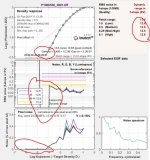
Yes, that is what I meant, areas with less signal, and no...a consistent level of noise is not what the Imatest chart shows. That is the assumption Gunther made too; a consistent level of noise. Well, not in this case, not in any case probably. It's dangerous to assume anything. The charts showed pixel noise as % of |v| @ -6 stops to be about 3.5X less than Canon C300 Mark III, so Canon has more signal and more noise. It could be noise reduction, or it could be sensor gain or offset voltage or all three. It should matter not to us because it is what it is. We get a number but we should still be looking at the picture quality, which E2-F6 looked not bad at all. But back to noise, it's about 3X higher at -2 stops than at -6, you just don't notice it as easily.
 
I agree that the images look pretty. But if you read the rest of the article, he chooses to overlook the Imatest result and rate the DR based on a comparison with the P6K, and concludes that the E2-F6 has only 11.5 stops:

"We rated the BMPCC6k at 11.8 stops (SNR = 2), and as the shadows looks definitely cleaner than the Z CAM E2-F6 (albeit close) I would rate the dynamic range of the of the Z CAM E2-F6 at 11.5 stops."
 
Regarding the test shot of the bookcase, that's what I meant about noise as % of |v|, it's more at -2 stops than at -6. The bookcase was dark but it wasn't in the black. Is the noise that we see a ratio of S/N or is it just an amount of noise? You tell me.

The mistake Gunther made in his interpretation of the graph (he circled), is that the plot on the Y axis is not S/N ratio, it's RMS noise which is the (1/x) reciprocal. So as you count stops down noise is on a mostly consistent upward trend before suddenly shooting straight up at -12.8 giving no more stops of DR. So if anything was in question, it's the assumption that there should be another stop of DR to accompany the subsequent doubling of noise. Imatest did the right thing not giving credit for another stop of DR (to 13.8) when you might have expected that it would. In other words, it's the assumption that there should always be another stop of DR above 0.5 RMS noise that tricked Gunther. Does that make sense?

0.5 RMS Noise = 2.0 S/N
1.0 RMS Noise = 1.0 S/N
 
I am not quite sure I get Cinema 5D's dynamic range test considering the Pocket 6k holds highlights and shadows better than the Ursa 4.6k which they rate 12.5 vs the Pocket at 11.8

The Sony A7s3 is likely using pretty heavy Noise Reduction if its anything like its predecessor. That is really why I wouldn't buy one. Unless they make an option to disable the noise reduction. Motion ghosting is the worst.
 
Gerald Undone (he's crazy) has a review on the E2-F6. It was before he used the Xyla chart and Imatest but he covers low light in the camera pretty comprehensively. He made these remarks about it:

- Z-Log exposes differently and is much flatter.
- It doesn't quite succeed as well in the highlights as the Blackmagic, but close.
- It does do a very good job of managing noise.
- Darker image areas manage noise better than expected.
- NR is subtle but effective and has the option of turning it off.
- Not forced to overexpose to keep log clean, but 1/2 stop over produces nicer image.
- Suffers hue shifts when changing ISO.
- If you like his review, hit the like button.
- If you don't like his review, feel free to hit the un-like button twice. :grin:

https://youtu.be/x3xZKM1HHeA
 
A side note - this clip has over 66,000 views, which is several times greater than the number of the E2-F6 cameras that will actually be sold in the English speaking world. And those clicks are big numbers for any manufacturer, especially for the pro gear. The consumer tier gets hundreds of thousands of views combined.
 
They are pretty average numbers. Most YouTubers with 100K - 500K subscribers have the same amount of views across their content (hot cameras attract more), and the ones with millions pull in more, 1-2 million views sometimes.

In general, those are very low numbers compared to more universal entertainment.
 
Regarding the test shot of the bookcase, that's what I meant about noise as % of |v|, it's more at -2 stops than at -6. The bookcase was dark but it wasn't in the black. Is the noise that we see a ratio of S/N or is it just an amount of noise? You tell me.

The mistake Gunther made in his interpretation of the graph (he circled), is that the plot on the Y axis is not S/N ratio, it's RMS noise which is the (1/x) reciprocal. So as you count stops down noise is on a mostly consistent upward trend before suddenly shooting straight up at -12.8 giving no more stops of DR. So if anything was in question, it's the assumption that there should be another stop of DR to accompany the subsequent doubling of noise. Imatest did the right thing not giving credit for another stop of DR (to 13.8) when you might have expected that it would. In other words, it's the assumption that there should always be another stop of DR above 0.5 RMS noise that tricked Gunther. Does that make sense?

0.5 RMS Noise = 2.0 S/N
1.0 RMS Noise = 1.0 S/N

I remain skeptical. Gunther speculates that the camera is filtering noise and that's why the darkest stops are cleaner. (He also says there's not much difference between the bottom few stops so they'll band if you try to lift them, which is what happened in his latitude test.)

But basically I think if you're going to count those clean stops in its DR measurement, then you should compare it to the P6K with noise reduction applied. Because it seems to me that the shadow noise has already been reduced on the F6. I also think the chroma noise is uglier on the F6 than the P6k. I think you're overrating the camera

1.) I didn't rate the camera Imatest did and Gunther is fudging the number. The P6k doesn't have anything to do with it. It's not about fairness to cameras. There was an objective, impartial test. If the test is flawed, stop using the test but it's wrong to fudge a different number than the test gave.

2.)The banding Gunther was referring to is not the shot noise seen in the latitude tests. He was referring to false contours, posterization from have fewer shades between stops 12, 13, 14.
 
They are pretty average numbers. Most YouTubers with 100K - 500K subscribers have the same amount of views across their content (hot cameras attract more), and the ones with millions pull in more, 1-2 million views sometimes.

In general, those are very low numbers compared to more universal entertainment.

They're actually very low numbers for "general entertainment" but pretty decent ones for someone doing a wonky tech analysis.

On the other hand, 1,000,000 views on a smartphone model that might sell hundreds of millions over the course of its production run isn't as significant for its manufacturer as 66,000 views for a model that might sell 20,000.

PS. For a casual observer, the oddest thing is when a classic rock album has fewer clicks than some nitwit "reacting" to a song from the same album. That puzzles me to no end.
 
1.) I didn't rate the camera Imatest did and Gunther is fudging the number. The P6k doesn't have anything to do with it. It's not about fairness to cameras. There was an objective, impartial test. If the test is flawed, stop using the test but it's wrong to fudge a different number than the test gave.

The test IS flawed and some say we shouldn't use it. But there's like no other way to standardize a reading. It's flawed in 2 ways:

1. it only works in the absence of noise reduction. otherwise results are inconsistent between cameras or even meaningless. Here is the s1 in flat profile:
Panasonic-S1-Flat.jpg

2. dynamic range is subjective. there are different types of color noise that may bother a person more or less. kinda like looking at color charts and concluding that sony has better color than canon. it's better to look at footage and best to shoot footage yourself.

im not saying you're being unfair to the p6k, just that - if there is NR going on here - all the values in your list should shift up to include the NR result from each camera.

2.)The banding Gunther was referring to is not the shot noise seen in the latitude tests. He was referring to false contours, posterization from have fewer shades between stops 12, 13, 14.

Right this is more of a latitude thing, but interrelated with DR. my point was just that you may not be able to lift the shadows as much as your DR rating implies
 
DR may be a subjective term, the measurement of it to S/N =2 is not. It's measured the same way for every camera on the list. I report the measurements, nothing else. How it was obtained as far as iso, temporal N/R is beyond my control. Gunther can offer his opinion, but I'm not substituting a number.
 
Last edited:
Back
Top