Sony A7SIII = $3500, 10-bit 4K120p internal, 16-bit 4K60p RAW out

Interestingly, here's a recent Sony 12MP quad Bayer sensor that they put in a smart phone. The video framerates it pumps out are close to the rumored specs of the A7SIII.

So, they can do similar processing in a phone. Make it a full-frame sensor that can read out that quickly and they could do a similar implementation for the video recording.
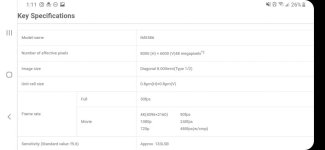
Screenshot_20200712-011107_Chrome.jpg
 
Oh gotcha! Yeah - 48mpix stills, 12megapixel 120fps 4K with great dynamic range would work too :)

Definitely not buying a Canon R5 until I know for sure.

My friend is getting the R5 and Macgregor has the Mini LF so I'll probably get the Sony then we can compare all 3x and I can choose between the Sony and the Canon at that point - if the Canon is better I'd be able to return the Sony.

Then watch Fuji do an 8K X-H2 in 6 months :) I sold my X-T3, miss it already!

Bruce Allen
www.bruceallen.tv
 
Bigger sensors are waaaaay slower than small sensors. Making a bigger version of a similar design completely screws the thermal budget, and if you don't make it run a lot slower you have to put a huge heatsink and fan on the back. They probably can't make a FF sensor that matches the readout speeds of their phone sensors.

One important keyword in that a7sIII rumour is that it's a stacked sensor. The Venice is a 24 Mpix stacked sensor. The a9II is a 24 Mpix stacked sensor. They probably can make an a7sIII with a 12 Mpix stacked sensor able to run at the rumored specs. But I doubt that's the case (yet) in a quad-Bayer design, and a 12 Mpix camera can't be my main stills camera.


edit: the IMX521CQR seems to be their fastest quad-bayer full frame design so far. It's 15 Mpix x4 and it does 30fps in 16x9 14-bit mode, 72 fps in 16x9 12-bit mode. It can't do 4k 120fps. It's not stacked, so maybe that would do the trick. We'll see...
 
Last edited:
Fstoppers headline: "If It Wants to Beat the Canon r5 and r6, the Sony a7s III Just Needs to Shoot 4k 60p Without Overheating"
 
I shot on a friends A7 II, a pretty cheap, basic variant as a B camera when I shot the FX9 and the AF on this low end A7 tracked almost a well as the FX9.
That was one thing about it I liked. The menus, OTOH, never having shot with this variant though were a freaking nightmare. I still don't like the A7s as much as almost all of the other
mirrorless but they aren't bad at all, they just don't align with how I like to use them. The FX9 was pretty sweet, no issues with it under pressure.
 
The a7sii is contrast detect no? As long as the A7SIII has phase detect, I'm not concerned. If they give it contrast detect, I will buy a tin hat from DLD

Don't know if the new A7 SIII will have it but the FX9 has both phase and contrast based AF on one sensor. That's why it's AF is almost like magic in it's accuracy and tracking ability.
Sony should put this AF on every AF camera they come out with from here on out, it's so good compared to my C200/300 MKII, which is decent, which is better than the X-T3 AF.
 
And it was so hot today, Mickey Rooney was dating Jane Russell just so he could stay in the shade (and that's a 70-year old joke, btw)

Saul I'm saying.

I love old Hollywood jokes. As someone who spent hours with both before they left this world in the early 2000s, not at the same time though, that's hilarious.

Jane was a delight, very intelligent and sharp although a bit of a religious fanatic and Rooney should have been in a care faciility when I shot
his interviews, his family was pimping him out to make money big time, it was sad.
 
Sonyalpharumors: "I am still not 100% sure yet but I am getting some early info about a Sony A7sII successor launch event around July 28/29. The camera is rumored to start shipping out in mid August."
 
it's funny, the first Sony A7s all had major overheating issues when shooting 4K. The latest, apparently not. Now the Canon competition seems to have
overheating problems, some things never change. IMHO, Canon should have just made the R5/R6 as one model,
made sure it could shoot 4:2:2 10-bit 4K 60P for as long as the user wanted it to without overheating and been done with it. 8K, especially in a small
body doesn't seem ready for prime time.

Maybe the shipping R5/6 will be better than the prototypes the YouTubers are playing with? Maybe they won't overheat all of the time?
Maybe they won't have horrific skewing and Jello? It seems unbelievable to me that in the name of specs that nobody needs or is asking for,
Canon may have wholesale crippled the usability of the R5, who knows about the R6?

If this is true, maybe the Sony A7 SIII will become the 2020 mirrorless success story. Sony certainly has the knowledge to do it, but they too seem stuck in a room with wet paint, backed into a corner. The FX9 confirmed that
the A7 SIII couldn't have internal RAW and that's okay, but I hope all of the other features work well and that the camera doesn't share the same overheating issues.
 
The first a7S captured 4K only to recorders, so rarely saw it. It was there in the second one, but wasn't as common as the a6300/a6500, which introduced the world to camera overheating all at once (via YouTube).
 
I think the A7SIII will benefit from neglecting the stills side. Perfect for guys like me who don't need much stills or could still bring my 5Dmk3.

The R5 is a true hybrid like a high-end A7III and only the stills side is flawless. It sounds like plenty of people are happy with it, though. You can't please everybody with the same tool
 
Sony should make this new A7 SIII variant a pure video mirrorless, hopefully this is it. They have so many damn A7 variants and most are more geared toward stills more than video already.
 
What to expect from new A7SIII in terms of light sensitivity? It is still 4K (minimum), it is still around 12 megapixels on full frame, so really the only things changing to make it better in low light is the sensor and its processing power. Now, my brain might be confused but I think I read earlier when the A7SII came that the light sensitivity was pretty close to the physical limit, i.e. 70% or 80% of all the light coming in would register on the sensor, i.e. there was only 20-30% more improvements left to do in "light gathering sensitivity". Point being, there was only about half a stop left to gain from making it physically perfect (somewhat akin to how diffraction is a physical limitation), and lots of diminishing returns in that area therefore much better to improve noise reduction, since then you can get many stops of improvements. Clean ISO seems to double every 2-3 years (just like Moore's Law, more CPU = more power to de-noise), given that AS7II came 2015 I would think this one is about 2 stops, maybe 3 stops cleaner, i.e. ISO 5000 on the old model should be around ISO 20 000 or 40 000 on the new one.

Now, I gladly like any info regarding the physical limits of sensors as I might be completely off.
 
I nearly climaxed when I saw this post on Sony Alpha rumors Today:

600mbps bitrate
16bit RAW output
Sony claims 15 stops dynamic range
iso is still the same as previous a7s2 – 409600
Base ISO for slog 3 is 160 instead of 1600 (As7II) on the pre-production unit.
 
I nearly climaxed when I saw this post on Sony Alpha rumors Today:

600mbps bitrate
16bit RAW output
Sony claims 15 stops dynamic range
iso is still the same as previous a7s2 – 409600
Base ISO for slog 3 is 160 instead of 1600 (As7II) on the pre-production unit.

Yeah... I’ll believe 16-bit raw out when I see it. Sony Alpha Rumors constantly gets stuff wrong, especially when it comes to the A7SIII. It’s embarrassingly bad. And I don’t at all believe that Sony would put 16-bit raw out in this camera. No way.
 
Maybe 12 bit raw out then. Sony Alpha rumors is usually pretty accurate about an imminent release. There could be some miscommunications of course. I'd be surprised if they put raw out in here as well. But its competitors have raw out like the s1h or raw internal like the R5.
 
Back
Top

