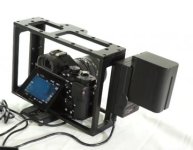
sony a7s ii - external power (yes, another one...) questions and thoughts

ymotion

Member
Hi,
I've been doing some research recently about external power for Sony a7 series. It seems like there are quite a few options, ranging from complete set to a DIY.
My starting point was trying to figure out whether to go with 14.4V or 7.2V (also the 5V, which I passed)
I have very little knowledge when it comes to electronics, but logically the 7.2V fits my needs better. I think one should go for the 14.4V if there's a lot of stuff to power. In my case, I need just to power the camera + XLR adapter (hot shoe) and for that I think the 7.2V is fine.

[1]
Still not sure about the following, and would very much appreciate your input. Afaik, the running time depends on the battery's capacity (measured in mAh or Ah). Most of the 14.4V batteries are marked with Wh. To convert from mAh to Wh, this is the formula:
(mAh) * (V) / 1000 = (Wh).
If I use the 14.4V battery I will need a regulator (or whatever you call it) to transform the 14.4V to 7.2V of the camera. But if I look at the formula, the 14.4 batteries will have less mAh because you divide them by 14.4 [for example, 95Wh 14.4V battery will give you: 95000/14.4 = 6600mAh, and 6600mAh is just a normal f970 battery]. Am I right here? Or because using the regulator the formula gets 7.2? Again, I don't know the answer but logically it makes sense that a 7.2V battery would be more efficient than14.4V to power a 7.2V device. Yes/No?

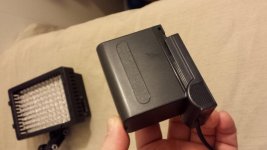
[2]
Another reason to go with the 7.2V option is that these D tap to NP-FW50 regulators are very expensive. If you compare it with just a dummy, which is quite cheap. Also, to charge the D tap batteries, the charger is more expensive.

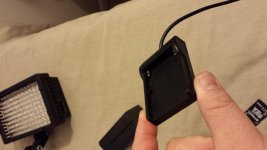
[3]
Currently, I have two options for the 7.2V
(a) buy the Swit S-8972, a DC cable and a dummy
(b) buy F970 battery, use a battery plate with a DC out, then a dc cable and a dummy.


Pros for (b)
PRICE: I can actually buy two F970 batteries for the price of one Swit. The Swit is 47Wh, F970 you can find good replacement in 57Wh. So double the time here.

Cons for (b):
I have no indication of the power left. The Swit battery has an indication levels on the battery. Unless the internal battery indicator of the camera can give indication of the external F970. Can it?

Also, to use the F970 you'll need a plate (like THIS). If you're shooting with a tripod this can be an advantage: you can easily mount it. I usually shoot hand held, and the battery will go into my pocket. For me the plate is disadvantage - I'm a bit worried the battery will slide out (better to have fewer connections)

Hope I was clear. A lot of info and tried to keep everything as neat as possible. Would love to hear answers and comments!

Thanks
 
Sounds like you're on a budget?

$400 - Simplest solution is the Atomos Power Station - comes with two 970's, power level, DC or USB options: http://www.bhphotovideo.com/c/product/1148546-REG/atomos_atompws002_atomos_power_station.html
<$40 - Not sure why you're discounting 5V. it's probably the cheapest and I've personally tried it on various paid shoots, discrete enough and reliable. 12000mah will get you 10-12 hours (not sure how much XLR consumes for power). Some people are saying it will ruin your battery, maybe but I doubt it. I found a youtube video showing the power drain from USB. Sony has smarts in there so it will pull 90-95% of the power from USB when recording which means you're not charging the internal battery, you're simply putting a very small drain on it = SAFE. this only works for A7sII/A7RII/A6300
Do you have this on a rig? I've looked at power options before, trust me in paid work, get what's simplest. no cheap/temp/just good enough solutions. Rig go for this: http://www.bhphotovideo.com/bnh/controller/home?
O=&sku=1100248&gclid=CNPIsILljs0CFQ8yaQodv5cNqA&is=REG&A=details&Q=


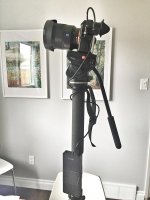
Here's my setup, compact and light, never have to worry about power.FullSizeRender.jpg
 
Last edited:
Hi tatawaki,

Thanks a lot for your comments.

I totally agree with you about getting the equipment that works the best. I'm not looking for cheap solutions but the best combination. And the most efficient one in terms of my needs.

I'm mostly shooting video hand-held. So I would like to stay light. And would like to keep the external battery in my pocket. Most D-tap batteries are V mount or Gold mount - they are big and heavy. I wouldn't mind carrying them if I knew they give me something I cannot get otherwise (but I think it is not the case). However, the D-tap connection feels much tighter and firm than the dc, which is an advantage.

The Atomos is an option. I think it works well when attached to a tripod's plate. Otherwise, it is as big as a v mount battery. The advantage of the Atomos is that you can hot swap. I saw it elseewhere as well - it gives 8.4V. Isn't that a bit too much for Sony a7 (7.2V)?

Your setup looks great. And you're absolutely right - it is the simplest and the most elegant of them all! But for me, I'd prefer to have the cable going from the bottom rather then the side (USB) - this is a personal preference as I already have a mic on the top and don't want too many wires. So dummy battery is more comfortable for me...
 
Last edited:
Hi,
If I use Sony F970 battery as an external power for the a7s ii - would I still be able to get the battery levels on the camera screen (like the levels I get from the NP-FW50 battery)?
thanks
 
Hi,
If I use Sony F970 battery as an external power for the a7s ii - would I still be able to get the battery levels on the camera screen (like the levels I get from the NP-FW50 battery)?
thanks

Yes, with some caveats. For starters, I've noticed what others have called the 3-hour-limit, where the camera seems to think that no internal battery could last 3+ hours non stop, so it sort of artificially reports the battery life going down even if it hasn't. I covered a live event once with two of these, and all I had to do was a quick power cycle off/on to get it to report the correct battery life remaining (which I verified with a voltmeter). The good news is that the camera will always err on the conservative side. It will always have AT LEAST what it reports left, sometimes more.

I ran my p970 setup on a cage/monopod, attached to a shoulder rig, and even one time in my pocket (I'm working on a belt clip version). I built mine out of a bunch of spare battery chargers I have accumulated over the years that came with aftermarket batteries.
More on that if you're interested:
https://www.youtube.com/watch?v=g2e_mGxvBtU
(lots of rambling, skip towards the middle if you don't care to hear my explanation)

As for using the USB input... I'm still using an A7S mark i so I can't speak from my own experience, but I'm not under the impression that it works the way tatawaki says. My friends' mark ii battery was hot to the touch after using it with an external USB supply- much more than my mark i or P970s are. It appears that the camera runs on more than the 5v input can offer, so you're basically still relying on the battery to supply enough voltage and amperage, and the USB supply sort of trickles in slowly to keep the battery from depleting as quickly as it would have otherwise. It would make sense that it works this way, since most other electronic devices such as phones, etc, do the same. If this is true, by using more power than the charger can supply on a long term basis, you are actually putting the battery through a lot of stress which will noticeably reduce the run time / capacity in the future. I know I have phones that I left plugged in all the time for an experiment (stress testing an app running 24/7) and it fried the battery in at least 2 or 3 of them. They maybe last a half day now, whereas they'd easily last a full day before the experiment.

I'd say if you are going to use the USB method, use cheap third party batteries that you wouldn't care about frying. But that's just my opinion.
 
Yes, with some caveats. For starters, I've noticed what others have called the 3-hour-limit, where the camera seems to think that no internal battery could last 3+ hours non stop, so it sort of artificially reports the battery life going down even if it hasn't. I covered a live event once with two of these, and all I had to do was a quick power cycle off/on to get it to report the correct battery life remaining (which I verified with a voltmeter). The good news is that the camera will always err on the conservative side. It will always have AT LEAST what it reports left, sometimes more.

I ran my p970 setup on a cage/monopod, attached to a shoulder rig, and even one time in my pocket (I'm working on a belt clip version). I built mine out of a bunch of spare battery chargers I have accumulated over the years that came with aftermarket batteries.
More on that if you're interested:
https://www.youtube.com/watch?v=g2e_mGxvBtU
(lots of rambling, skip towards the middle if you don't care to hear my explanation)

As for using the USB input... I'm still using an A7S mark i so I can't speak from my own experience, but I'm not under the impression that it works the way tatawaki says. My friends' mark ii battery was hot to the touch after using it with an external USB supply- much more than my mark i or P970s are. It appears that the camera runs on more than the 5v input can offer, so you're basically still relying on the battery to supply enough voltage and amperage, and the USB supply sort of trickles in slowly to keep the battery from depleting as quickly as it would have otherwise. It would make sense that it works this way, since most other electronic devices such as phones, etc, do the same. If this is true, by using more power than the charger can supply on a long term basis, you are actually putting the battery through a lot of stress which will noticeably reduce the run time / capacity in the future. I know I have phones that I left plugged in all the time for an experiment (stress testing an app running 24/7) and it fried the battery in at least 2 or 3 of them. They maybe last a half day now, whereas they'd easily last a full day before the experiment.

I'd say if you are going to use the USB method, use cheap third party batteries that you wouldn't care about frying. But that's just my opinion.

Hi Gilden,
Thanks a lot for taking the time to write back, share your ideas and the youtube video - it's all very helpful.
I didn't think about using a charger as a plate - it's interesting. I actually ordered a ready-made one:
http://www.amazon.com/Battery-Plate...&qid=1465210893&sr=8-1&keywords=f970+smallrig

The thing I didn't like about the charger as a plate is that some of the battery sticks out:

Screen Shot 2016-06-06 at 12.51.04 PM.jpg

I would prefer to have the bed long enough for the legs :)
And I hope the ready-made plate I ordered would be.

Another thing I'm looking for is to come up with a plate that is a bit thinner (both charger and the ready-made plate are too thick). Maybe taking just the adapter of the charger and soldering a dc out cable? I have no knowledge in electronics but willing to learn!

Since I'm shooting video mostly hand-held, I'm looking for something compact. I saw some videos with people saying that f970 is terribly big. I would not say something like that - I have no problem carry it in my pocket. I like the Swit battery S-8972, because it has a dc out - so actually you don't need a plate at all. The disadvantage here is the price: you can actually buy two batteries with more Wh in the price of one Swit. But this is something to aspire to - and would like to build something as close to it as possible.

About the USB power - I know there are a lot of guys that use it. It's a very easy set up and also the cheapest and even the most elegant that I've found so far! But my gut feeling tells me to stay away. Too much conversion or too little power. Maybe I'm wrong...anyway, would prefer to try the f970 option first.
 
Hi Gilden,
Thanks a lot for taking the time to write back, share your ideas and the youtube video - it's all very helpful.
I didn't think about using a charger as a plate - it's interesting. I actually ordered a ready-made one:
http://www.amazon.com/Battery-Plate...&qid=1465210893&sr=8-1&keywords=f970+smallrig

The thing I didn't like about the charger as a plate is that some of the battery sticks out:

View attachment 114355

I would prefer to have the bed long enough for the legs :)
And I hope the ready-made plate I ordered would be.

Another thing I'm looking for is to come up with a plate that is a bit thinner (both charger and the ready-made plate are too thick). Maybe taking just the adapter of the charger and soldering a dc out cable? I have no knowledge in electronics but willing to learn!

Since I'm shooting video mostly hand-held, I'm looking for something compact. I saw some videos with people saying that f970 is terribly big. I would not say something like that - I have no problem carry it in my pocket. I like the Swit battery S-8972, because it has a dc out - so actually you don't need a plate at all. The disadvantage here is the price: you can actually buy two batteries with more Wh in the price of one Swit. But this is something to aspire to - and would like to build something as close to it as possible.

About the USB power - I know there are a lot of guys that use it. It's a very easy set up and also the cheapest and even the most elegant that I've found so far! But my gut feeling tells me to stay away. Too much conversion or too little power. Maybe I'm wrong...anyway, would prefer to try the f970 option first.

Well, that's just because P-series from Sony are longer than other types of batteries. If I use the Canon ones (which I think appear elsewhere in that video), it fits just fine, no overlap. I agree it looks a little funny, but it doesn't seem to effect how well it holds, especially when mounted to a monopod leg (which I think I also demonstrated in the video- I think?).
Anyway, as far as it being thicker than it needs to be- I did actually originally make the whole thing smaller, I used just the plate itself. See here:
btt1.jpgbtt2.jpg

Like this, I actually shoved it into my pocket once and ran around like that. I was going to drill a hole in the middle to use as a mounting point, and/or come up with a belt clip attachment for it, but in the end I liked the idea of doing it to the BASE instead, that way I could choose from different batteries at whim by swapping the plates. Want something smaller and lower profile? Don't use a P970, use a Canon battery. Want longer life? Swap the plate back to the P970. Keep it simple.
 
Well, that's just because P-series from Sony are longer than other types of batteries. If I use the Canon ones (which I think appear elsewhere in that video), it fits just fine, no overlap. I agree it looks a little funny, but it doesn't seem to effect how well it holds, especially when mounted to a monopod leg (which I think I also demonstrated in the video- I think?).
Anyway, as far as it being thicker than it needs to be- I did actually originally make the whole thing smaller, I used just the plate itself. See here:
View attachment 114371View attachment 114372

Like this, I actually shoved it into my pocket once and ran around like that. I was going to drill a hole in the middle to use as a mounting point, and/or come up with a belt clip attachment for it, but in the end I liked the idea of doing it to the BASE instead, that way I could choose from different batteries at whim by swapping the plates. Want something smaller and lower profile? Don't use a P970, use a Canon battery. Want longer life? Swap the plate back to the P970. Keep it simple.


Hi Gilden, good to hear from you
My concern is that the battery would slide off accidentally once it is in my pocket. And we know what happens when you suddenly cut off the camera from power...What's your experience here? Lock/release would be great here.
 
Hi Gilden, good to hear from you
My concern is that the battery would slide off accidentally once it is in my pocket. And we know what happens when you suddenly cut off the camera from power...What's your experience here? Lock/release would be great here.

A lock/release would be great, but since I built this off found parts, I just make do with what I have. I usually just mount it in a way that gravity is in my favor (slide down into charger, or on top of cage- never with the bottom hanging off facing downward). For extra safety, sometimes I use gaffer's tape to wrap the battery to the plate and prevent movement. However, if locking it off on a tripod for a long shoot (which is mostly when I set this up), I'm not really too concerned it will budge so I skip that step.
As far as putting it in your pocket- There's definitely what to be cautious about, however if just sporting the little plate by itself in your pocket, its more like the battery is holding the plate on than vice versa. In fact, I'd wager that keeping it in your pocket actually holds the items together better- there isn't really any wiggle room for the battery to separate in a pair of jeans, but I won't lie and say the thought hasn't crossed my mind. It could happen.
The only time a battery fell off this setup is one of the first times I tried it at an event, I was using it clamped to a monopod, charger facing the wrong direction, and running up a flight of stairs (and using the monopod occasionally as a walking stick involuntarily). After that is when I started using a piece of gaffer's tape and turning it the other direction and/or putting it on top with a cage.
 
A lock/release would be great, but since I built this off found parts, I just make do with what I have. I usually just mount it in a way that gravity is in my favor (slide down into charger, or on top of cage- never with the bottom hanging off facing downward). For extra safety, sometimes I use gaffer's tape to wrap the battery to the plate and prevent movement. However, if locking it off on a tripod for a long shoot (which is mostly when I set this up), I'm not really too concerned it will budge so I skip that step.
As far as putting it in your pocket- There's definitely what to be cautious about, however if just sporting the little plate by itself in your pocket, its more like the battery is holding the plate on than vice versa. In fact, I'd wager that keeping it in your pocket actually holds the items together better- there isn't really any wiggle room for the battery to separate in a pair of jeans, but I won't lie and say the thought hasn't crossed my mind. It could happen.
The only time a battery fell off this setup is one of the first times I tried it at an event, I was using it clamped to a monopod, charger facing the wrong direction, and running up a flight of stairs (and using the monopod occasionally as a walking stick involuntarily). After that is when I started using a piece of gaffer's tape and turning it the other direction and/or putting it on top with a cage.


That's what happens when one uses the tripod as a walking stick...Tripods should be used as (3 legged) walkers :)
Thanks again for sharing. Very interesting stuff. The Dolgin has a locking mechanism - and afaik also the SmallRig one. Currently in Europe and couldn't try the Dolgin - so ordered the SmallRig and will check.
BTW, do I need to check polarities when I connect a dummy battery to the battery plate? My battery dummy shows the following: + C - . I guess it means the inner part of the male is negative right?
 
That's what happens when one uses the tripod as a walking stick...Tripods should be used as (3 legged) walkers :)
Thanks again for sharing. Very interesting stuff. The Dolgin has a locking mechanism - and afaik also the SmallRig one. Currently in Europe and couldn't try the Dolgin - so ordered the SmallRig and will check.
BTW, do I need to check polarities when I connect a dummy battery to the battery plate? My battery dummy shows the following: + C - . I guess it means the inner part of the male is negative right?

Yes, although they probably follow some sort of conventional standard, you never know. I remember finding out that Panasonic used the opposite pin out in their dummy battery as the conventional one, and a few people fried their cameras the first time they tried to rig up an external power supply. I think Sony is conventional, but I'd still use a voltmeter to test. In the case of the adapter I built myself, the wiring inside was very clearly marked + and -, and since I was using the cable that came with the dummy battery already, I didn't need to check polarity, I could use the labels on the circuit board I pulled it out of (the cable came with the included AC adapter for the dummy battery, and the battery charger plate has wires that go to a circuit board inside. Disconnecting the cables from the AC adapter inside were clearly marked + and - with black and red wires as well. It was just a matter of connecting them to the inside of the charger with the same + and - marked wires, and splice together).
 
Yes, although they probably follow some sort of conventional standard, you never know. I remember finding out that Panasonic used the opposite pin out in their dummy battery as the conventional one, and a few people fried their cameras the first time they tried to rig up an external power supply. I think Sony is conventional, but I'd still use a voltmeter to test. In the case of the adapter I built myself, the wiring inside was very clearly marked + and -, and since I was using the cable that came with the dummy battery already, I didn't need to check polarity, I could use the labels on the circuit board I pulled it out of (the cable came with the included AC adapter for the dummy battery, and the battery charger plate has wires that go to a circuit board inside. Disconnecting the cables from the AC adapter inside were clearly marked + and - with black and red wires as well. It was just a matter of connecting them to the inside of the charger with the same + and - marked wires, and splice together).

Thanks Gilden, will do the checking...
 
Yes, although they probably follow some sort of conventional standard, you never know. I remember finding out that Panasonic used the opposite pin out in their dummy battery as the conventional one, and a few people fried their cameras the first time they tried to rig up an external power supply. I think Sony is conventional, but I'd still use a voltmeter to test. In the case of the adapter I built myself, the wiring inside was very clearly marked + and -, and since I was using the cable that came with the dummy battery already, I didn't need to check polarity, I could use the labels on the circuit board I pulled it out of (the cable came with the included AC adapter for the dummy battery, and the battery charger plate has wires that go to a circuit board inside. Disconnecting the cables from the AC adapter inside were clearly marked + and - with black and red wires as well. It was just a matter of connecting them to the inside of the charger with the same + and - marked wires, and splice together).

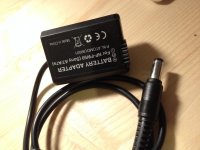
Just got the adapter and a bit confused here.
IMG_4321.jpgIMG_4322.jpg
The dc adapter = inner part +
The dummy battery inner part -
What should I do?
 
Just got the adapter and a bit confused here.
View attachment 114473View attachment 114474
The dc adapter = inner part +
The dummy battery inner part -
What should I do?

Sorry for the late response, I've been away for a bit. You're sure that the DC dummy battery has negative as the inner part? The markings above don't show me anything about the polarity of the plug, all I see are the markings showing which pin on the dummy carries what connection (there are 3 pins on the battery; positive, negative and C). In the order they appear, I could understand how you might mistake the C as a wire diagram, but I assure it isn't. They are telling you about the pins they sit in front of, and the C I think stands for Control or some bit used to communicate with the battery.
The only way to determine the polarity of the plug would be to see it either on the base adapter it came with to connect to (should be a wire diagram on that label), or using a volt meter to test for yourself (test continuity on the + or - pins marked on the dummy battery and the outer or inner ring of the wire). I would check mine, but the polarity can be whatever the manufacturer decides to use with their adapter. So, telling you that mine is inner part + doesn't mean yours is. Although I'd likely assume it is, I don't want to bank my expensive camera's continued existence on that assumption.

Things like this are the reason I opted to wire up my own rather than just hope everyone adheres to the same standard. When I open up the battery plate, and splice it with the wire from the AC adapter, they both clearly mark positive and negative wires so there is no determination needed. That and it was practically free to build. :)
 
Back
Top