Sony A7000 with 15.5 stops on sensor HDR video !

joe1946

Veteran
We are all excited about the latest Sony A7rII and RX cameras. So what could be so special on the rumored “a7000″ APS-C E-mount camera to make as “Wow” again? Well, we have the answer: The Sony A7000 is rumored to be the first system camera of the world having a native “on sensor HDR” feature. This means both images and recorded video are capable of 15.5 stops of dynamic range!
I don’t know yet in detail how this works on the A7000. I know the Xperia Z smartphone has a similar on sensor HDR tech. If they use the same technique on the A7000 than this is how it works (via Image Sensor World):
How HDR video recording works
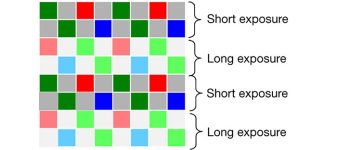
To achieve true HDR video recording, the advanced Exmor RS camera sensor in Xperia Z changes the exposure every two lines of pixels. This creates a spatially varying exposure (SVE) array image, which is then used to make an image that is perfectly exposed in both dark and light areas.
To simplify the concept, for each frame the camera shoots one picture with two different exposure levels at the same time, one light and one dark. Then, an intelligent software algorithm is used to combine (synthesize) the two shots into one picture, pixel by pixel. This allows you to see the details of both the dark and the bright parts of the picture.

HDR for still images
With HDR for still images, the camera quickly captures the image twice with different exposure levels and stitches the two shots together to create one optimised photo. This way, HDR lets you capture clear photos even against strong backlight. HDR is automatically activated when Superior Auto detects scenes with strong backlight.
​
The A7000 is now rumored to be released sometimes in late Summer! Stay tuned on SAR while I hope to get more specs of the camera!
http://www.sonyalpharumors.com/sr3-...e-mount-camera-with-15-5-stops-on-sensor-hdr/

SonyHDRsensor_zpsotu1klbx.jpg
 
Sony Alpha Rumors is a pretty decent site, as far as rumors go, but the above is no more than someone's pondering.

In terms of business sense, it's highly unlikely that a camera in the $1K range will have better dynamic range than a flagship model. And, with those claimed 15.5 stops, "A7000" would be.
 
Hard time believing its 15+ stops for video. Just don't see that happening in real world experience. Not to say it won't in the future for smaller cameras...just don't see how this is accurate.

RED Dragon was 21 Stops...remember?


Edit...if it is...I'll get like 10 of them.
 
Last edited:
There are already cameras in the market of the size of a cigarette package with super16+ sensor and fast f1,7 glass and 12 stops of DR. They are also able to store up to five cigarettes, a lighter and two cups of hot expresso coffee. So what's your point?
 
In terms of business sense, it's highly unlikely that a camera in the $1K range will have better dynamic range than a flagship model. And, with those claimed 15.5 stops, "A7000" would be.


but what if the line skipping introduced moire and aliasing. Bad but you can still sell it based on one great feature.
 
Last edited:
Baseless rumors, and Sony has been keeping things close to their chest lately (e.g. SAR draw blanks on A7II)
That's not to say it's impossible to do a multi-exposure architecture.
 
but what if the line skipping introduced moire and aliasing. Bad but you can still sell it based on one great feature.
The proposed color filter does look a bit like the recently announced "white pixel" mask for a Sony sensor. It was designed to improved the low light performance of a (12 MPX) smartphone. I posted the link on the "21st Century cameras" thread a few weeks ago. Could this migrate to an APS-C size? Possibly ... but, from the technological uniformity across the various product lines, it'd be wiser to deploy the BSI instead, rendering the "white pixel" technology less important on larger sensors. IMO, what is becoming more and more important now is the ability to match the dynamic range of a photo still in a video mode. That requires handling a lot of data without tossing it away at the early stages, as it comes off of the sensor itself, and this data handling is very processor intensive. Which produces a lot of heat. Which, not so accidentally, is why there's a 5-minute limit on 4K recording in several of their most recent "point-and-shoots" and why - according to the rumors on that very same site - A7000 has been delayed over and over again. It ain't the sensor performance, it's the heat of the processors.

PS. The above was one of the reasons I thought that the large body A77 II and A99 II would have the most advanced 4K. Those should have had no problems handling heat. Alas, A77II came out with only 1080p and A99II hasn't come out at all.
 
I think the color filter in that image is not what you'll find in the a7000, but what you can find in some of the smartphone sensors where they use this alternating-rows tech. This pattern makes sense for 1.1 um pixels, but not for the 4um pixels of an APS-C 24 mpix sensor (blue samples are too far apart from each other, same for red). They would have to go to 50 Mpix for this to make sense on APS-C (100 Mpix if, on top of that, they also want the dual-exposure thing to work on full-res stills).

I call BS on this one, and even more so for the video part. If they wanted, just by implementing a wider gamma curve, Sony could give us nearly 2 stops of DR more on the a7S, nearly 3 stops if they went for RAW video (here). No need for a trick that requires a lot of processing power and can produce pretty bad image artifacts.

My hopes for the next Sony cameras:
* a7000: clean internal 4K 8-bit 420 XAVC-S with slog2 (same DR in video mode as a7S). Hopefully with IBIS, but maybe that's too much (think of an a7II with 24 Mpix APS-C sensor and no line skipping, for $1300).
* a7S II: clean internal 4K 8-bit 420 XAVC-S with slog3 (1.5 stops better DR than the a7S) and IBIS.
 
Would love to see on the a7s ii
full 4k down scale on FF
full 8mp 4k on aps-c crop
Backside illuminated
IBIS
4k 10bit out
120p :p (hah)
 
My hopes for the next Sony cameras:
* a7000: clean internal 4K 8-bit 420 XAVC-S with slog2 (same DR in video mode as a7S). Hopefully with IBIS, but maybe that's too much (think of an a7II with 24 Mpix APS-C sensor and no line skipping, for $1300).
* a7S II: clean internal 4K 8-bit 420 XAVC-S with slog3 (1.5 stops better DR than the a7S) and IBIS.
How about a video geared A99II - 28-33 MPX FF BSI sensor, S-Log, oversampled 4K from 17-24 MPX, internal 10-bit 4:2:2 XAVC @ 220 Mbps, priced at $4,000?
 
^ I doubt it will happen, but it would be welcome if it did. I'd still get what I described for the a7S II, though (slog3 and IBIS would be pretty big for me)
 
Back
Top