FS7: Sony 85mm G Master f/1.4 getting high praise

JPNola

Veteran
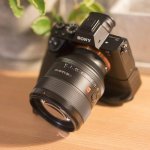
163380539256bde34983aa2.jpg


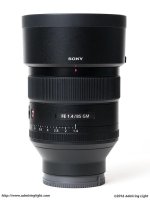
85gm_hood.jpg


Yeah, it's a Sony lens. It doesn't have the provenance of a Zeiss, Leica, or Cooke. Yeah, the build of the lens is more plastic(ky) than the Milvus or Otus.

However, the Sony 85mm GM is said to have better bokeh than the Otus as a result of it being "trimmed":

Via Photozone:

"The lens has a so-called apodisation optics using one APD element. APD elements resemble neutral density filters which become thicker the more you move towards the perimeter thus reducing the amount of light passing through. Out-of-focus circles are therefore (comparatively) defined in the center but are gradually loosing light towards the edges thus producing a very silky bokeh (out-of-focus blur) – the primary sense of existence of this lens.""
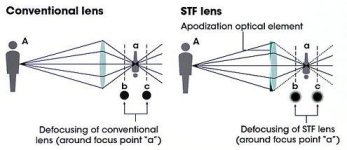
trimmed.jpg

The Sony 85mm GM is said to be tack sharp wide open.

Pros:

* awesome bokeh. Some reviewers saying it has the most dreamy bokeh of any modern lens. A result of the 11-blade iris and the "trimmed" nature of the iris.

* Manual iris and right-way focus. ( with the Milvus and Otus it is either no iris ring on the lens or iris ring and wrong-way focus ).

* AF should you want or need it.

* E-mount. No adapters needed. ( You bought an e-mount camera, did you not? And if the Sony brand is good enough for your camera, why not for your lenses as well? A Sony lens keeps it all in the family. )

* Price. While not exactly cheap it is a bargain compared to the Otus.

* The iris ring is a usable diameter, like that of a cine prime. ( The iris ring on the Milvus and Otus are of a still camera form, of smaller diameter than the focus ring and difficult to access while shooting. )

* Sharper than the Milvus according to tests by reviewers and with more creamy bokeh than the Milvus. ( I've even seen one test claiming it is sharper than the Otus ).

* More of a "cine" form factor and appearance than the Milvus / Otus with their distinctive bell-shape.

* "G Master" isn't as dorky a name as is "Milvus" and "Otus", names that sound like the two Redenbachers that "Orville" never introduced us to. :Drogar-BigGrin(DBG)


Cons:

* Very minimal Longitudinal Chromatic Aberration ( LoCa ) whereas the Otus has near none.

* Lacks the snob-factor / showoff factor off the Otus.

* Unlikely to retain resale value as much as will the Otus.

* As pricey as the Milvus yet not of the tank-like build quality of the Milvus.

* With the Milvus and to a lesser extent the Otus you can build a "set" in that there are other focal length primes in the line. As of yet the Sony G Master 85mm is a bit of an orphan as far as prime siblings. It only has zooms in its GM family thus far. However, if you are simply purchasing an 85mm prime for interviews to go along with your zooms, the inability to build a set of Sony G Master primes isn't of concern.

* Some complaints by early owners about the AF motors being loud. But if you are shooting video you are likely to be focusing manually and have the AF disabled. ( yeah, we video guys spend a bunch of money on lenses that can auto focus and then we never use the auto focus. We crazy like that, y'all !! )


Beefy and large, but still slightly lighter in weight and smaller in size than the Otus. ( not sure if that is a pro or a con ).
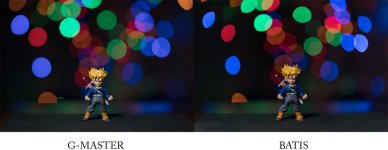
85batisvsgmbokeh.jpg
 
Very interesting about the bokeh design, looks gorgeous. Form factor and operation would still keep me from ever wanting to use this on motion picture work, but looks like a fantastic development in terms of optical design.
 
Very interesting about the bokeh design, looks gorgeous. Form factor and operation would still keep me from ever wanting to use this on motion picture work, but looks like a fantastic development in terms of optical design.

Agree with you there. But it is, I would argue, a better form factor for video than the Milvus, Otus, or Canon EF primes. I was thinking more Lighting Cameraman / Videographer who operates solo without a focus puller than I was "motion picture work". The diameter of the barrel on the Sony GM 85mm and the length of focus travel is right for that sort of work. ( that's my nice way of saying "well no sh*t it isn't something you would use for motion picture work, Sherlock" )

The 85mm GM could be a nice option for someone who primarily uses zooms but wants a fast prime for interviews. The Sony 85mm GM is an alternative to the Canon EF 85 f/1.2L II. An alternative to the Milvus and, yes, to the holy grail Otus. As one reviewer put it:

"The differences between the capabilities of the Otus and Sony 85mm GM will certainly be lost in the other variables of motion work such as cameras, lighting, and technique." In other words, for most people and for most video work, the Otus is more quality than you need and won't gain you anything that will be noticed by any viewer. Only by pixel peepers. Motion picture work is likely only about, what? 1% of all motion photography?

At less than half the price of a CP.2, this lens makes better images and is more usable for the "shooter". [ "shooter" as opposed to "operator" or "DP". A shooter being someone who does it all themselves- lens changes, focus pulling, zoom operation, media card changes. Someone who works as part of a one-man or two-man ( Camera and Sound man ) crew.

There are few lenses that offer AF / AE yet also have an iris ring / infinitely variable iris capability. AF and AE are not features I often use, but it is nice to have them for those rare times you might want them. The Sony 85mm GM is what I call a hybrid lens. A cross between still photo glass and video glass.

In my interest and enthusiasm for the Sony I am embracing both economics and the future. Quite possibly we scoff at auto-focus today just as we used to scoff and harumpf at the thought of using LED lighting. Using e-mount glass on the Fs7 you'll never be screwed because you forgot your e-mount adapter or find yourself complaining that you are getting flaring from your metabones adapter.
 
Last edited:
As one reviewer put it:

"The differences between the capabilities of the Otus and Sony 85mm GM will certainly be lost in the other variables of motion work such as cameras, lighting, and technique." In other words, for most people and for most video work, the Otus is more quality than you need and won't gain you anything that will be noticed by any viewer. Only by pixel peepers. Motion picture work is likely only about, what? 1% of all motion photography?


Did that reviewer pull focus either with a follow focus or with his hand on the lens going between two subjects and repeat the move with precision?

Or did they just set up a static shot and start rolling and make no alterations?
 
Did that reviewer pull focus either with a follow focus or with his hand on the lens going between two subjects and repeat the move with precision?

Or did they just set up a static shot and start rolling and make no alterations?


ruh-roh. Now I've done it. I've gone and gotten Ben's Otus-hairs riled up!

I'm with you on the like of mechanical focus, Ben. And I have no doubt at all that the focus action of the Otus is lovely and far superior to that of the Sony. But rarely in my type of shooting do I need to precisely repeat a focus pull. And, sticking my neck out here, I venture to guess that is also the case with the vast majority of shooters. Precise focus pulls are more of a feature film / commercial thing. And if I am DP-ing a feature or commercial I am hopefully going to be using true cinema primes and not Sony GM, Milvus, or- forgive me- Otus.

My point here, I think, is that yes, the Sony GM 85mm is a compromise with a cost saving from the Otus. You give up the mechanical focus of the Otus. However, your Otus is also a compromise with a cost saving from a lens such as an Ultraprime. You are giving up the mechanical / non-electronic iris. For all its merits the Otus is still a hybrid lens just as is the Sony GM 85mm. And, as you well know because I have seen you tout Contax glass, sharpness and lack of CA isn't everything. Repeatable, precise focus action is really nice to have but so is an iris ring and infinitely variable iris. Neither the Sony GM or the Otus have both. And before you go there, yes, if forced to choose I'd rather have lovely precise focus action over an iris ring since we ride focus so much more often than we ride iris.
 
Forget the Otus for a second. Completely forget it. It's not the only lens in the world with mechanical focus and me buying into the system is a bit of an experiment for me. I'm excited because I just got one but it'll be a while before i can comfortably report back on using it day to day.

The biggest sign of amateurish production is when you see someone shooting too wide open and missing focus points. It's gotten so bad it is almost nowadays treated like an aesthetic. The vast majority of the time that's because people are shooting wide opening on electronic stills glass and don't have the control either because it's a Canon L lens with no hard stops or its fly by wire.

A solid 95+% of my work isn't commercials or beauty or narrative stuff and is more branded content/corporate/factual stuff. And yet being able to accurately pull focus is is still of paramount importance to me every say I am shooting. It may even be the thing that sets me apart from people doing similar work on a similar level.

Contax Zeiss stuff is great, and plenty sharp. Manual iris and manual mechanical focus with decent focus throws. But Nikon AIs, Leica Rs, Helios/Jupiters all offer that at varying price points.

I look forward to trying this and would love to be pleasantly surprised, but in my experience unless you're only shooting statics, Sony's lenses aren't fit for purpose for video.
 
As a guy who mostly does not have an AC and has to pull his own focus , I find repeatable focus marks incredibly important. Anytime I want to rack, I have to practice the move a few times and sometimes even put tape on the lens to make it repeatable or hand off the rack to a PA or even my gaffer. Its a gigantic drag when they keep floating.

I also think there is a place for push Autofocus though I pretty much never use it. Ideally a lens that can do is the best of both worlds. The Sony EX-1 lens passed that test and was a good idea.
 
"Sony's lenses aren't fit for purpose for video."

Well, neither is an iPhone but I've seen live network tv shots being shot with an iPhone!

I get what you are saying but I think it overstatement to say that Sony lenses are not fit for video. The Ex3 lens isn't fit for video? The Sony Cine Alta primes are not fit for professional video production? ( I know, I know. You meant the Sony still photography / hybrid glass. You meant the Sony electronic focus fly-by-wire glass like the Sony / Zeiss glass with the infuriatingly vague and unrepeatable focus action. )

Reviews such as the following are what caused me to think that the focus action on this one might be different, may have gotten it far better than in the past:

"
Fly-by-wire focus systems, commonly found on other Sony stills lenses, have a reputation for being hard to manually focus and I dread using them for video. I often miss my focus by a few centimetres when trying to track a subject with them due to their somewhat unpredictable response. This shortcoming is one of my major criticisms of the otherwise useful 18-105mm f4 kit lens from the FS5. When Sony told me that the fly-by-wire focus system in the G Master lenses had been improved I was very curious.

At the end of the day I was won over – especially by the 85mm. What Sony have somehow managed to do is improve the fly-by-wire system focus to the point where it now feels and acts much more naturally – more like the ones found on Canon L and Nikon lenses (which are mostly mechanically coupled via rollers). There is very little lag between you stopping focussing and the lens following you. Both lenses have over 100 degrees of rotation between near focus and infinity. Both also focus past infinity like many other stills designs. I found it relatively easy to do rack focus shots by hand. If there were focus errors in the video it was usually my fault and not the lens
"

http://www.newsshooter.com/2016/03/05/review-sony-g-master-24-70mm-f2-8-and-85mm-f1-4-are-they-worth-it-for-video/


The good news here for all of us is that, even if they have yet to get it right, Sony is hearing the call for better focus action from we video guys. And both Sony and Canon are incorporating iris rings on some their new lens designs.

 
As a guy who mostly does not have an AC and has to pull his own focus , I find repeatable focus marks incredibly important. Anytime I want to rack, I have to practice the move a few times and sometimes even put tape on the lens to make it repeatable or hand off the rack to a PA or even my gaffer. Its a gigantic drag when they keep floating.

I also think there is a place for push Autofocus though I pretty much never use it.

Apparently Sony got it far better with this one. See the news shooter review I quoted. You gotta be liking the de-clicked infinitely variable iris on the Sony. I often end up riding focus with one finger and riding iris with another finger when on lenses that have a iris ring on the lens. I hate having to ride iris with my right hand operating a little dial. And I hate stepped iris. Even were I to swallow the backwards focus of the ZF Milvus or ZF Otus, that iris ring looks like it would be more difficult to ride than the one on the Sony GM 85mm. It looks small and short in travel. And I don't like that it is recessed / of a smaller diameter than the focus ring.
 
As a guy who mostly does not have an AC and has to pull his own focus , I find repeatable focus marks incredibly important. Anytime I want to rack, I have to practice the move a few times and sometimes even put tape on the lens to make it repeatable or hand off the rack to a PA or even my gaffer. Its a gigantic drag when they keep floating.

I also think there is a place for push Autofocus though I pretty much never use it. Ideally a lens that can do is the best of both worlds. The Sony EX-1 lens passed that test and was a good idea.


Yep it is a huge skill only achieved with a ton of practice. I almost always shoot without an AC as well so I always need as much control as possible.

Push auto on the ex1 and ex3 was very helpful for the stuff I was doing on them back in the day.
 
focussing mechanics are vitally important I tested the 50mm Milvus and wanted to really like it and I did from a purely optical standpoint but compared to the otus 55mm the mechanics and focus throw were lacking so I had no choice but to go Otus again not because of the optics but because of the mechanics.
 
Back
Top